
Winter Route Optimization & Fuel Efficiency for Business Jets

19 December 2025
| By Just Aviation TeamWinter operations require business aviation operators to adapt routing strategies, manage stronger seasonal winds, and apply precise regulatory planning. As operators work to maintain reliability on long-range sectors, winter route optimization and fuel efficiency become central to ensuring both performance and compliance. By integrating authoritative weather data, structured documentation, and dynamic navigation planning; both operators and dispatch teams can mitigate winter-specific risks while keeping each mission operationally predictable and cost-effective.
Winter Route Optimization
In winter, polar jet streams strengthen, so eastbound crossings may enjoy strong tailwinds while westbound flights face heavy headwinds; plan routes and cruise altitudes accordingly. Always ensure cold-temperature altimeter corrections are applied per the FAA Cold Temperature Airports guidance, especially for any instrument approaches in freezing conditions. Operators must assign adequate alternate airports and fuel in strict accordance with their governing authority (FAA, EASA, or ICAO), ensuring all regulatory reserves are met for winter conditions.
Regulatory Fuel Requirements by Authority
Winter fuel planning requires strict adherence to authority-specific mandates while accounting for seasonal weather variables.
- FAA (Part 91 & 135): Operators must carry enough fuel to reach the destination, fly to the required alternate, and fly thereafter for 45 minutes at normal cruising speed.
- EASA (Commercial Air Transport): Standard fuel planning includes taxi, trip, contingency (5%), alternate, and final reserve fuel.
- Final Reserve: For turbine engines, this is fuel to fly for 30 minutes at 1,500 ft above the aerodrome in standard conditions.
- Contingency Note: EASA operators can reduce contingency fuel to 3% if an En-Route Alternate (ERA) is available, which is a valuable strategy when winter winds restrict payload.
- ICAO: General standards align closely with EASA, requiring fuel to destination, alternate, plus a final reserve of 30 minutes at holding speed at 1,500 ft.
Winter Contingency Buffers
- Icing Contingency: If reliable forecasts are unavailable, assume icing will occur below +10 °C or in moist conditions (0 to –20 °C).
- Alternate Fuel: Plan fuel to reach the alternate under worst-case scenarios (e.g., engine-out depressurized flight).
- Weight Trade-off: Avoid carrying unneeded fuel “just in case,” since each extra pound burns more fuel. Use precise dispatch tools and satellite weather to get good forecasts, and plan for only the extra reserve legally required. For example, if a Bombardier Challenger 350 needs 10,000 lbs for trip+alternate+reserves, carrying an extra 2 hours of fuel effectively adds drag and weight. Instead, consider a refueling stop if long reserves are needed.
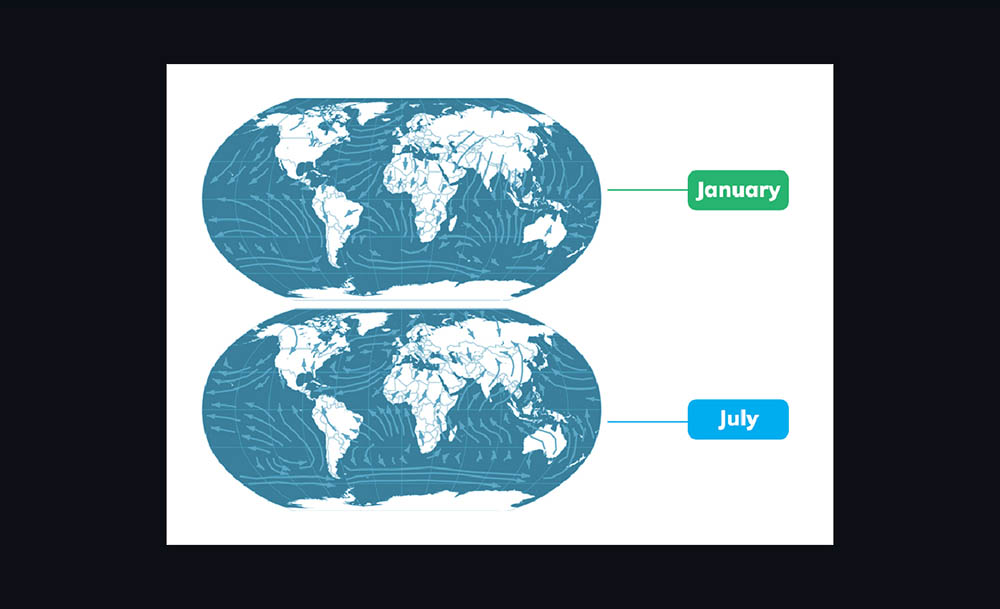
Comparing Wind Patterns: Winter vs. Summer
Practical Scenarios and Tactics
Each scenario illustrates the importance of winter-specific tactics: plan extra (but not excessive) fuel for bad weather, use all available data to optimize route and altitude, and leverage fuel-saving procedures like continuous idle descents:
1. Los Angeles (KLAX) to Tokyo (RJAA/RJTT)
A winter eastbound trans-Pacific flight typically follows PACOTS (Pacific Organized Track System) / NOPAC (North Pacific Organized Track) tracks or great-circle RNAV routing via Oakland and Anchorage FIRs. Daily PACOTS bulletins indicate active tracks (~1000–2100 UTC), and dispatchers select the track to align with tailwind cores. Winter polar jet streams often shift south, producing strong west-to-east winds at FL350–400. Filing higher initial flight levels (FL360–400) allows maximum tailwind capture, with step climbs planned as weight decreases; step descents may be used if headwinds arise unexpectedly.
During polar crossings and northern Japan departures, altitude adjustments may be required due to extreme low temperatures. Corrections of 50–200 ft at intermediate fixes ensure aircraft remain within operational limits. Cold outside air temperatures (OATs) minimally affect fuel freeze margins but must be verified to maintain reserve. Optimizing step climbs and flight level selection against forecast winds significantly reduces trip consumption over the Pacific.
ETOPS (Extended-range Twin-engine Operational Performance Standards) considerations are minimal for a single ocean crossing, but alternates such as Fairbanks, Anchorage, or Honolulu remain identified. Oceanic flight plans include all HF (High Frequency) or ADS-C (Automatic Dependent Surveillance – Contract) waypoints, and monitoring winds aloft allows mid-flight adjustment of levels or minor route deviations to retain efficiency.
2. Singapore (WSSS) to Sydney (YSSY)
Winter flights across the equatorial and Southern Hemisphere primarily follow great-circle RNAV tracks via Indonesia and the eastern Indian Ocean. Planners assess SIGWX (Significant Weather) and WAFC (World Area Forecast Center) winds aloft, as seasonal patterns may favor eastbound flight but can require level adjustments for monsoon or tropical storm influences. Initial flight levels are selected to exploit prevailing winds, and step climbs or minor lateral deviations are considered to maintain optimal groundspeed.
Diversion options include Kuala Lumpur (WMSA), Denpasar (WADD), Noumea (NWWW), or Norfolk Island (NSFA); fuel calculations incorporate these alternates plus contingency reserves (~5% of trip fuel), adjusted for potential headwinds or weather deviations. Aligning the planned path with prevailing winds minimizes consumption, while early identification of deviations ensures operational efficiency without compromising reserve requirements.
Key Planning Categories and Practices
| Category | Good Practice / Consideration |
| Route Structure & Airspace | ● File along established ATS/RNAV routes or approved direct (DCT) segments. For oceanic legs, use published organized tracks (e.g. NAT, PACOTS) or optimized user-preferred routes (UPRs).
● Adhere to the latest Track Bulletins; for example, use the daily preferred North Atlantic tracks (Shanwick message at ~08:30Z) to avoid amended clearances. ● Plan to avoid prohibited/restricted airspace per NOTAMs. |
| Winds & Cruise Optimization | ● Select cruise flight levels to maximize tailwinds and reduce headwinds based on winds-aloft forecasts.
● Use WAFC/ICAO SIGWX charts (ICAO Annex 3) and high-altitude wind forecasts to identify jet streams. Plan step climbs (or step descents) as weight or winds change during flight. ● Account for seasonal wind shifts (e.g. northern jet in NH winter). |
| Cold Temperature Corrections | ● Apply barometric altitude corrections when flying to/from very cold airports (cold-temp airports, CTA). Use Federal tables (FAA AIM TBL 7-3-1) during preflight planning.
● Verify cold-temperature limits on approach plates (don’t descend below cold-temp altitudes). ● Monitor fuel freezing points (add fuel if needed for anti-ice) and engine/airspeed performance in low temps. |
| Fuel & Contingency Planning | ● Compute taxi, trip, contingency, alternate, and final reserve fuel. Contingency fuel should be ≥5% of trip fuel (or 5 minutes holding, whichever is greater).
● Final reserve (EASA rule for jets): 30 minutes holding at 1,500 ft above the destination aerodrome. ● Use live weather data (winds, TAFs/SIGMETs) to refine fuel plan pre-departure. |
| Alternate & ETOPS Planning | ● File a destination alternate whenever required by regulations (e.g. when destination TAF < mins+1hr). Carry fuel to fly via destination and then to alternate, plus reserve.
● For long oceanic/remote routes (e.g. polar or Pacific crossings), plan to meet ETOPS/ETOPS Diversion Time Standards: ensure one-engine-inoperative (OEI) reach to a suitable alternate (within authorized ETOPS distance) with required fuel. ● Consider enroute alternates (diversion points) and account for diversion fuel. |
| Weather & Forecast Data | ● Brief using official forecasts: ICAO High/Medium SIGWX charts (WAFC London/Washington), winds-aloft, temperature charts, SIGMET/AIRMET bulletins (icing, turbulence).
● Update briefing with real-time data (PIB/FDPS bulletins, HF voice) before departure. |
| NOTAMs & Airspace Notes | ● Review NOTAMs for runway conditions (snow/ice), airspace/military exercises, and navigation aid outages.
● Plan for any airport-specific restrictions (e.g. cold-weather departure procedures). ● Update route plan for any temporary RNAV or airway changes. ● Incorporate national “emergency” routes if needed (e.g. Snowbird tracks in US Eastern Corridor). |
| Communications & Surveillance | ● Ensure appropriate long-range comms/equip: HF or SATCOM for oceanic segments.
● File ADS-C/FANS routes if available for better ATC spacing. ● Plan position reporting per ICAO (use waypoints or lat/long as required). ● Use datalink (CPDLC) where available to receive route clearances (e.g. PDC) and updates. |
FAQs
1. How do winter temperature inversions impact cruise altitude planning for business jets?
Winter inversions can trap warmer air above cold surface layers, often leading to unexpected turbulence and degraded climb performance at certain levels. Operators should review upper wind and temperature charts (e.g., from WAFC London/Washington) and coordinate with dispatchers to select a cruise level above the inversion cap.
According to ICAO Doc 9976, inversions can cause minor thrust efficiency losses at mid-levels (FL200–FL300). Selecting a higher cruise altitude (FL390+) once fuel burn allows recovery of 2–3% efficiency compared to staying below inversion layers.
2. What’s the best way to handle long taxi delays in freezing conditions from a fuel management perspective?
FAA winter operations guidance notes that extended ground holds can significantly affect fuel temperature and viscosity. During prolonged taxi or de-ice queues, operators should:
- Plan extra APU fuel (typically 5–8% of block fuel for high-traffic winter hubs like Toronto or Munich).
- Avoid unnecessary engine start before de-icing clearance.
- Monitor fuel temperature limits in MEL data; Jet A starts waxing around –40 °C, and A1 near –47 °C.
Eurocontrol suggests including a “Taxi & Hold fuel margin” for known congested airports in winter NOTAMs.
3. How can dispatchers minimize routing inefficiencies due to winter jet stream shifts?
The North Atlantic Organized Track System (OTS) changes daily based on jet stream positions. In winter, strong westerlies can move optimal routes up to 400 NM (typical ranges) northward or southward within 24 hours.
Operators should subscribe to Eurocontrol NOP or FAA NAT Track bulletins, comparing fixed versus daily dynamic routes. Dispatch software that cross-references wind-optimal random routes may yield fuel savings of up to 4–5% over using published OTS tracks blindly. In practice: westbound legs may require lower FLs to reduce headwind exposure, while eastbound flights can use higher or more northerly FLs for better tailwind advantage.
4. How do crosswind and gusting conditions affect fuel efficiency during approach and landing in winter?
Crosswinds and gusts increase drag and necessitate higher approach speeds, leading to 5–10% more fuel burn in the terminal phase.
According to FAA AC 120-108, operators should apply a maximum wind correction of half the gust factor (not exceeding 20 kt additive). Dispatchers may add an approach fuel increment for airports where METAR data shows frequent gusts exceeding 25 kt.
5. How can operators ensure regulatory compliance for cold temperature corrections across multiple regions?
Different authorities have unique cold-temperature correction thresholds.
- FAA AIM 7-3-5: Mandatory correction when temperature is below published threshold for the airport’s elevation.
- EASA CS-AIROPS: Requires barometric correction for all minimum altitudes below 5000 ft AGL if OAT ≤ –15 °C.
Operators managing multi-region fleets should maintain a standardized correction table in the dispatch manual aligned with the strictest authority (usually EASA). For example, if flying from Oslo to Montreal, apply EASA-style corrections on departure and FAA Table 7-3-1 values for arrival; ensuring terrain and obstacle clearance remains compliant with both authorities.
For operators seeking smarter seasonal planning, Just Aviation supports data-driven strategies that enhance winter route optimization & fuel efficiency through precise route planning, accurate fuel forecasting, and compliance with official aviation authority guidelines.
Sources
- https://www.weather.gov/zme/safety_ice
- https://www.weather.gov/zme/safety_turb
- https://www.faa.gov/sites/faa.gov/files/InFO%2022002.pdf
- https://www.law.cornell.edu/cfr/text/14/91.167
- https://www.faa.gov/media/28701
- https://www.faa.gov/documentLibrary/media/Advisory_Circular/AC_135-42.pdf
- https://applications.icao.int/tools/ATMiKIT/story_content/external_files/102600063919931_en.pdf


 +971 4 5855 689