
Slot-Controlled Airports: Why Slots Matter for Permits

25 December 2025
| By Just Aviation TeamBusiness jet operations into high-traffic airports require more than just permit approvals; slot coordination plays a critical role. At fully slot-controlled airports, understanding why slots matter for permits is essential for maintaining regulatory compliance and operational precision. A confirmed slot is often a prerequisite for landing permits, affecting scheduling, parking, and air traffic planning.
Understanding Slot-Controlled Airports
Slot-controlled (Level 3) airports operate at or beyond capacity, so every flight must reserve a “time ticket” (a slot) before arriving or departing. An airport slot is literally permission to operate at a specific time, allocated by an independent coordinator. At busy hubs (called Level 3 airports), demand far outstrips runway capacity, as shown in the bar chart below. To avoid chaos, slot coordination spreads flights evenly. By definition, “all airlines and aircraft operators” need a slot allocated before they may arrive or depart.
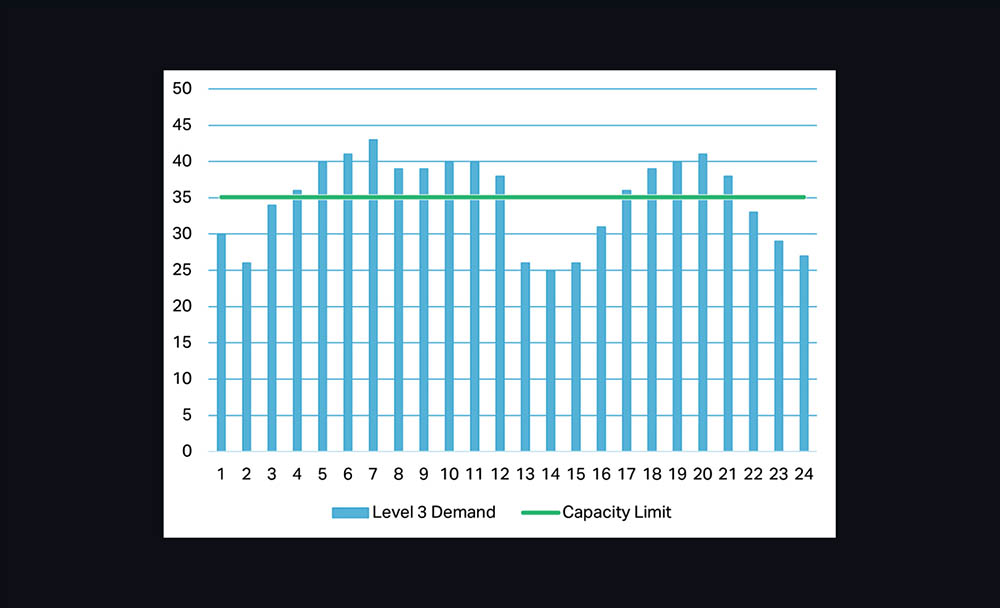
The above figure illustrates how peak demand (yellow) exceeds the airport’s fixed hourly capacity (blue) at a slot-controlled airport. This imbalance is why major airports follow strict slot rules.
The IATA Worldwide Airport Slot Guidelines and Levels of Coordination
Slot coordination follows IATA’s Worldwide Airport Slot Guidelines (WASG). IATA defines three levels of coordination: Level 1 (no coordination needed), Level 2 (schedule facilitation), and Level 3 (full slot control). Under WASG, slot coordinators allocate times to airlines (or other operators) according to published schedules and historical precedence.
Busiest airports run a biannual scheduling process (summer/winter seasons) or on-going ad-hoc allocation. All coordinated airports follow a “Calendar of Coordination Activities” to sequentially allocate slots network-wide. In a nutshell, operators send slot requests (via standard IATA SCR messages or a general aviation equivalent) and the coordinator grants arrivals/departures that keep traffic at or below capacity. Unlike Level 1/2 airports, at Level 3 everyone (even one-off charters or private jets) must hold a slot.
How Slot Coordination Affects Permits
Because slots dictate when a plane can land or take off, most aviation authorities require them when approving flight permits. In effect, securing a slot is often a prerequisite to a valid permit. Many regulators expect operators to have a confirmed slot as part of their planning. For example, Singapore explicitly mandates that “a slots approval is required before you operate” at Changi or Seletar airports:
- Singapore’s Civil Aviation Authority even requires non-scheduled and private flights to submit a Slot Clearance Request (SCR) at least 72 hours before the flight (or a GCR if the aircraft has no IATA code). Until the slot is approved, the flight cannot proceed, effectively making the landing permit contingent on slot coordination.
Likewise, Hong Kong’s authorities require business jets to reserve runway slots via the Hong Kong Slot Coordination Office. GA/Business Aviation operators apply through an online system (OCS) at least 3 business days in advance. Only then can they obtain the official confirmations (parking, handling, etc.) needed to finalize their Hong Kong (China) landing permits. Hong Kong’s slot guidelines emphasize that operators “require both slot clearances and necessary license/operating permit” to carry out flight:
- In other words, even a charter (non-scheduled) flight needs both an approved slot and a valid operating permit to be authorized.
In the US, the FAA designates JFK, LaGuardia (LGA) and Washington National (DCA) as slot-controlled (High-Density) airports. Operators flying into these airports must follow the FAA’s slot administration process (In practice business jet operators typically work through FBOs or slot brokers to obtain these slots).
- It’s not enough to secure a letter of authorization; if the airport is slot-controlled, the FAA slot office must approve the times. In all cases, no slot means no landing opportunity, so permit offices often delay or deny approval until a slot is booked.
Major UK airports like Heathrow and London City require slots year-round. Business jets should work with their FBO or UK slot coordinator well in advance. Unlike ad-hoc charters at smaller fields, Heathrow follows seasonal scheduling: historical airlines submit schedules and slot bids long before the season. New or charter flights must request an Ad Hoc slot, typically by submitting at least 72 hours (often much longer) before flight.
- Practically, an operator planning a private flight to LHR will file a slot request as soon as possible. Once the desired slot is conditionally held, the operator can apply for the UK landing permit (if needed) and slot-clearance in tandem. Operators should also coordinate parking and ground handling, for example, requiring approved slots and gate assignments as part of the booking process.
Operational Insights
Business jet operators should include slot coordination as a key element of their preflight checklist. To ensure smooth operations at Level 3 (slot-controlled) airports, the following tactics are recommended with expert support available from Just Aviation where needed:
- Submitting slot requests early: Sending requests to the airport coordinator (via email or online system) as early as possible helps secure preferred times. Our team assists in identifying the correct submission windows and managing coordinator communications.
- Running slot and permit applications in parallel: Treating slot procurement and permit processing as simultaneous tracks ensures efficiency. We make sure each confirmed slot number is properly included in related overflight or landing permit submissions.
- Using correct IATA message formats: Following standard IATA formats (SCR for scheduled flights, GCR for non-scheduled/GA flights) unless local procedures apply helps avoid rejection. Our specialists verify compliance with all format requirements.
- Coordinating with local handlers: Working with experienced ground handlers who understand the airport’s slot rules ensures smoother approvals. Through our trusted partner network, we help operators navigate regional variations and local slot restrictions.
- Observing “ad-hoc” request deadlines: Monitoring and respecting short-notice slot request windows, particularly at many European airports, prevents last-minute disruptions. We keep track of these timelines to maintain schedule integrity.
In short, no slot = no landing. With the right flight planning and professional coordination support, operators can secure reliable slot approvals and maintain punctual, efficient operations at even the busiest airports.
FAQs
1. What is the difference between a slot allocation and an airport slot tolerance window?
A slot allocation is the approved time an aircraft is authorized to operate at a coordinated airport, while a tolerance window defines how early or late the aircraft can move relative to that slot (typically ±15 minutes). Exceeding this tolerance without re-coordination can result in slot misuse penalties or denied access.
2. Are slot allocations transferable between aircraft of the same operator?
Usually no. Slots are granted for specific aircraft types, registrations, or flight identifiers. At many Level 3 airports, coordinators consider each slot tied to an operator and flight number. A change in aircraft or flight number often requires re-submission of a slot request to ensure compliance with declared capacity and parking limitations.
3. How do airport slots interact with ATFM (Air Traffic Flow Management) slots?
Airport slots are managed locally by the airport coordinator, while ATFM slots are issued regionally by network managers (e.g., Eurocontrol NM). Even if an operator holds a valid airport slot, the flight must comply with ATFM restrictions. These systems are independent; holding one does not guarantee compliance with the other; so operators must synchronize both timings carefully.
4. Can a flight operate under a diplomatic or emergency permit without a slot?
In most jurisdictions, diplomatic or emergency flights receive priority handling, but they still require slot acknowledgment from the coordinator unless the airport explicitly exempts them. Such exemptions are rare and usually limited to humanitarian, SAR, or state flights under direct authority coordination.
5. What happens if a slot is missed due to operational delays or weather?
If a flight misses its slot by more than the tolerance window, the operator must immediately contact the slot coordination office to request a revised slot. Many airports have “no-show” policies that penalize repeated non-compliance, potentially suspending an operator’s slot privileges for future requests.
6. Are business jet parking stands linked to slot allocation?
Yes. Many busy airports synchronize slot approval with apron and parking availability. For example, a slot may only be granted if a parking position is available for the aircraft category. Failing to coordinate ground handling or parking ahead of time can invalidate a slot, even if timing was approved.
7. How are slots managed during major events (e.g., World Economic Forum, Olympics)?
During high-demand events, airports implement temporary slot restrictions and “event coordination programs.” Business jet operators must submit requests within special timeframes, often through dedicated online portals. Slots may also be allocated on a “first come, first served” or priority basis for state and scheduled operators.
8. Do slot-coordinated airports share data between countries?
Yes. Under IATA’s Worldwide Airport Slot Guidelines (WASG), coordinators participate in the Slot Exchange and Calendar of Coordination Activities, ensuring seasonal slot harmonization. This allows interconnected coordination between airports (for instance, aligning an outbound slot at one hub with an arrival slot at another) to maintain global schedule integrity.
Sources
- https://www.acl-uk.org/wp-content/uploads/2018/10/ACL-Guidance-on-Slot-Allocation-and-Monitoring-OCT2018-FINAL.pdf
- https://www.iata.org/en/programs/ops-infra/slots/coordinated-airports/
- https://www.caas.gov.sg/operations-safety/air-operations/foreign-air-operators
- https://www.hkgslot.gov.hk/others/Slot%20Coordination%20Guidelines%20at%20HKIA.pdf


 +971 4 5855 689