
Understanding En-Route Navigation Charges and Strategies to Reduce CRCO Costs

22 January 2026
| By Just Aviation TeamEn-route navigation charges are fees that aircraft operators pay for the use of air traffic control and communications services while flying through controlled airspace. These charges fund the air navigation service providers (ANSPs) and are generally assessed per flight based on distance flown and aircraft size.
In Europe, the Central Route Charges Office (CRCO) of EUROCONTROL consolidates these fees for most EU member states: business jets receive a single monthly invoice (in EUR) for all flights over EUROCONTROL territory. These payments are essential to finance and modernize air traffic management (ATM); in fact, CRCO route charges help ensure the European ATM system is safely funded and evolved under programs like Single European Sky and Single European Sky ATM Research (SESAR).
What Is the Central Route Charges Office (CRCO)?
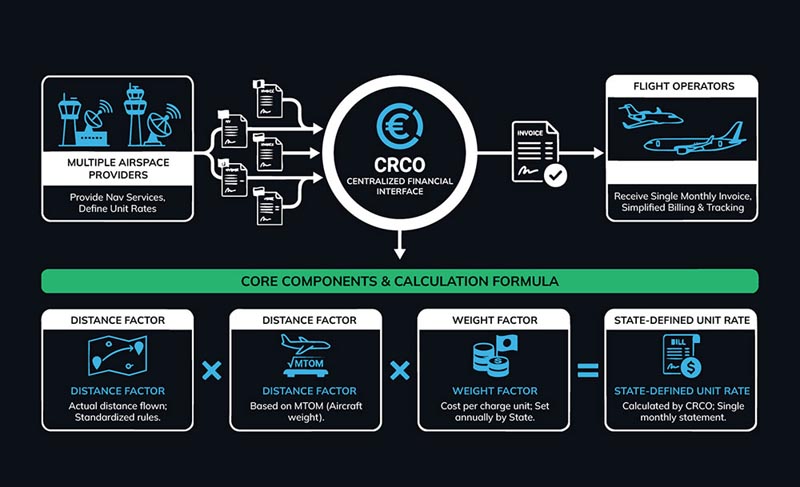
The Central Route Charges Office (CRCO) is the centralized administrative body responsible for calculating, invoicing, and collecting en-route air navigation charges on behalf of participating states within the European region. Rather than operators receiving separate invoices from each national air navigation authority, CRCO consolidates all applicable en-route charges into a single monthly statement per operator.
From an operational cost-management perspective, CRCO acts as the financial interface between flight operators and multiple airspace providers, ensuring standardized charge calculation based on approved rules. For business flight operators conducting frequent cross-border missions, this centralized system simplifies billing visibility, improves predictability of navigation-related costs, and enables structured cost tracking across multiple European flight segments.
Core Components of the Central Route Charges Office (CRCO) System
CRCO charges are built on three primary components: the distance factor, the weight factor, and the state-defined unit rate:
- Distance factor: Reflects the actual distance flown within each participating airspace and is calculated according to standardized rules. It represents how much of each state’s airspace is used during the flight.
- Weight factor: Derived from the aircraft’s certified maximum takeoff mass (MTOM). A square-root formula is applied, and this factor directly influences the final charge amount.
- State-defined unit rate: Established annually by each state and represents the cost per charge unit for air navigation services within that airspace.
From an operator’s perspective, the distance factor, weight factor, and unit rate are multiplied together. Small variations in routing, aircraft weight declaration, or airspace selection can materially affect total en-route charges.
How Are Charges Calculated?
Within the CRCO system, an en-route route charge is computed as Distance Factor × Weight Factor × Unit Rate. The distance factor is essentially the great-circle distance flown in each charging zone (state), divided by 100 km. (Note: 20 km are deducted from this distance for each takeoff or landing in a state.)
The weight factor is based on the aircraft’s maximum takeoff weight (MTOW): it is the square root of (MTOW in tonnes ÷ 50). For example, a 77.0 t jet yields √(77.0/50) ≈ 1.24. Finally, the unit rate is a tariff (in EUR) set by each country (or region) for that year. Unit rates can vary widely between states: in a December 2024 example, the rate in Spain was about €62.73 per charge-unit, while in Belgium it was €112.19. The product of these three factors (calculated per state) gives the route charge in each airspace, and CRCO sums them for the total bill.
As an illustration, a sample calculation from the CRCO customer guide (December 2024) shows a 77 t business jet flying 1,862 km from Barcelona (BCN) to Copenhagen (CPH). The flight passed through six Eurocontrol states (Spain, France, Belgium, Netherlands, Germany, Denmark), and each segment’s charge was computed by (distance/100 * weight factor * unit rate). In that example the total CRCO route charge was €1,784.61 (summed across all states). This underscores that even a single inter-European flight can incur charges on the order of thousands of euros.
Regional Charging Schemes
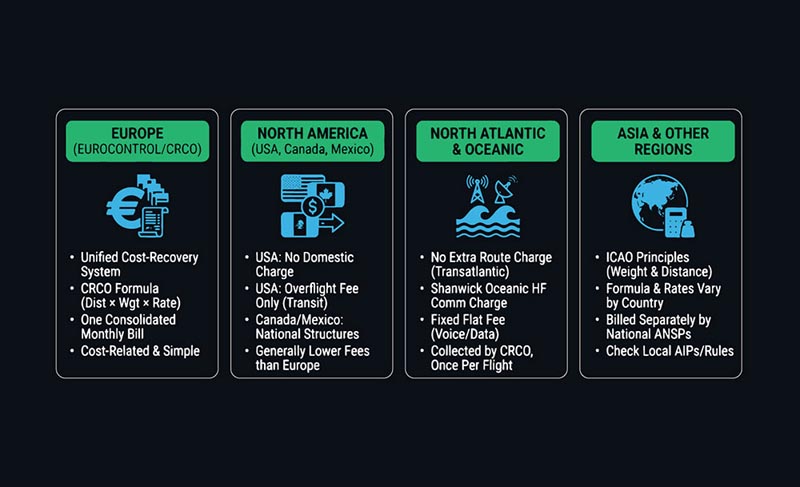
En-route navigation charges are implemented differently around the world. The EUROCONTROL system is designed to be cost-related, simple (one monthly invoice per operator), and non-discriminatory.
North America
The United States does not charge domestic flights for use of en-route navigation (radar/comm) facilities. Instead, the FAA only imposes an overflight fee on aircraft that transit U.S.-controlled airspace without landing.
Any flight that lands in or departs from the U.S. does not incur this fee. Canada and Mexico have their own national charge structures (e.g. Canada uses an annualized ICAO-based scheme), but in general North American fees are modest compared to Europe.
North Atlantic & Oceanic
For transatlantic crossings, there is no extra “route charge” beyond those above. However, CRCO does bill a flat communication charge for use of the Shanwick (Ireland/UK) oceanic HF radio service. Every flight in the North Atlantic (Shanwick Oceanic Region) is assessed a fixed CHF/EUR amount per flight.
This fee, set by AirNav Ireland and collected by CRCO, covers voice/data comm services. In practice, an operator flying from Europe to North America pays this HF charge once per flight. Once the jet enters U.S. (or Canadian) airspace, the FAA overflight fee applies as noted.
Asia and Other Regions
Most other world regions charge according to ICAO principles (weight and distance). For example, many Asian, Middle Eastern and African ANSPs set en-route fees based on MTOW and kilometers flown (often using a √(MTOW) factor similar to ICAO’s recommendation of exponent 0.7). The exact formula and rates differ by country, and some nations invoice routes in parts (e.g. China’s scheme vs. India’s).
Each country typically publishes its unit rates or charge tables in Aeronautical Information Publications (AIPs) or civil aviation websites. Operators should check the local rules (e.g. Japan, Singapore, Saudi Arabia have public charge tables) when planning long-haul flights, as these charges are billed separately (often via a local cost-recovery office or directly by the state). In some regions (e.g. intra-ASECNA in West Africa), special regional procedures or exemptions may apply.
Strategies to Reduce En-Route Charges
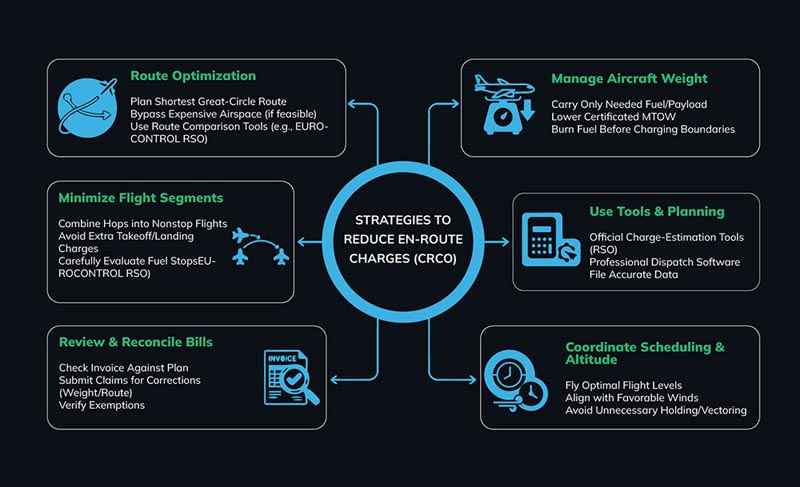
Business jet flight departments can take several steps to minimize navigation fees without compromising safety or efficiency. Typical strategies include:
Optimize route choice
Carefully plan the flight path to minimize high-cost distance. Because CRCO charges are strictly proportional to distance, the shortest great-circle route is usually cheapest. However, small detours that bypass a very expensive airspace may be worthwhile. For example, in the Barcelona–Copenhagen case above, routing through Belgium (with a 2024 unit rate of €112) contributed a large portion of the fee.
If alternative waypoints could avoid Belgian FIR (at the cost of a few extra nautical miles), that might cut the total bill slightly. Operators should use tools (like EUROCONTROL’s online RSO distance calculator) to compare charge estimates for different routings. For instance, loading proposed waypoint coordinates into the RSO tool returns the distance per country and the resulting charges, making it easy to see if a nominally longer route could actually cost less in fees.
Manage aircraft weight
The weight factor √(MTOW/50) means lighter jets pay much less. For business operators, this means carrying only the fuel and payload needed, and possibly using a lower certificated MTOW. (Many corporate jets file a “weight limited” certificate: e.g. reducing MTOW from 50 t to 45 t changes the weight factor from 1.00 to √(45/50)≈0.95, a 5% reduction.)
Even such a small factor drop can save hundreds of euros on a long haul flight. In practice, this might mean burning extra fuel before crossing a charging boundary or redistributing passengers/cargo. (Care must be taken that fuel reserves and safety are never compromised, of course.)
Minimize flight segments
Each takeoff or landing incurs its own charge segment. Breaking a trip into two legs means two fully charged flights. Wherever possible, combine passengers into one nonstop flight rather than multiple hops. Not only does this save duplicate billing, it also removes the extra 20 km distance offsets per takeoff (which count against you).
Conversely, a carefully chosen fuel stop can sometimes allow avoiding an expensive FIR on one leg, but this trade-off must be evaluated (fuel burn and additional ATC fees vs. saved nav charges).
Use available tools and planning support
Take advantage of official charge-estimation tools. EUROCONTROL publishes the Route Charges Estimation (RSO) tool where operators can enter flight details and get an approximate CRCO charge. This allows quick “what-if” checks on alternative routes or weights.
Professional dispatch software can also incorporate cost indexing or overlay en-route fees on routing options. Importantly, always file accurate data in the flight plan (correct MTOW, aircraft ID, flight levels) so CRCO billing is based on the true parameters.
Review and reconcile bills
After each flight, check the CRCO invoice (or CEFA portal) against the planned flight. If the plane flew lighter or shorter than filed, operators can submit a claim for correction. For example, if the actual (verified) MTOW was lower, or the route was amended in flight, you may be entitled to a partial refund. Timely claims (with supporting data) ensure you don’t overpay. Likewise, make sure any applicable exemptions (such as state flights or diplomatic status where allowed) are applied.
Coordinate scheduling and altitude
While altitude or time of day do not change the formula, they can affect fuel load and routing. Flying higher (if possible) can shorten flight time, reducing fuel and weight; it also may align better with favorable winds and direct airways. In practice, operators should file optimal FLs to maximize efficiency.
Similarly, avoid unnecessary holding or vectoring in congested airspace (since extra mileage, even if small, still increases cost). Good pre-flight ATC coordination and use of advanced ATM services (like preferred routes) can keep the flown path as short as possible.
Each strategy yields modest savings, but together they add up. For example, a light jet with MTOW ~10 t has weight factor √(10/50)≈0.45, whereas a 45 t Gulfstream-class jet is ~√(45/50)≈0.95. All else equal, the smaller jet pays less than half the CRCO charge of the heavier one on the same route. Similarly, cutting just 100 km of flight (roughly 6% of distance) directly cuts each state’s distance factor by 0.06, yielding a proportional fee reduction.
FAQs
1. When does a CRCO charge become applicable to a flight?
A CRCO charge becomes applicable when an aircraft operates within the controlled en-route airspace of participating states above the published lower flight levels. Charges are assessed only for the en-route phase and do not include terminal or ground-based navigation services.
2. How are flight plan changes reflected in CRCO billing?
CRCO billing is based on actual flight data validated by air traffic control systems. If routing or flight level changes occur after departure, the final invoice reflects the flown trajectory rather than the initially filed flight plan.
3. Does aircraft registration affect CRCO charges?
Aircraft registration does not influence the charge calculation. CRCO charges are determined solely by flight distance, declared maximum takeoff mass, and applicable unit rates, regardless of registry or operator nationality.
4. Are training or repositioning flights treated differently by CRCO?
Training, positioning, and ferry flights are treated identically to revenue flights under CRCO rules. As long as the flight operates within chargeable en-route airspace, standard route charges apply without operational purpose differentiation.
5. How often are CRCO unit rates updated?
Unit rates are reviewed and published annually by participating states. Updated rates typically take effect at the beginning of the calendar year, making early-year cost forecasting critical for flight operations budgeting and trip cost estimation.
6. Can incorrect aircraft weight declarations increase CRCO costs?
Yes. Declaring a higher maximum takeoff mass than certified directly increases the weight factor used in charge calculation. Accurate aircraft data submission is essential to avoid unnecessary overbilling across multiple flight segments.
7. How does CRCO support transparency for flight operators?
CRCO provides detailed charge breakdowns per flight and per state, allowing operators to audit distance calculations, applied unit rates, and aircraft weight factors. This transparency supports internal cost analysis and invoice verification processes.
8. Is CRCO billing immediate after each flight?
CRCO charges are not issued per flight. Instead, all eligible flights within a billing period are aggregated and invoiced monthly, enabling operators to review cumulative navigation costs rather than managing individual flight-level payments.
Managing en-route navigation charges requires more than regulatory awareness; it demands consistent operational oversight, accurate data handling, and informed planning decisions. In this context, Just Aviation supports business flight operators by bridging technical knowledge with day-to-day operational execution, ensuring CRCO-related considerations are addressed proactively. Through structured coordination and charge awareness, operators can maintain cost efficiency while preserving operational continuity across complex regional airspace environments.
Sources


 +971 4 5855 689