
Unraveling Air Navigation Charges: Understanding Operators’ Billing for Airspace Usage

18 January 2026
| By Just Aviation TeamWhat are airspace usage charges? Air navigation charges, also known as airspace fees or airspace usage charges, are fees paid by airlines and aircraft operators for using controlled airspace and air traffic management services. These charges fund air traffic control, navigation systems, communication networks, and surveillance infrastructure.
This blog explains how air navigation charges work, how operators are billed for using airspace, the factors that influence airspace fees, and practical strategies for managing navigation-related operating costs.
Do Airlines Pay for Using Airspace?
Do airlines pay to use airspace? Yes, airlines and aircraft operators typically pay air space usage charges for flying through controlled airspace. These fees help fund essential services such as air traffic control, navigation systems, communication networks, and surveillance infrastructure that support safe and efficient flight operations.
In addition to air navigation charges, operators may also pay overflight fees when flying through a country’s airspace without landing. These charges are usually collected by Air Navigation Service Providers (ANSPs) and can vary based on factors such as aircraft weight, distance flown, and the airspace used.
What are Airspace Usage Charges?
Airspace usage charges are a key component of aviation operating costs, covering the air traffic management and navigation services that enable safe and efficient flight operations. These services include air traffic control, communication systems, navigation aids, and surveillance infrastructure provided within a country’s controlled airspace.
Typically, air navigation charges are calculated based on various factors, such as the maximum take-off weight (MTOW) of the aircraft and the distance flown within specific flight information regions (FIR). For instance, aircraft entering or transiting through a designated FIR may incur en-route air navigation service charges. The charges can vary significantly, with flat rates or tariffs established by civil aviation authorities or regional bodies like Eurocontrol member states.
Operators may also be subject to overflight fees when passing through a country’s airspace without landing. Because charging structures vary between jurisdictions, understanding these costs is essential for accurate flight planning, budgeting, and route optimization.
To promote consistency and transparency, organizations such as ICAO, IATA, and regional bodies like Eurocontrol provide guidance and frameworks for the administration of air navigation charges worldwide.
What Fees Do Airlines Pay for Using Airspace?
Airlines and aircraft operators may incur different charges when operating within controlled airspace. The most common fees include:
• En-route navigation charges
• Overflight fees
• Terminal navigation charges
• Airport charges
READ MORE: Understanding Navigation Fees: What Are They & How Do They Impact Operators?
What Fees Do Airlines Pay for Using Airspace?
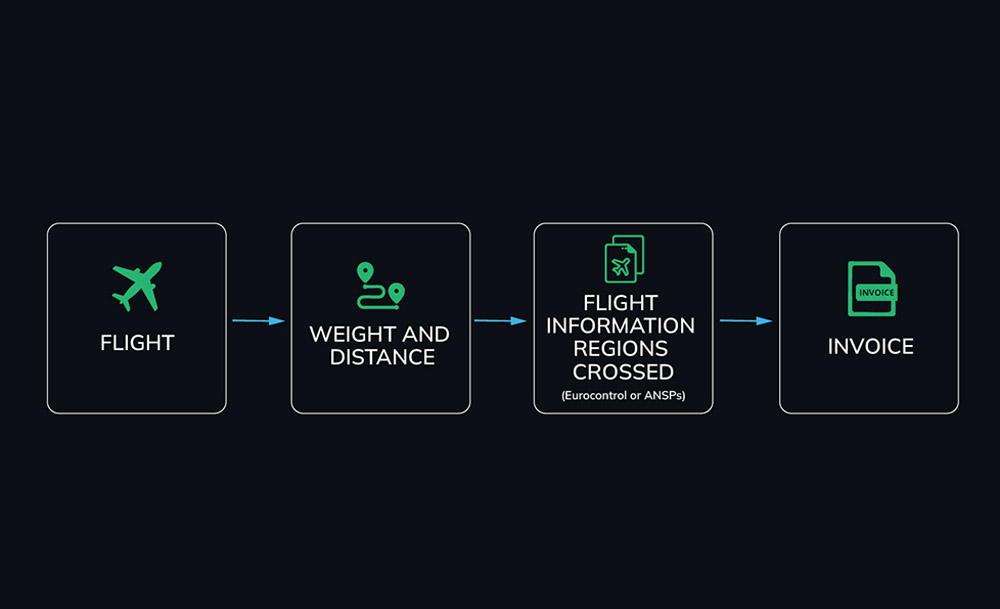
The standard international formula used by Eurocontrol and many global aviation authorities to calculate en-route airspace fees is:
Charge = Distance Factor x Weight Factor x Unit Rate
Where:
Distance Factor = The distance flown inside the airspace divided by 100
Weight Factor = The square root of the aircraft’s Maximum Takeoff Weight (MTOW) divided by 50
Unit Rate = tariff set by the ANSP or regional authority
Key Considerations for Air Navigation Charges
Air navigation fees, commonly referred to as “nav fees,” are typically based on several factors:
- Flight Route: Flights operating through congested or heavily managed airspace may be subject to higher charges.
- Distance Flown: Charges may be calculated based on the distance flown within a country’s airspace.
- Aircraft Specifications: The maximum takeoff weight (MTOW) and wingspan of the aircraft are often considered.
- Time of Operation: Some regions may have higher fees during peak operating periods.
| Factor | Impact on Charges |
|---|---|
| Aircraft Weight (MTOW) | Heavier aircraft generally pay higher fees. |
| Distance Flown | Longer routes increase charges. |
| Airspace Used | Rates vary by country and ANSP. |
| Route Complexity | Congested airspace may cost more. |
| Time of Operation | Some regions apply peak-period charges. |
Because airspace charges vary across regions, operators must consider these factors when planning routes and estimating operational costs.
How Operators Are Billed for Airspace Usage
Operators are typically billed for airspace usage through post-flight invoices issued by Air Navigation Service Providers (ANSPs) or regional collection agencies. Charges are calculated using factors such as aircraft weight, distance flown within controlled airspace, and applicable regional tariffs.
Depending on the region, invoices may be issued directly by the relevant ANSP or through a centralized organization that collects charges on behalf of multiple countries. For international flights that cross multiple Flight Information Regions (FIRs), operators may receive separate invoices from different ANSPs or a consolidated invoice from a regional collection agency.
These charges are determined using flight plan information and actual flight data recorded during the flight. Invoices typically include flight identification details, route information, chargeable distance, aircraft weight factors, applicable unit rates, and the total amount due.
Who Collects Air Navigation Charges?
Collection methods vary by region. National ANSPs are typically responsible for collecting charges within their own airspace, while regional organizations may administer collections across multiple countries.
Most operators pay air navigation charges through bank transfers, credit accounts with ANSPs, or third-party flight support providers that manage billing on their behalf. Many ANSPs also provide online portals where operators can review invoices and submit payments electronically. While post-flight invoicing is the most common billing method, some jurisdictions may require direct payment or self-reporting of navigation charges in accordance with local regulations.
How Do Operators Estimate Future Charges?
To forecast operating costs, operators often use flight planning software, ANSP fee calculators, Aeronautical Information Publications (AIPs), and published tariff schedules. Industry resources provided by organizations such as IATA can also help operators review navigation charge information across different regions and jurisdictions. Estimating navigation charges in advance helps operators evaluate route options and manage overall trip expenses more effectively. Because navigation charges and tariff structures can change over time, operators should regularly review ANSP publications and regulatory updates when planning flights.
Typical Billing Process
1. Flight plan is filed.
2. Aircraft flies through controlled airspace.
3. ANSP calculates applicable charges.
4. Invoice is issued.
5. Operator submits payment.
Managing Air Navigation Charges
Operators can employ several strategies to manage air navigation charges effectively:
- Route Optimization: By varying the route of flight, operators can potentially reduce total nav fee charges.
- Weight Management: Ensuring the aircraft operates at an optimal weight can affect the MTOW-based fee calculations.
- Timely Payments: Avoiding penalties by adhering to payment deadlines is crucial for cost management.
Calculation Methods
Different countries and regions have distinct methods for calculating air navigation charges.
Airspace Billing Examples
Let’s consider a hypothetical scenario to illustrate how these charges might apply to a business jet operator:
Scenario 1
A business jet flying from Paris to Dubai, with a maximum takeoff weight (MTOW) of 40,000 kg, covers a distance of 5,500 km. The route passes through several countries with varying nav fees. The total cost might be calculated as follows:
- France: €500 for en-route services.
- Italy: €300 based on distance and MTOW.
- Greece: €200 for airspace usage.
- Turkey: €400 considering the complexity of airspace and MTOW.
- Total estimated cost: €1,400.
Scenario 2
The same aircraft takes an alternate route to avoid certain airspaces with higher charges, resulting in a longer distance of 6,000 km but a lower total cost:
- France: €500 for en-route services.
- Switzerland: €250 based on distance and MTOW.
- Egypt: €350 for airspace usage.
- Saudi Arabia: €300 considering the complexity of airspace and MTOW.
- Total estimated cost: €1,400.
Strategies for Managing Air Navigation Costs
Operators can reduce air navigation costs through route optimization, advanced flight planning, weather monitoring, technology upgrades, and regular review of ANSP, ICAO, and IATA guidance.
• Route Optimization: Utilize advanced software to analyze various routes and select the one that minimizes air navigation charges without compromising safety. For example, choosing a route that avoids busy airspaces where possible can reduce costs.
• Weather Forecasting: Incorporate real-time weather data to adjust flight paths and avoid weather-related delays or detours, which can lead to increased charges.
• Technology Upgrades: Invest in newer avionics that enable more efficient flight paths and communication with air traffic control, potentially qualifying for reduced charges.
• Collaborative Decision Making (CDM): Engage in CDM programs that allow for shared information between airlines and air navigation service providers, leading to more efficient operations and cost savings.
• ICAO and IATA Guidelines: Regularly review the International Civil Aviation Organization (ICAO) guidelines and International Air Transport Association (IATA) policies on charges for updates and strategies.
Operators should also ensure all required overflight and landing permits are obtained before departure to avoid operational disruptions and route changes.
It’s equally important to stay informed about the latest changes in air navigation charges by regularly consulting official sources such as ICAO documents, national AIPs, and IATA’s air navigation charge reports.
How Operators are Billed for Air Navigation Charges?
Billing for air navigation charges can vary depending on the country and the air navigation service provider (ANSP). Here’s a general overview of how business aviation operators are typically billed:
Invoicing and Payment Methods
- Invoicing: Operators may receive an invoice from the ANSP after the flight. This invoice will detail the charges based on the factors like distance flown, aircraft weight, and airspace complexity.
- Direct Payment: In some cases, operators are required to pay the navigation fees upon landing, before departure.
- Self-Reporting: Certain countries mandate that operators self-report their navigation fees. For example, in Mexico, operators must calculate their fees using a predetermined distance chart and pay them via a Mexican bank in local currency within seven days to avoid penalties.
Collection Entities
- Regional Collectors: Some entities, like Eurocontrol, collect navigation fees for multiple countries within a region.
- Local ANSPs: In other cases, local ANSPs handle the billing and collection of navigation fees for flights within their airspace.
Payment Options
Operators have various payment options, including:
- Credit Cards
- Checks
- Wire Transfers
- Online Payments: Some ANSPs offer online platforms where payments can be made.
Managing and Estimating Costs
To manage and estimate these costs effectively, operators can:
- Use online calculators provided by entities like Eurocontrol.
- Consult the International Air Transport Association (IATA) for a list of navigation fees worldwide.
- Check the Aeronautical Information Publications (AIPs) for specific country charges.
It’s important for operators to stay informed about the latest regulations and charges for navigation fees, as they can be frequently updated and may vary significantly between different airspaces and ANSPs. Regular consultation of official sources and careful flight planning are key to managing these costs efficiently.
ICAO Policies on Air Navigation Charges
ICAO provides guidance to member states on the development of fair, transparent, and cost-related air navigation charges through its policies on charges for airports and air navigation services. The organization encourages charges to reflect the cost of providing services while avoiding discrimination between users. ICAO also promotes international cooperation and harmonization of charging practices to support safe and efficient global air transport.
Frequently Asked Questions
Do airlines pay for using airspace?
Yes. Air space usage charges are typically paid by airlines and aircraft operators for the use of controlled airspace. These fees help fund the systems and services required for safe and efficient flight operations: air traffic control, navigation systems, communication systems, and surveillance systems.
What are airspace usage charges?
Airspace usage charges are fees levied on aircraft operators for the use of air traffic management and air navigation services within a country’s controlled airspace, also known as air navigation charges or airspace fees. These charges are used to pay for air traffic control, communication, navigation, and surveillance services.
Do airlines pay to fly over countries?
Yes. Airlines typically pay overflight fees when flying through a country’s airspace without landing. These charges are generally determined by the country’s Air Navigation Service Provider (ANSP) and are dependent upon the charging policy, distance flown, aircraft weight, etc.
How are airspace fees calculated?
Typically, airspace fees are determined by the maximum takeoff weight (MTOW) of the aircraft, distance flown within controlled airspace, and applicable unit rates set by the applicable ANSP. Some regions use standardized formulas, while others apply their own charging methodologies.
Who collects air navigation fees?
National Air Navigation Service Providers (ANSPs) are typically responsible for collecting air navigation charges. Some regions collect charges centrally through organizations such as Eurocontrol, which collects them on behalf of more than one country and redistributes payments to the organizations that provide the services.
Are airspace charges the same in every country?
Airspace charges vary from country to country and region to region. The operator’s fees charged for use of controlled airspace can be influenced by a variety of factors, including differences in charging structures, tariff rates, air traffic management systems, and regulatory frameworks.
How much do airlines pay for using airspace?
The fees charged by the airline are influenced by a number of factors, such as the type of aircraft, maximum take-off weight, route distance, and the countries/flight information regions (FIRs) crossed. The charges can be relatively modest on short domestic flights, but can be substantial on long-haul international flights traversing a number of airspaces.
How are operators billed for airspace usage?
Costs are generally charged under post-flight invoices to operators from Air Navigation Service Providers (ANSPs) or regional collection agencies. Charges are based on flight data, aircraft weight, distance flown in controlled airspace, and region rates. Operators may receive separate invoices from multiple ANSPs or a consolidated invoice from a regional collection agency.
Conclusion
Air navigation charges are a key operating cost for airlines and business aviation operators, making it essential to understand how they are calculated, billed, and managed. By staying informed about regional charging practices and using effective flight planning strategies, operators can better control costs and improve operational efficiency. Just Aviation helps streamline flight operations worldwide.
We excel in demystifying air navigation charges for business aviation operators. By working hand in hand with flight crews, cabin staff, and ground handling teams, we simplify billing processes and enhance cost management strategies. Our vast network of FBOs and partners allows us to deliver customized support, ensuring your operations are streamlined and your financial performance is maximized.


 +971 4 5855 689