
Types of Aviation and Operational Use Cases

14 January 2026
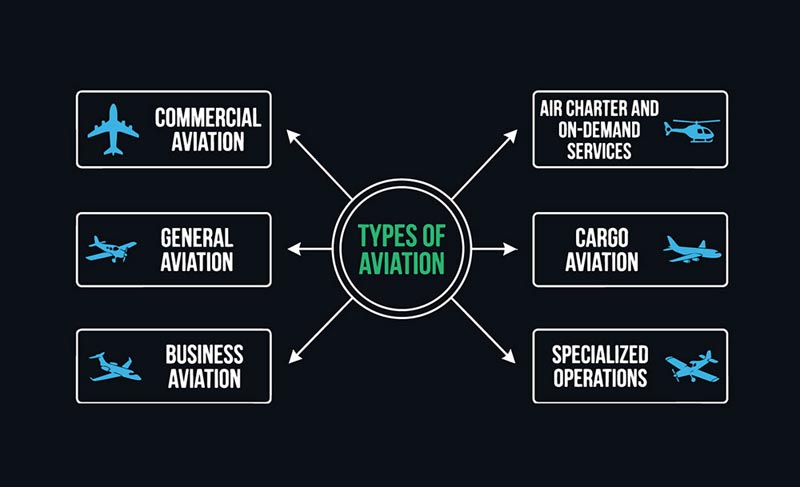
| By Just Aviation TeamAviation encompasses all flight operations of aircraft, ranging from private charters to scheduled airliners. These operations are commonly classified into different types of aviation based on purpose and aircraft characteristics. Commercial aviation involves scheduled airlines that transport passengers and cargo between cities on fixed routes.
In contrast, general aviation (GA) includes all civil flights outside of major airlines, such as private business jets, small propeller aircraft, helicopters, and other nonscheduled operations. Business aviation is a subset of GA focused on corporate and private enterprise travel. In this context, operators organize flights under various regulatory frameworks (e.g., Part 91 or Part 135 in the United States) to meet specific mission requirements.
Commercial Aviation
Commercial aviation refers to the airline industry’s scheduled passenger and freight services. This segment uses large airliners on established timetables and routes. Airports, air traffic control, and airline crews follow standardized procedures and regulations. For business flight operators, commercial aviation is often an external factor: it defines the major airports and flight corridors they use, but it operates under different constraints (e.g. fixed schedules, standardized cabin service).
From an operational perspective, commercial aviation represents one of the primary types of aviation characterized by predictability and standardization.
Key operational attributes:
- Fixed routes and scheduled slots
- Slot-coordinated airports with long-term planning cycles
- Centralized dispatch systems
- Standardized turnaround procedures
- High reliance on published airport infrastructure
Operational implications for support teams:
- Slot availability and airport congestion are primary constraints
- Limited flexibility for schedule changes
- Ground handling procedures are standardized and rarely customized
- Airport services are pre-contracted and airport-driven
While business operators do not manage airline flights directly, understanding this structure is essential when coordinating mixed-use airports, shared terminals, or peak-time operations.
General Aviation
General aviation (GA) covers all non-airline, non-governmental flights. By definition, GA includes private flying, business flights, flight training, aerial work, and recreational flights. The International Civil Aviation Organization (ICAO) defines GA as “all civil aviation operations other than scheduled air services and nonscheduled air transport for hire”.
In practice, GA is extremely diverse; from a small single-engine piston plane flying a sightseeing route to a turbine-powered corporate jet shuttling executives. The business aviation community itself is a large part of GA: about 97% of organizations using business aircraft are small or mid-size enterprises. GA flights operate at many smaller airports worldwide, providing flexible point-to-point connectivity that scheduled airlines often cannot offer. General aviation is best understood as infrastructure-flexible aviation.
Operational features:
- Access to secondary and regional airports
- Minimal dependence on slot-controlled hubs
- Ability to operate outside airline peak windows
- Diverse aircraft performance envelopes
Operational advantages:
- Reduced congestion exposure
- Simplified airport coordination
- Faster ground times
- Greater scheduling autonomy
For flight support teams, GA operations often require:
- Verification of airport operating hours
- Prior Permission Required (PPR) coordination
- Local handling capability assessment
- Fuel availability confirmation for smaller airfields
Business Aviation
Business aviation is one of the specialized types of aviation that uses general aviation aircraft for corporate or organizational purposes. Companies of all sizes employ business aviation to travel efficiently: executives, specialists, and teams can visit multiple cities in a day, reach remote locations, or conduct confidential meetings in flight. The business aviation fleet is diverse, ranging from light propeller aircraft and turboprops to large long-range jets and helicopters.
The National Business Aviation Association (NBAA) notes that business aircraft include “everything from piston aircraft not much bigger than a car… to jets that seat more than a dozen people and are capable of non-stop international flights.” In practice, most business jets carry around six passengers over stage lengths under 1,000 miles. Depending on their design, business jets may cruise below airline traffic (under 20,000 ft) or above it (over 40,000 ft) for optimal efficiency.
Business aircraft come in multiple propulsion and size categories. Piston-engine planes are small GA airplanes (often training or light personal aircraft) that burn avgas and typically cruise under 15,000 ft. Turboprops are fixed-wing planes with turbine engines driving propellers; they use Jet-A fuel, carry more payload than pistons, and usually cruise up to about 35,000 ft.
Business jets have turbine (jet) engines and burn Jet-A fuel; they are faster and fly higher than prop-driven planes, with many models capable of long-range and high-altitude cruise. Helicopters add vertical takeoff/landing capability: they are lifted by rotors and powered by piston or turboshaft engines (avgas or Jet-A). Helicopters are valuable for point-to-point city or remote-site transport where runways are unavailable.
Core Business Aviation Operational Elements
1. Trip Planning Depth
Business aviation flights require detailed pre-trip preparation, including:
- Route optimization based on aircraft performance
- Fuel stop strategy analysis
- Alternate airport suitability checks
- Terrain and performance margin reviews
2. Regulatory Classification Awareness
Operators must clearly identify whether a flight is:
- Private (non-commercial)
- Charter (commercial)
- Owner-operated or third-party managed
This classification directly affects:
- Crew qualification requirements
- Documentation carried onboard
- Permit eligibility in certain regions
3. International Documentation Control
For cross-border business aviation, operators typically manage:
- Overflight permits
- Landing permits
- Diplomatic clearances (where applicable)
- Noise compliance certificates
- Insurance documentation aligned with local requirements
Accuracy and consistency in documentation are critical, as discrepancies may cause delays or reprocessing.
Air Charter and On-Demand Services
Many operators supplement owned aircraft with air charter or on-demand flights. These are essentially commercial GA flights: an aircraft is hired by a company for a specific trip. To carry paying passengers, charter flights must hold an Air Carrier (Part 135) certificate (in the U.S.) or equivalent, authorizing commercial operations.
Obtaining and maintaining this certificate is involved, so most companies charter an existing operator rather than certify their own aircraft. Under Part 135 charter rules, flights must comply with tighter standards than private (Part 91) flights. For example, crew duty times, pilot qualifications, maintenance checks, and equipment fit more stringent requirements. In return, the operator can offset costs by offering additional flights for hire when the aircraft is not in use by the company.
Charter services often use the same types of business aircraft as corporate fleets: light jets, midsize jets, turboprops, and even helicopters. The service may also include air taxi flights (typically shorter hops under Part 135) and fractional ownership programs (where several users share an aircraft). In all cases, these on-demand flights allow businesses to access aviation without committing to full ownership.
Operational Differences from Private Flights
Commercial oversight includes:
- Enhanced crew qualification tracking
- Mandatory operational control systems
- Defined duty and rest limitations
- Increased audit and compliance requirements
From a flight support perspective, charter operations typically require:
- Operator certification verification
- Commercial insurance validation
- Passenger handling procedures
- Documentation alignment with host country requirements
Charter flights, as one of the commercial types of aviation, also involve contractual responsibility, meaning schedule changes, cancellations, or diversions must be coordinated across multiple stakeholders.
Cargo Aviation
While business flight support primarily deals with people transport, cargo aviation is a related category. Dedicated cargo airlines and freighter services move goods on specialized aircraft. These airfreighters have large cargo holds and often omit passenger amenities to maximize payload. Air cargo is vital for time-sensitive shipments worldwide, and business flight departments sometimes coordinate cargo charters or carry company freight in belly-hold space. Cargo flights require their own planning (weight calculations, pallet loading plans) and clearances but follow similar operational principles as passenger flights. Cargo aviation, even when using business aircraft platforms, operates under payload-driven planning.
Key Operational Factors
-
- Weight and balance dominance
- Center of gravity limitations
- Load sequencing requirements
- Ground equipment availability
- Support teams must ensure:
-
- Cargo documentation accuracy
- Handling capability at destination
- Timely customs coordination
- Ramp access planning
In mixed passenger-cargo operations, careful planning ensures that operational efficiency is maintained without compromising schedule or compliance.
Regulatory Environment
In the U.S., non-airline business flights typically fall under FAA Part 91 (private operations) or Part 135 (charter). Part 91 flights are non-commercial and cannot be conducted for hire. They have flexibility: for example, there are no pilot flight-time or mandatory rest limits under pure Part 91, and operators have more discretion over scheduling. Part 135 operations, by contrast, allow compensation but come with stricter oversight: pilots must meet higher qualifications, undergo drug/alcohol testing, and fly under controlled crew rest schedules. Aircraft in Part 135 service must meet higher maintenance standards and sometimes carry additional equipment (e.g. interior fire blocking).
International operators follow their national aviation authority’s regulations. For example, the European Union Aviation Safety Agency (EASA) distinguishes between private and commercial operations across different types of aviation using similar regulatory frameworks. Operators must also comply with international conventions, such as International Civil Aviation Organization (ICAO) standards, governing flight plans, navigation, and communications.
Specialized Operations
Beyond standard passenger transport, business aviation often supports special missions. For example, medical evacuation flights or urgent cargo deliveries utilize business aircraft capabilities. Helicopters may be deployed for VIP transport or reaching locations without runways. These specialized flights still follow the same aviation procedures, often requiring coordination with ground medical teams or cargo handlers.
Helicopters are part of the business aviation mix. They lift off vertically and can land in confined areas, making them ideal for on-demand short-range missions. Like airplanes, they require flight planning and regulatory clearances. According to NBAA, a helicopter may be powered by either piston or turbine (turbo-shaft) engines, using avgas or Jet A fuel. Operators coordinate helicopter flights just as they would fixed-wing: filing flight plans, obtaining permits, and scheduling fuel and crew.
FAQs
1. How does aviation type affect flight plan structure?
Flight plan structure varies based on operation classification and aircraft performance. Commercial and long-range business operations require detailed route validation, fuel contingency calculation, and alternate airport planning. These flights may also require navigation approvals such as Performance-Based Navigation authorization. Once filed, the Flight Plan (FPL) must reflect aircraft capability, operational status, and regulatory requirements applicable to the specific aviation type.
2. Does aviation type influence required onboard documentation?
Yes. Onboard documentation varies by operation classification. Commercial operations require additional documents such as the Air Operator Certificate (AOC), approved Operations Manuals, and crew qualification records. International flights also require validated insurance certificates, aircraft registration, and airworthiness documents. These documents must be current, accessible onboard, and consistent with the flight’s declared operational status.
3. How does aircraft category impact alternate airport selection?
Alternate airport selection depends on aircraft performance certification, braking capability, and approach availability. Larger or high-performance aircraft require alternates that meet runway length, pavement strength, and Rescue and Fire Fighting Service category requirements. Fuel reserves must support the selected alternate under forecast conditions, and the alternate must remain operational throughout the planned arrival window.
4. How do aviation types affect Notice to Air Missions (NOTAM) analysis?
The relevance of Notices to Air Missions (NOTAMs) depends on aircraft category and operational classification. Business and commercial operations must evaluate NOTAMs related to navigation aids, runway conditions, approach procedure availability, lighting systems, and airport operating hours. Applicable NOTAMs may directly affect landing minima, alternate eligibility, or overall flight dispatch legality.
5. Does aviation type change Minimum Equipment List (MEL) and dispatch limitations?
Yes. The Minimum Equipment List (MEL) defines which aircraft systems may be inoperative for dispatch under specific conditions. Commercial operations must strictly comply with MEL deferral intervals, operational procedures, and performance penalties. Private operations may operate under a Minimum Equipment guidance framework, but all inoperative items must remain within regulatory and aircraft limitations.
6. How does aviation type influence crew qualification requirements?
Crew qualification requirements vary by aircraft complexity and operation classification. Commercial operations require structured initial and recurrent training, documented proficiency checks, and experience thresholds. Additional approvals may be required for international or advanced navigation operations. Private operations rely on baseline licensing and medical certification but must still meet currency and recency requirements.
7. How is performance calculation affected by aviation type?
Performance calculations depend on aircraft certification and operational classification. Commercial and high-performance business aircraft require validated takeoff, climb, and landing calculations considering runway conditions, environmental factors, obstacle clearance, and aircraft configuration. These calculations ensure compliance with regulatory performance margins and form a critical part of dispatch authorization.
8. Does aviation type affect operational control responsibility?
Yes. Commercial operations require a defined Operational Control system, where responsibility for flight planning, release, and monitoring is shared between the operator and designated operational personnel. Private operations place primary operational control with the Aircraft Commander, resulting in different accountability structures and decision-making authority throughout the flight lifecycle.
Supporting different types of aviation requires a clear understanding of operational expectations, coordination depth, and execution standards. From routine movements to complex international missions, tailored support plays a critical role in maintaining efficiency and consistency. This operational awareness is the foundation of how Just Aviation approaches business flight support across diverse aviation activities worldwide.
Sources
- https://nbaa.org/business-aviation/business-aircraft/
- https://www.faa.gov/hazmat/air_carriers/operations
- https://www.icao.int/publications/doc-8643-aircraft-type-designators
- https://www2023.icao.int/Meetings/STA10/Documents/Sta10_Wp028_en.pdf
- https://download.aopa.org/Media/General-Aviation-Explained-r5.pdf#:~:text=WHAT%20IS%20GENERAL%20AVIATION%20,training%2C%20firefighting%2C%20banner%20towing%2C%20pipeline


 +971 4 5855 689