
Eurocontrol Route Availability Document RAD & How to Use It for Efficient Navigation Filing

17 January 2026
| By Just Aviation TeamEurope’s airspace is one of the most complex and tightly managed in the world, especially for business flight operators. At the center of this system is the Eurocontrol Route Availability Document (RAD), which defines where, when, and how IFR routes may be filed. A clear understanding of the RAD, free route airspace, and route restrictions is essential for efficient navigation filing, minimizing rejections, and achieving optimal routing across the European network.
What is a Route Availability Document (RAD)?
The Route Availability Document (RAD) is a centralized reference of all major en-route route restrictions, openings, and free-route airspace rules in European airspace. It serves as the definitive “sole-source” flight-planning document for Europe. In practice, the RAD contains every published traffic-flow rule (TFR), sector constraint, and free-route corridor across participating States.
Under EU regulation, each country’s National RAD Coordinator compiles local route availability data, and these are coordinated with Eurocontrol’s Network Manager for publication 28 days before each Aeronautical Information Regulation And Control (AIRAC) cycle. The baseline RAD (version 1.0) comes out at AIRAC D‑28, with incremental versions (1.1, 1.2, etc.) following if needed as changes arise.
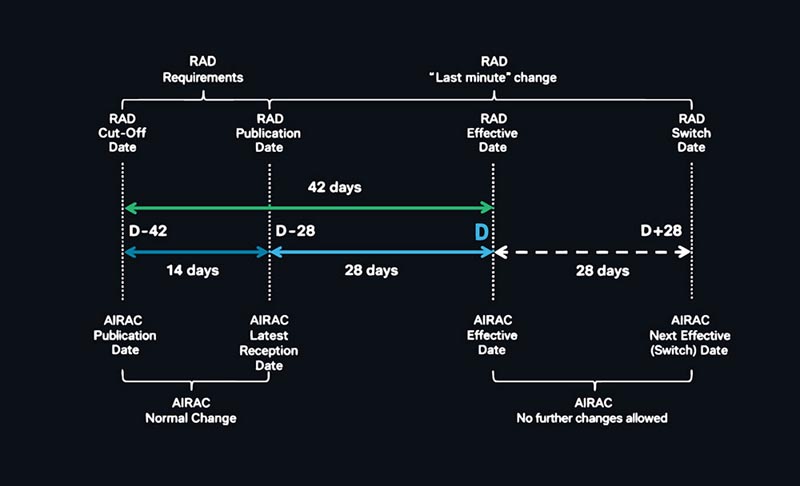
Structure and Content of the RAD
The RAD is organized by State or functional airspace block and consists of a main document plus annexes of data. Its key contents include:
- ATS Routes and Waypoints: Statements about the status of fixed airways or waypoints (e.g. “open”, “closed”, or “available under conditions”). Time-based or altitude restrictions (such as certain corridors only open at FL200 and above) are noted here.
- Free Route Airspace (FRA) blocks: Definitions of areas where operators may file point-to-point routes without following fixed ATS routes. For each FRA region, the RAD lists the entry/exit points and allowed altitude bands.
- Direct (DCT) Connections: A catalogue of approved direct flight-plan segments between specified fixes or navigation points. Annexes (e.g. Annex 3B) detail which en-route “DCT” pairs are permitted by each State. These cover both FRA-based direct filings and legacy direct routes outside FRA.
- Traffic Flow Restrictions (TFRs): Rules that control how traffic flows through certain segments. For example, a TFR may require that if a flight plan does not include a particular “reference point” when traversing part of a segment, the plan must be rejected. In essence, a TFR can force filing via a long route unless the flight includes the full set of waypoints. The RAD precisely describes these conditions.
- Sector and Special Constraints: Information on mandatory sector-change points, crossing routes, altitude restrictions, and temporary closures. Some of this overlaps with what’s in AIPs, but the RAD harmonizes it for route filing. For instance, special event NOTAMs often have corresponding RAD notes to guide planners.
- Free Route “Gates”: Points on the boundaries of FIRs where flights enter or exit free-route areas (often called “gates” or “common points”). These are listed for procedural purposes and flight-plan routing.
All of this is compiled into the RAD publication. Eurocontrol’s RAD Application (a web-based database) stores the historical and current data, but operators usually use the published RAD documents or integrated flight-planning databases. The RAD documents (PDFs or data files) are freely available on Eurocontrol’s NM website. National Coordinators and the NM team jointly maintain the data to ensure consistency with regulations (e.g. EU 255/2010 and EU 2019/123).
Using the Route Availability Document (RAD) in Flight Planning
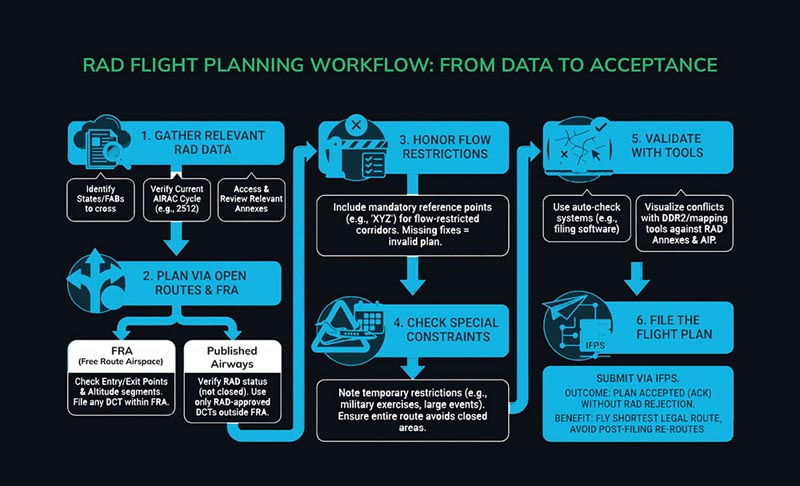
Business flight planners (e.g. corporate operators flying a Bombardier Global or Gulfstream) should consult the RAD to choose the most efficient valid route. A typical process is:
1. Gather Relevant RAD Data
Determine which States/FABs the flight will cross and obtain the latest RAD version for those areas. Eurocontrol’s RAD site and associated AIRAC briefs identify the relevant annexes for each country. Ensure the RAD version is current (e.g. “AIRAC 2512 v1.37, published 19-Dec-2025” for flights between 27-Nov-25 and 25-Dec-25).
2. Plan via Open Routes and FRA
For each segment of the desired flight path, check that the route is permitted. For example, if planning a direct line in a known FRA zone, confirm that the entry/exit points and altitude (as given in the RAD) allow it. If using a published airway, verify the RAD does not list it as closed. Within FRA, you may file any DCT between established waypoints. Outside FRA, only RAD-approved DCT points may be used.
3. Honor Flow Restrictions
If a planned routing crosses a flow-restricted corridor, include any required reference point as specified. For instance, a flow rule might say that any flight not including a certain fix “XYZ” when partially flying through a segment will be rejected. In practice, this means if you’re not flying the full set of waypoints, you must add “XYZ” in your flight plan. Ignoring such rules will cause the flight plan to be invalidated.
4. Check Special Constraints
Note any temporary restrictions. If a special exercise or large event is happening, the RAD annex might show that certain areas are closed or limited. Alternate routing might be recommended. Always verify that your entire route avoids or complies with such notes.
5. Validate with Tools
Most modern flight-plan filing systems automatically check your route against RAD rules (and will reject or warn if there’s a conflict). Operators can also use charting tools – for example, Eurocontrol’s Airspace Mapping Tool (DDR2) – which lets you plot a potential flightplan and highlights any RAD or AIP conflicts. These tools often draw on the same RAD Annex data (e.g. Annex 3B) and AIS databases to visualize compliance.
6. File the Flight Plan
Once the route is verified against the RAD, file it through the normal channels. If everything conforms, the Network Manager’s flight plan processor (Eurocontrol IFPS/eNMOC) will accept it without a RAD-related rejection.
By following the RAD rules, planners can file the shortest legal route and avoid post-filing re-routes. For example, a Gulfstream G650 flying from London to Rome might check the RAD and see that from FL330 upwards it can file point-to-point via a high-altitude free-route sector, then rejoin published routes at a convenient fix. Filing that trajectory (rather than an all-airway route) could shave 10–20 nm off the track. Consistency with the RAD means the flight will not hit unforeseen closed segments en-route.
Free Route Airspace (FRA) and Direct Routing
FRA is one of the RAD’s most useful features for operators. In FRA regions, flights may be filed in straight lines between defined entry and exit points (and published intermediate points) without referencing fixed routes. The RAD lists these regions and their rules. For example, the RAD will name the eastern and western “gates” of an FRA zone and the altitudes at which free routing is allowed. A flight entirely within FRA can be filed by specifying significant waypoints or even arbitrary fixes in sequence.
More than 75% of European airspace now has active free-route corridors. This means that for most cross-country flights, a significant portion of the route can be filed freely. Network data confirm the impact: the average EU route extension (the extra distance flown vs. the great-circle) has fallen dramatically; from about +3.58% in 2007 to only +1.57% by mid‑2025. In effect, flights today usually fly much closer to the direct path than in the past. Business flights can exploit FRA by climbing into the allowed flight levels and filing fixes that cut across the continent, then rejoining the normal airway network near the destination.
Even outside formal FRA zones, the RAD supports efficiency via RAD-DCT connections. These are approved direct routes at higher altitudes (e.g. between two VORs or intersections) that States have agreed to keep open. Filing such DCT points according to the RAD can avoid lengthy detours. In short, by using the RAD’s FRA and DCT permissions whenever possible, operators minimize excess distance and fuel burn.
Benefits and Efficiency Gains
Using the RAD (especially with FRA) brings concrete savings. Shorter distances mean lower fuel costs and emissions. For example, studies of FRA projects indicate massive cumulative benefits. When fully implemented across Europe, FRA is expected to save on the order of 1 billion nautical miles flown, 6 million tonnes of fuel, and 20 million tonnes of CO₂ per year – roughly a €5 billion annual fuel cost reduction. Even partial implementations yield big gains: the South-East Europe FRA project (SEEFRA) alone was estimated to cut flight distances so much that it saves about 29,200 tonnes of fuel and 91,920 tonnes of CO₂ annually.
An NM-SESAR trial of Dynamic RAD (where select restrictions were temporarily lifted day-by-day) showed real-world benefits. Over a five-month period with thousands of flights, about 8,400 flights filed more optimal paths and together eliminated about 2,800 tonnes of CO₂ emissions. This confirms that when RAD constraints are eased (and FRA used), operators quickly file shorter trajectories.
In everyday terms, RAD-based planning means:
- Reduced flight distance: Many flights cut 0.5–1.0% of distance simply by avoiding fixed detours. This translates to minutes of flight time saved on each sector.
- Fuel and cost savings: Those distance trims directly save fuel. For a long-range jet, even a 1% reduction (say 10–15 NM on a 1,000 NM flight) is significant over time. Multiplying across an operator’s entire schedule, it can amount to tens of thousands of dollars per year.
- Predictability: Planning with the RAD reduces the chance of en-route ATC re-routes (which can happen if a filed airway is unexpectedly closed). This improves on-time performance. Controllers also report that FRA leads to steadier flows with fewer tactical changes.
- Environmental impact: Shorter routes cut CO₂ output. The FRA benefits studies highlight that each seat-mile flown under optimized routing yields less emissions. This helps operators meet sustainability goals.
Network reports note that while RAD restrictions (when applied) slightly raise the average route factor, the overall trajectory-based efficiency remains high thanks to FRA. In sum, close adherence to RAD guidelines ensures business flights fly as efficiently as the current airspace structure allows.
Recent Developments and Updates
The RAD and its surrounding processes continue to evolve to aid operators:
New RAD Structure (2022)
In May 2022 Eurocontrol deployed a revamped RAD data format and database. This update improved how rules are categorized (by sector or capacity) and harmonized terminology. It also launched the NM “RAD Application,” which feeds the public RAD publications. National RAD Coordinators received support to migrate to the new system smoothly.
Publication Cycle
A subscription alert service now informs users when a new RAD version is posted. Each AIRAC’s V1.0 is released on schedule (e.g. AIRAC 2513 V1.6 was released 19-Dec-2025). Intermediate (delta) updates are issued as needed. From AIRAC 2601 onward, UK-specific route data (SRDs and SALs) will also be published on the RAD site.
Flight Planning Guidelines (2025)
In November 2025 Eurocontrol published version 6.0 of its NM Flight Planning Requirements. This comprehensive guideline incorporates RAD and FRA rules, and replaces earlier documents. Business operators should align their filing procedures with these guidelines to ensure full compatibility with the Network Manager’s systems.
Read-only RAD Access (2025)
As of late 2025, the RAD Application database itself will be accessible (read-only) to flight planners and computerised flight planning service providers (CFSP)s via the iNM portal. This means future planners can query the authoritative RAD content directly, rather than relying only on static PDFs. (Access requires an account request.)
Dynamic RAD Trials
The concept of daily dynamic management of RAD restrictions (through the Airspace Use Plan process) is being implemented. During live trials, ANSPs and airlines collaboratively selected which restrictions could be relaxed on a given day. The success of those trials is pushing toward regular dynamic flexibility, which will allow even more efficient filings when traffic permits.
Expanded FRA Corridors
New cross-border free-route areas continue to be rolled out. For example, Baltic and Balkan FRA corridors were activated in 2022. Each expansion is reflected in the RAD, giving operators more direct routing options.
Tools and Notices
The European Airspace Improvement Synopsis (RAIS) and NM ACE Chart briefings summarize each AIRAC’s major RAD changes and should be reviewed by planning staff. Additionally, the Eurocontrol Airspace Mapping Tool (via DDR2) now integrates RAD and CADB data, letting users draw and verify compliant routes.
By staying current with these updates, business flight operations can maximize RAD’s benefits. In practice, this means always using the latest RAD data when flight planning, including any FRA/DCT possibilities, and watching for mid-cycle amendments. Ongoing automation (e.g. improved flight-plan pre-validation and TFR simplification) will continue to make RAD-based filing faster and more reliable.
FAQs
1. How does the RAD interact with the European flight plan validation process?
The RAD is directly embedded into the European flight plan validation logic. Any route segment that conflicts with RAD rules will trigger an automatic rejection during pre-tactical validation, even if the route appears acceptable on charts or in national AIPs.
2. Are RAD restrictions altitude-dependent?
Yes. Many RAD rules apply only within specific flight level bands. A route may be prohibited at lower levels but fully available above a defined altitude, particularly within free route airspace or high-level overflight corridors used by business jets.
3. Can a RAD-compliant route still be tactically re-routed by ATC?
Yes. RAD compliance ensures acceptance at filing, but tactical re-routing may still occur due to weather, sector overload, or special activation. However, RAD-compliant routes significantly reduce the likelihood of strategic or system-driven re-routes.
4. How are cross-border route restrictions handled in the RAD?
Cross-border rules are coordinated between adjacent States and published as harmonized restrictions. The RAD ensures continuity by defining mandatory entry and exit points, preventing mismatches between national routing structures at FIR boundaries.
5. What is the operational impact of missing a required reference point in a RAD rule?
Omitting a mandatory reference point typically results in flight plan rejection. These points are often used to manage traffic flow through constrained sectors and must be included exactly as defined to satisfy the routing condition.
6. Does the RAD include contingency or exceptional routing?
Yes. Certain RAD sections define alternative routings for specific scenarios such as seasonal traffic peaks, airspace restructuring, or temporary capacity reductions. These routings are valid only under stated conditions and time windows.
7. How frequently should business operators review RAD changes?
At a minimum, the RAD should be reviewed every AIRAC cycle. Operators with frequent European operations should also monitor interim RAD updates, as restrictions may change within a cycle due to evolving network or capacity conditions.
8. Is the RAD applicable to all IFR business flights in Europe?
Yes. Any IFR flight operating within or transiting European airspace subject to centralized flow management must comply with RAD rules, regardless of aircraft category, flight purpose, or operator size.
Efficient route filing is not only about compliance, but about understanding how Europe’s airspace truly works. From business jets to other specialized operations, informed use of the RAD helps reduce uncertainty, cost, and unnecessary complexity. This is where operational expertise matters. Through comprehensive business flight support and a broad understanding of different aviation sectors, Just Aviation helps operators navigate these challenges with clarity, precision, and confidence across the European network.
Sources
- https://www.eurocontrol.int/sites/default/files/2023-05/eurocontrol-annual-nor-2022-main-report.pdf
- https://www.sesarju.eu/sesar-solutions/dynamic-route-availability-document-rad
- https://www.nm.eurocontrol.int/RAD/
- https://www.eurocontrol.int/concept/free-route-airspace
- https://www.eurocontrol.int/archive_download/all/node/10820
- https://www.eurocontrol.int/sites/default/files/2025-05/prb-prc-fra-benefits-study-20250519.pdf


 +971 4 5855 689