
Optimizing Flight Operations in the GCC: Requirements, Challenges and Opportunities

01 February 2026
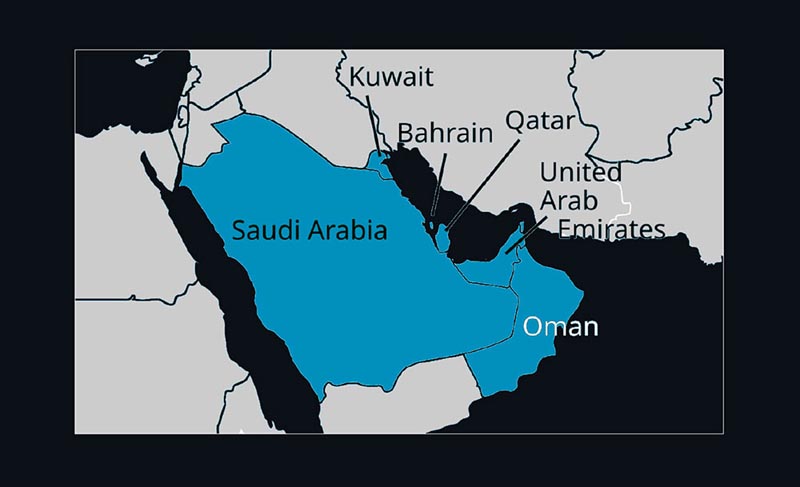
| By Just Aviation TeamBusiness jet and charter operators in the Gulf region must navigate a complex regulatory landscape. The Gulf Cooperation Council (GCC) (comprising the UAE, Saudi Arabia, Oman, Qatar, Bahrain and Kuwait) requires foreign operators to obtain advance permits for every flight, and to comply with each country’s Civil Aviation Authority (CAA) rules. Planning a Gulf flight means coordinating permits and slots with each CAA, ensuring all aircraft and crew documents are current, and equipping the aircraft with the required navigation technology.
Regulatory and Permit Procedures
Every non-scheduled (charter/private) flight in the GCC must obtain explicit permission from the local CAA. Procedures vary by country, but common elements include foreign‐operator registration, advance passenger data (API) filings, and landing/overflight permits. For example, the UAE’s GCAA requires overseas operators to register and complete a National Advance Information Center (NAIC) submission before any landing permit is issued. In practice, UAE operators follow these steps:
- Foreign-operator registration: Submit an application to the GCAA (for an NAIC account) before flying.
- NAIC approval: Provide advance passenger/crew data via the GCAA portal. A NAIC Certificate is mandatory prior to permit issuance.
- Landing permit application: Once NAIC is complete, apply online (specifying emirate and flight details). The authorities coordinate with slot offices and ground handlers before final approval.
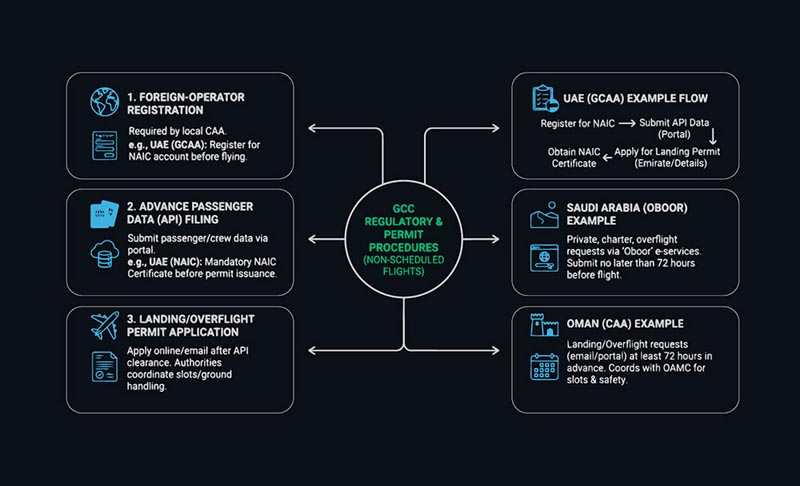
Similar processes apply in Saudi Arabia, Oman, etc., often via online portals or email. Saudi’s Air Transport sector uses the “Oboor” e-services platform: private, charter and overflight permit requests must be submitted no later than 72 hours before the flight. In Oman, both landing and overflight requests must arrive at least 72 hours in advance. (For example, Oman’s CAA requires charter flights to apply by T–72h and coordinates with its Air Navigation Center (OAMC) for slots and with safety inspectors to verify aircraft documentation.)
Documentation and Compliance for the Gulf Cooperation Council (GCC)
GCC regulators require that every aircraft and crew carry valid certificates. Key required documents include:
Aircraft certificates
Valid registration certificate and Certificate of Airworthiness (CoA) must be on board. For charters, many CAAs (like Oman’s) explicitly require copies of the operator’s AOC (Air Operator Certificate) and insurance certificate during the permit application. Oman’s AIP, for example, lists “AOC, Certificate of Airworthiness, Certificate of Registration, Insurance, Noise Certificate, and Radio License” as mandatory attachments for non-scheduled flight permits.
Insurance
An active aviation insurance policy (typically hull and third-party liability) is universally required. Regulators will often check that the policy covers the entire planned flight region. (In Oman, a copy of the aircraft insurance certificate must be provided for charter permits.)
Operator credentials
Foreign charters must fly under a valid AOC or a Foreign Operator Authorization (FAA-authorized non-U.S. operators will have the equivalent). The authorities may require a copy of the AOC or Operations Specifications for the specific aircraft. Many Gulf CAAs also insist on a local representative or “sponsor” for the flight, especially in Saudi Arabia (though the trend is to simplify this for purely business travel).
Crew licenses
All pilots and flight crew must carry up-to-date pilot licenses and medical certificates. Saudi regulations explicitly mandate that “each member of the flight crew must carry a valid airman certificate or license” authorizing their duties. Any ratings or language endorsements (e.g. an Instrument Rating) must also be current.
Operational manuals
The aircraft’s Flight Manual and weight/balance documentation should be on board. Gulf AIPs often require a Dispatch Release or weight statement for charters.
Passenger documents
Crew passports and visas must be valid (often six months min. validity) along with any necessary entry visas or entry permits for each country. (Visa rules lie outside aviation regulation but flight ops must always verify them.)
Airspace and Navigation Requirements
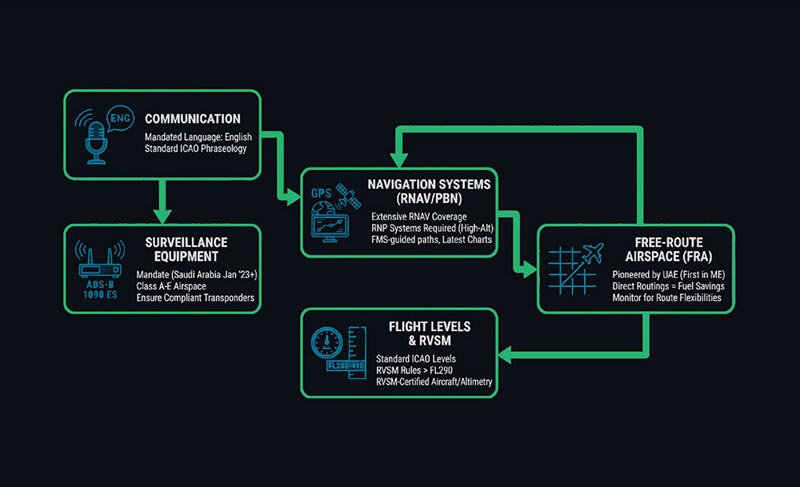
Gulf airspace is modern but heavily regulated. Operators must equip and plan according to the standards of the region’s air traffic services. Key navigation considerations include:
Communication
English is the mandated language. At least one flight crew member on each flight must be capable of two-way radio communications in English while in Gulf airspace. Standard phraseology applies, so crews should be familiar with ICAO terminology.
Surveillance equipment
As of January 1, 2023, Saudi Arabia mandates 1090 MHz Extended Squitter ADS-B Out on all flights operating in Classes A, B, C, D or E airspace. In practice, this means nearly all IFR flights must have a serviceable 1090ES ADS-B transmitter (certified to EASA or FAA standards). Some other Gulf states have similar ADS-B requirements on schedule for the next few years, so operators should ensure their transponders are compliant.
Navigation systems
Most Gulf airspace has extensive Area Navigation (RNAV) and Performance-Based Navigation (PBN) coverage. Operators should have functional GPS/INS-based navigation (or equivalent RNP-approved systems) for all high-altitude routes. Many published SIDs/STARs require RNAV capability, and oceanic/planned routes often assume FMS-guided paths. Operators should load the latest Gulf ICAO airway charts and electronic IFR charts (AIPs or Jeppesen) to capture any new waypoints.
Free-Route Airspace (FRA)
The UAE recently pioneered full Free Route Airspace in the Middle East. In July 2023 the UAE GCAA opened FRA for the entire Emirates FIR. This allows overflights to fly more direct routings between entry and exit points without following fixed ATS airways. The official ICAO report notes the UAE is the first ME country to implement FRA. As a result, up to 55,000 flights per year are expected to benefit, saving over 30 million kilograms of fuel annually. Gulf operators should monitor such developments; taking advantage of new route flexibilities can reduce fuel burn and flight time.
Flight levels
Most GCC enroute operations use standard ICAO flight levels. RVSM (Reduced Vertical Separation Min.) rules apply above FL290, so aircraft and altimetry systems must be RVSM-certified when flying FL290–410. (Some FIRs may impose higher minimum altitudes for certain routes; consult the AIPs.)
Required Documentation (Checklist)
Every Gulf flight must carry a suite of current certificates. Operators should prepare the following documents before departure:
- Aircraft and Operator: Up-to-date Aircraft Registration and Airworthiness certificates (ICAO format). A copy of the Air Operator Certificate (or foreign operator authorization) if flying for hire.
- Insurance: A valid aviation insurance certificate covering the flight region. Ensure hull and liability limits meet the destination country’s requirements (often at least $5–50 million).
- Noise Certificate: Many Gulf airports enforce noise limits. Carry the aircraft’s noise certificate (for all airports in Oman, for example).
- Radio License: An aircraft radio station license (if required by the registry).
- Crew Documents: Each pilot/crew member’s license and current medical, plus passport with appropriate visas. Saudi regulations explicitly require each crew member to carry a valid license. (Arrange crew visas well in advance – Gulf charter flights do not receive visa-on-arrival.)
- Passenger Manifest: An accurate list of all passengers and crew. Submit this to the authorities as required (often via the permit system or upon request).
- Flight Plan/Release: In many Gulf states, dispatchers must issue a flight release or operations sheet. Some permit systems require submitting the filed flight plan (ICAO format) at least 24–48 hours ahead.
- Dangerous Goods: If carrying any DG, ensure you have the special Dangerous Goods permit or approvals from the CAA. (Saudi, Oman and others treat DG flights separately, with extra lead time.)
Note: All documents must be valid at the time of flight. For example, Saudi annual GA permits expire after one year and cannot be used past the expiry date; Oman’s approach requires current certificates for every entry. A lapse in any key document usually means no permit. In practice, flight departments use a master compliance log and reminders to track expiry dates (licenses, passports, insurance) to avoid any gaps. For instance, Saudi rules stipulate that an annual GA permit must be renewed at least three weeks before expiry.
Operational Challenges
Operating in the Gulf poses a few unique challenges, but also technological opportunities. The region’s climate and traffic environment require extra planning:
High Temperatures
Gulf summer days can reach 50–55°C on the ground. High ambient temperature leads to low air density, degrading engine thrust and wing lift. Operators must consult performance charts carefully: takeoff-roll distances will lengthen and climb rates drop. Practically, this often forces weight reductions (fewer passengers or less cargo) or early departures to cooler hours. Airlines are advised to request precise temperature forecasts and factor in high-density-altitude conditions. Dispatchers should build in extra fuel reserves in case hot-air engine limits (or winds) force an unplanned delay or runway backtrack.
Dust and Sand
Dust storms or blowing sand (especially in spring) can severely reduce visibility. Flights planned around summer should include alternate airports and lower visibility minima. Ground delays may occur if local airports shut or decline operations in sudden sandstorms. Always check NOTAMs for any dust-related closures.
Peak Traffic
Major Gulf hubs run at high capacity. Operators may face long taxi or holding delays, especially at congested airports like Dubai or Doha. Early slot requests and contingency plans (e.g. alternate airports) can mitigate this. On the positive side, most international routes over the Gulf allow direct routings over water, reducing complexity once underway.
Airspace Complexity
While generally well-structured, some busy terminal areas (e.g. Riyadh CTR or Dubai TMA) have special route requirements. For instance, Riyadh uses fixed VFR corridors (UVRs) which pilots must obey. IFR flight plans, however, are normally cleared through the busiest sectors with standard SIDs and STARs as published. In-country ADS-B or ground-based surveillance is ubiquitous, so standard separation applies.
Regulatory Fragmentation
The biggest challenge is managing six sets of rules. For example, Saudi still requires a local ground handler confirmation and (for some flights) military coordination. Operators overcome this through thorough pre-flight checklists and by leveraging local agents. On the solution side, the Gulf is actively moving toward harmonization: the UAE’s recent launch of a regional free-flight system and the planned Gulf-wide CAA aim to simplify overflight/landing approvals and reduce bureaucratic overhead. In the meantime, operators use advanced flight-planning software and digital NOTAM services to cope with last-minute changes.
Best Practices and Solutions
To turn challenges into opportunities, business flight operators can adopt several best practices:
Advance Planning
Start the permit process as early as possible. Since most Gulf permits need 72h lead, prepare flight details and documents at least 4–5 days ahead. Use digital portals where available (the UAE GCAA and Saudi Oboor systems provide status tracking).
Maintain a Document Log
Keep a centralized database of all certificate expiry dates (airworthiness, registration, licenses, visas, insurance, etc.). Configure alerts for renewals at least 30 days in advance. This avoids last-minute permit rejections due to an overlooked expiring document.
Leverage Technology
Use modern flight-planning tools that incorporate Gulf AIP data. Apps that automatically update with the latest Gulf NOTAMs, satellite weather, and performance calculations help dispatchers meet all requirements. For example, optimized routing software can suggest the new UAE Free-Route corridors for fuel savings. Electronic flight bags (EFBs) with up-to-date charts also aid in compliance checks en route.
Partnering with Expertise
Work exclusively with Just Aviation, an experienced Gulf-based operation and handling partner. Just Aviation understands each CAA’s “special rules” (such as airport curfews and slot restrictions) and can expedite all required paperwork. They also coordinate ground handling, security clearances, and catering; critical tasks that can cause delays if left until the last minute.
Regular Training
Ensure your flight ops staff stay current on Gulf regulations. CAAs occasionally update rules (the ADS-B mandate in Saudi was a recent example). Periodic briefings on regional changes (via seminars, industry groups or CAA bulletins) keep crews and dispatchers aware.
Environmental Mitigation
Plan hot-weather operations carefully: use early morning departure slots, calculate high-temp performance margins, and always include a cool-weather runway analysis. In practice, this might mean removing seats or offloading non-essential weight on very hot days. Similarly, for dust threats, schedule flexibly around forecasted sandstorm windows.
Regional Harmonization
Take advantage of ongoing improvements. As the Gulf moves toward unified regulations and one-stop travel systems (for example, the upcoming GCC entry/exit permit system), operators should monitor and adapt. For instance, the UAE’s Air Navigation Master Plan now includes a single free-route project; in time this could extend Gulf-wide, simplifying overflight filings.
FAQs
1. How do GCC CAAs evaluate foreign charter operator eligibility before issuing permits?
CAAs typically assess the operator’s AOC scope, aircraft type listing, operational control structure, and consistency between field schedules and commercial intent. Mismatches between declared operation type and documentation are a common cause of processing delays or permit rejection.
2. Are crew duty and rest considerations reviewed during permit approval in the GCC?
While duty limits are not directly approved during permitting, some CAAs may flag schedules that appear operationally unrealistic. Excessive sector counts or compressed rotations can trigger follow-up queries, especially for consecutive multi-state GCC operations within short timeframes.
3. How are aircraft substitutions handled once a GCC permit is already approved?
Most CAAs require a formal permit revision rather than a simple notification. Aircraft substitution usually triggers revalidation of insurance, noise certification, and ADS-B compliance, and may reset processing timelines, even if the new aircraft belongs to the same operator.
4. What role do ICAO aircraft equipment codes play in GCC permit acceptance?
ICAO equipment and surveillance codes are cross-checked against regional mandates. Incorrect or outdated codes (especially related to ADS-B, PBN, or Controller–Pilot Data Link Communications (CPDLC)) can result in operational restrictions, rerouting, or last-minute ATC coordination requirements during flight plan validation.
5. How do GCC states manage permit validity when schedules shift slightly?
Minor time shifts may be accepted within a limited tolerance window, but date changes almost always require reapproval. Operators should not assume flexibility, as permit systems are tightly linked to airport slots, immigration coordination, and airport authority notifications.
6. Are technical stops treated differently from full landing permits in the GCC?
Yes. Technical stops often require additional declarations confirming no passenger or cargo activity. CAAs may request fuel uplift confirmation and ground time limits. Failure to clearly declare a technical stop can lead to compliance issues during post-flight audits.
7. How do operators mitigate last-minute NOTAM-driven operational changes in the region?
Advanced NOTAM filtering and route contingency planning are essential. Operators often pre-validate alternate airports and secondary routings during dispatch to avoid re-filing permits if runway availability, navigation aid status, or airspace procedures change close to departure.
Successfully navigating the operational complexity of the GCC requires more than regulatory awareness; it demands structured coordination, technical accuracy, and constant alignment with regional authorities. This is where Just Aviation supports business flight operators by translating regulatory frameworks into practical operational workflows, ensuring permits, navigation requirements, and documentation remain aligned with real-world schedules while maintaining efficiency across multi-state GCC operations.
Sources
- https://www.gcaa.gov.ae/en/Pages/focus.aspx
- https://aimss.sans.com.sa/assets/FileManagerFiles/AIP%20AMDT%2006_24_2025_01_02/eAIP/GEN%201.2-en-GB.html
- https://www.caa.gov.om/en/services/air-transport-1/landing-requests-into-omani-airports
- https://www.aci-asiapac.aero/media-centre/news/aci-asia-pacific-and-middle-east-welcomes-the-creation-of-gulf-civil-aviation-authority


 +971 4 5855 689