
Managing Flight Operations in Europe’s Highly Regulated Airspace

04 February 2026
| By Just Aviation TeamEurope hosts one of the world’s most structured and closely coordinated highly airspace systems. For business flight operators, managing operations within this environment requires a clear understanding of harmonized regulations, centralized flight planning, and operational coordination across multiple states. Effective preparation ensures efficiency, compliance, and predictable outcomes for every European mission.
Centralized Flight Planning and Airspace Governance in Europe
Europe’s airspace is highly structured under the Single European Sky framework. All flights must comply with common rules set by EASA and Eurocontrol. In practice this means every instrument flight (and most cross-border flights) in Europe requires a filed flight plan. For example, EU regulations (SERA.4001) stipulate that “any flight … to be provided with air traffic control service” or crossing international borders must submit a flight plan.
In fact, Eurocontrol’s Network Manager processes all IFR flight plans centrally: “pilots intending to depart from, arrive at or fly over” Europe submit plans to the NMOC, which validates and distributes them to each country’s controllers. This central system (the Integrated Flight Plan Processing System) ensures consistency and predictability, simplifying cross-border operations and reducing costs.
In practical terms, business operators must ensure IFR flights are pre-filed via Eurocontrol (e.g. through the Network Operations Portal) well in advance; typically 120 h max to 60 min before departure. The flight plan itself must include all standard data (aircraft ID, equipment codes, route, speeds, altitudes, alternates, fuel, persons on board, etc.) as specified in SERA.4005. Even VFR flights can trigger these rules: a VFR flight crossing a state boundary or entering controlled airspace must file a plan just like an IFR one.
Airspace Structure and Free-Route Operations
Europe’s airspace is highly regulated and standardized under EASA and Eurocontrol oversight, creating a predictable operating environment for IFR traffic.
Airspace Classification
Europe’s airspace is divided into classes A–G under EASA rules. Class A airspace, typically from FL245 up to FL660, is strictly IFR only. Lower classes such as C and D permit IFR with full ATC control and allow VFR with separation or traffic information, while Class E permits both IFR and VFR with IFR given priority. Class G uncontrolled airspace generally exists only at very low altitudes or in remote regions. A major operational development is the widespread implementation of Free Route Airspace (FRA), which allows aircraft to file any direct route between defined entry and exit points rather than following fixed ATS airways.
In practice, this enables flights such as a direct routing from northern France to southern Germany along a near great-circle track. FRA has been implemented across most of the EU, with more than three-quarters of European en-route airspace now operating under FRA, reducing average route extension from 3.58% of great-circle distance in 2007 to about 1.57% by 2025. Final FRA implementation across Europe is scheduled by the end of 2025. Despite this flexibility, all flights remain subject to air traffic control, and controllers may still issue instructions for traffic, weather, or capacity reasons.
Altitude Rules, Equipment, and Communications
Below FL195, or the national equivalent, most European airspace is controlled as Class C or D, or advisory as Class E, meaning IFR flights must remain in contact with ATC and comply with clearances. Altitude rules differ for IFR and VFR, with IFR flights using direction-based even and odd flight levels. Above FL290, Reduced Vertical Separation Minimum standards apply, allowing closer vertical spacing.
Mandatory equipment requirements are tightly enforced: IFR flights must carry Mode C or Mode S transponders and maintain continuous two-way radio communication. Many European states now require ADS-B Out above FL100. In addition, above FL285 there is a CPDLC mandate for IFR flights under EU Data Link Service regulations, meaning aircraft and crews must be data-link capable or operate below FL285. These airspace, equipment, and communications requirements are harmonized across EASA member states and several associated countries to ensure consistency in high-density European operations.
Flight Planning: IFR vs. VFR Procedures
In Europe, IFR flights always require a flight plan and ATC clearance. Per EASA’s Standardised European Rules of the Air (SERA), any IFR flight into controlled airspace must file a plan and then “be provided with air traffic control service”. IFR operators thus file their plan to Eurocontrol (NMOC) before departure (often via an approved FPL filing system). The central IFPS will automatically reject or notify if the route or data are invalid.
Once airborne, IFR flights must enter an assigned cruising level and adhere to clearances; any changes (route or ETA) over 30 min require flight plan updates to the ATC units or NM. Failure to activate or close an IFR plan can trigger an unnecessary search and rescue alert, so operators also use network tools to monitor flight plan activation (e.g. the NM Flight Activation Monitor).
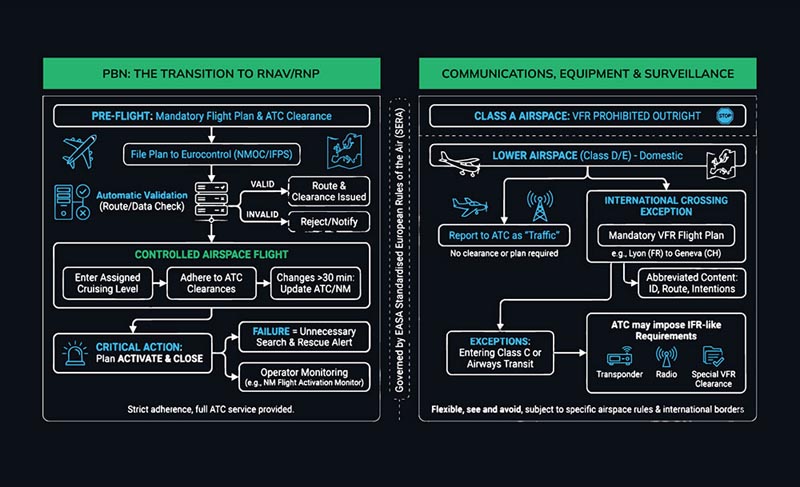
By contrast, VFR (Visual Flight Rules) flights are less restricted but still governed by SERA. In class A airspace VFR is prohibited outright. In most lower airspace (Class D/E), VFR flights need only report to ATC as “traffic” but do not require a clearance or plan unless crossing into another country. (SERA specifically requires a flight plan for any flight crossing an international border.)
For example, a light aircraft flying VFR from Lyon to Geneva would normally contact French ATC in Class D on departure and Swiss ATC before entering Switzerland – but because it is crossing borders, it must file a simple VFR flight plan beforehand. The flight plan content for VFR is abbreviated but still needs identification, route, and intentions. If a VFR pilot requests an airways transit or enters Class C, ATC may impose IFR-like requirements (transponder, radio, even an IFR clearance via Special VFR).
Key flight-plan rules (EASA SERA 4001) include:
- IFR flights and any flight receiving ATC service must file a flight plan.
- Any flight crossing a national boundary must file (unless local rules exempt it).
- Plans should be lodged up to 5 days in advance, but at least 60 min before departure (or 3 h if ATFM delays are possible).
- After departure, any significant route or time change must be passed to ATC quickly.
This structured filing regime ensures no flight enters European airspace without controllers knowing its intent. The plan is shared with each overflown country’s ANSP automatically, enabling coordinated airspace management.
Flight Operation Example: IFR Business Jet, London to Rome
A large business jet departs London City for a corporate meeting in Rome. The dispatcher files an IFR flight plan via Eurocontrol Network Manager Operations Centre (NMOC) well before departure, coding a free-route direct path through the UK, France, and Italy. The plan includes RNAV navigation (RNP-5) and a CPDLC capability code. ATC assigns initial clearance (including standard SID out of London), then once en-route allows flight via FRA segments. Near France, ATFM computes a CTOT, so the jet’s off-block time is adjusted by 10 minutes.
At FL360 in German airspace, the crew uses CPDLC to report position and requests a descent into Rome, and Italian ATC vectors it to an RNAV STAR for Rome Ciampino. The flight adhered to all SERA rules (flight plan filed, ADS-B on, RNAV tracking) and arrived as scheduled. The dispatcher later receives one monthly Eurocontrol invoice covering this flight’s route charges in UK, FR, DE, IT airspaces.
Navigation Performance and Communications
Europe applies harmonized navigation, communications, and surveillance standards to ensure IFR operations remain safe, predictable, and interoperable across national borders:
Performance-Based Navigation Standards
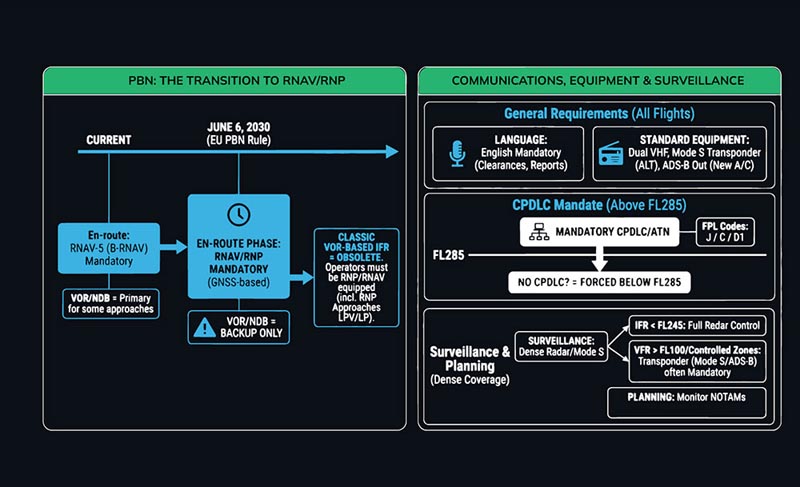
Europe has progressively mandated performance-based navigation (PBN) standards. All IFR flights must meet at least RNAV-5 (B-RNAV) requirements in en-route airspace. The EU’s PBN Implementing Rule effectively forbids any conventional navigation below 2030: by 6 June 2030, every en-route phase must use RNAV or RNP, with ground-based VOR or NDB procedures only allowed as backups.
This means business aircraft need GNSS-based RNAV capability for most European routes and SID/STAR procedures. For non-precision approaches, RNP approaches with LPV or LP minima are increasingly published to meet PBN criteria. In short, classic “VOR-based” IFR flying will be obsolete; operators should be fully RNP/RNAV equipped.
Communications and Mandatory Equipment
In terms of communications, all ATC clearances and position reports in Europe must be in English. Pilots must therefore be proficient in aviation English and may use standardized call signs. Equipment-wise, dual VHF, Mode S transponder with altitude reporting, and often ADS-B Out on newer aircraft are required.
Above FL285, Controller–Pilot Data Link Communication (CPDLC) is mandatory. An operator without CPDLC cannot legally file above FL285 in EU airspace unless exempted, and if such a flight plan is filed, controllers will automatically force the aircraft to remain below FL285. Thus, long-range corporate jets are upgraded to CPDLC/ATN, and dispatchers mark “J”, “C”, or “D1” (CPDLC capable) in item 10 of the flight plan.
Surveillance, Airspace Monitoring, and NOTAM Awareness
Radar and Mode S surveillance coverage in Europe is dense, so IFR flights below FL245 receive full radar control, and even Class F (traffic advisory) or Class G airspace often has some level of radar service. As a result, VFR operators should carry a transponder, with Mode S or ADS-B frequently mandatory even for small aircraft above FL100 or in controlled zones. Business operators must also monitor NOTAMs for any temporary airspace reservations such as parades or large VIP movements.
FAQs
1. How are flight plan route validations technically performed in European airspace?
All IFR flight plans are validated centrally against airspace structures, conditional routes, altitude constraints, and traffic flow rules. The system checks compliance with RAD (Route Availability Document) requirements, vertical profiles, and navigation capabilities before distribution to national ATC units.
2. What determines whether an IFR flight receives an ATFM slot allocation?
Slot allocation is based on predicted sector demand versus declared capacity. Factors include departure aerodrome congestion, en-route sector loading, arrival acceptance rates, and traffic complexity. Aircraft category does not exempt business operations from flow regulations applied by the network.
3. How do vertical flight profiles impact European en-route efficiency?
European airspace applies structured cruising levels and transitional altitude rules. Aircraft performance, direction of flight, and sector constraints may prevent optimal altitudes. Dispatchers must anticipate level caps and step climbs when calculating fuel burn, contingency margins, and arrival timing accuracy.
4. What technical elements influence RNAV and RNP procedure eligibility?
Eligibility depends on aircraft navigation system certification, database integrity, monitoring and alerting functions, and crew operational approval. Dispatchers must confirm that both aircraft capability and operator authorization meet the published procedure specification, particularly for terminal and approach phases.
5. How are cross-border FIR transitions managed operationally?
Flight plans are automatically coordinated between adjacent Flight Information Regions through centralized distribution. Entry conditions such as level, speed, and routing must remain consistent. Any airborne deviation requires tactical coordination to preserve separation standards and ensure uninterrupted ATC service continuity.
6. What factors affect alternate aerodrome fuel policy in Europe?
Fuel planning must account for destination weather minima, approach availability, expected traffic sequencing, and airspace constraints during diversion. In congested regions, alternates may be geographically close but operationally unsuitable due to runway limitations or simultaneous demand patterns.
7. How does surveillance coverage influence ATC service levels?
Radar and multilateration coverage across Europe enables continuous surveillance for most IFR and many VFR flights. This allows reduced separation standards and tactical control. However, service levels may vary by airspace class, affecting climb clearance timing and descent path predictability.
8. What operational checks are critical before flight plan activation?
Operators must verify aircraft equipment codes, wake turbulence category, PBN capability indicators, and communication status. Incorrect coding can lead to altitude restrictions, reroutes, or rejected clearances. Pre-departure validation ensures alignment between filed data and actual aircraft capability.
Navigating Europe’s complex airspace is streamlined with expert support from Just Aviation, ensuring every business flight complies with regulatory standards while optimizing operational efficiency. From precise flight planning to coordination with Eurocontrol and national authorities, Just Aviation helps operators optimize routes, manage ATFM slots, and maintain full compliance. Our guidance ensures predictable, safe, and efficient operations for corporate and private aircraft across Europe’s highly structured airspace.
Sources
- https://www.easa.europa.eu/en/document-library/easy-access-rules/online-publications/easy-access-rules-standardised-european?page=12
- https://www.eurocontrol.int/service/flight-plan-filing-and-management
- https://www.eurocontrol.int/concept/free-route-airspace
- https://www.easa.europa.eu/en/the-agency/faqs/airspace-usage-requirements
- https://www.eurocontrol.int/crco


 +971 4 5855 689