
Full Guide About Airport Slots

27 December 2025
| By Just Aviation TeamAirport slot coordination is a critical element of aviation operations, especially at heavily constrained airports where capacity is tight. In fact, according to the International Air Transport Association (IATA), 204 airports worldwide were slot-coordinated as of 2017, and those airports handled 43 % of global departing passengers that year. Understanding the slot system helps business-jet operators secure desired times, avoid scheduling bottlenecks and align with global best-practice procedures.
What Are Airport Slots?
An airport slot is an allocated time for an aircraft to land or take off at a slot-controlled airport. It serves as a permission to use the airport’s runway and gate at that time. For example, EU Regulation 95/93 defines a slot as “permission given by a coordinator… to use the full range of airport infrastructure… on a specific date and time”. Similarly, IATA defines a slot as “the time on a specific day for which an airline is granted a right to plan its future operation”(usually referring to operations at a busy airport).
Slots exist because many major airports operate at or near capacity, and demand far exceeds runway availability. Coordinators allocate slots to keep traffic flow smooth and efficient. Globally, there are over 200 fully coordinated airports (Level 3), handling roughly half of all air passengers. This underscores how critical slot management is to scheduling at major hubs.
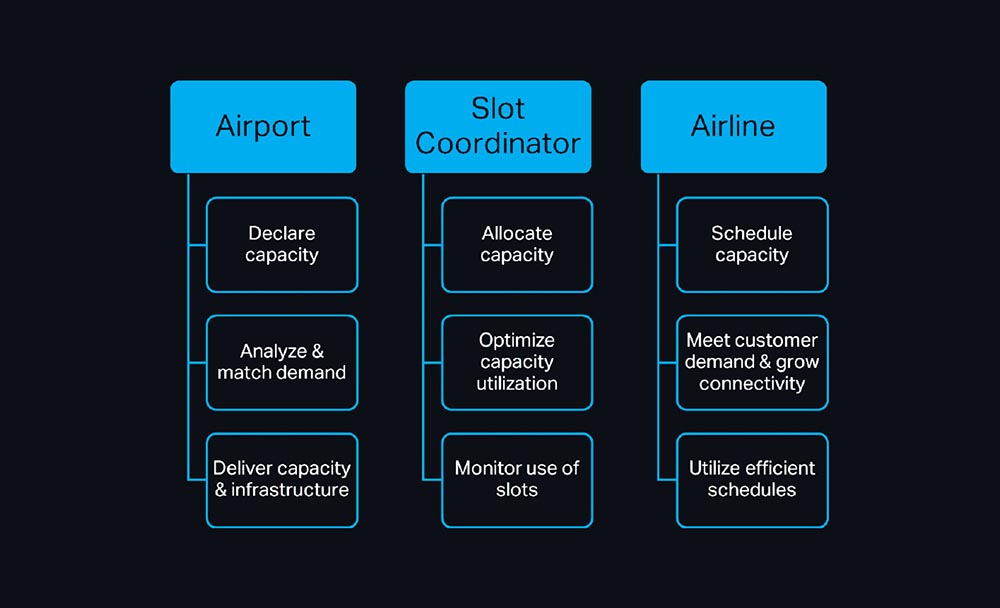
How Slot Coordination Works
Slot allocation follows international rules so that all operators are treated fairly. The IATA Worldwide Airport Slot Guidelines (WASG) set global standards: they require that slots at coordinated airports be allocated in an open, fair, transparent and non-discriminatory manner by an independent coordinator.
Each slot coordinator uses published schedules, historic rights and capacity data to distribute available takeoff and landing times among airlines and operators. Because this process is done well before flight day, a slot serves as a planning tool (the schedule is fixed in advance); on the day of operation, traffic control uses other measures (e.g. flow management) to sequence flights. Slots carry obligations. If you request a slot and it is granted, you are expected to use it.
The WASG enforces a “use-it-or-lose-it” policy. In other words, if an aircraft holds a slot but then fails to fly without timely cancellation, that operator can lose the slot or face penalties. This discourages operators from holding slots they do not intend to use.
Types of Slots: Seasonal vs Ad-Hoc
Slots can be seasonal (series) slots or ad-hoc slots. Seasonal slots are for flights that repeat regularly (for example, daily or weekly) during an established schedule (summer or winter season). An operator submits its series of flights for the season, and if approved, those slots become part of the airport’s published schedule. In future seasons, a consistently-used series slot can carry over as a historic slot, simplifying the process of retaining it.
Ad-hoc slots cover one-off or irregular flights (charters, special missions, etc.). Coordinators are required to process all ad-hoc slot requests from any operator, but these are handled after the seasonal schedules are set. In practice, coordinators slot the regular series first and then assign remaining capacity to ad-hoc flights. Importantly, ad-hoc slots have no automatic priority in the next season; they are not eligible for historic precedence, so each ad-hoc flight must request a slot anew each time.
There are exceptions for urgent cases. If a flight is truly time-critical, slot offices may consider it outside the normal timetable. The WASG notes that coordinators “may need to consider ad hoc requests before the series return deadline” to give operators enough notice.
Slot Scheduling Calendar and Deadlines
Coordinated airports follow an annual calendar of slot activities. Airlines and operators must submit their schedules by published deadlines. For example, the coordination calendar for Northern Winter 2025/26 shows an Initial Submission Deadline of 15 May 2025 and a season start of 26 October 2025. Operators needed to submit their slot requests by mid-May to operate in late October. Missing these deadlines usually means waiting for the next season.

Step-by-Step: Requesting an Airport Slot
- Determine if a Slot is Required: Check if your destination (and any coordinated alternate) is slot-controlled (Level 3). A coordinated airport requires a slot for every flight. If a slot is needed, you must secure it before filing flight permits.
- Identify the Slot Coordinator: Find the official slot coordination office or authority for that airport. Contact information is published by the airport or national aviation authority (IATA’s WASG Annex 12.7 contains a global directory). Just Aviation assists operators by coordinating slot requests directly with the official airport slot coordinator to ensure timely and compliant processing.
- Prepare Flight Details: Gather all necessary information: date, aircraft registration/type, departure and arrival points, requested arrival/departure times, passenger count or cargo info, and any special remarks. Accurate information helps the coordinator evaluate your request against capacity.
- Submit the Slot Request: Use the prescribed format. Commonly, slot coordinators accept IATA SSIM-format messages: scheduled flights use a Schedule Clearance Request (SCR) with 3-letter IATA codes, while general aviation flights use a General Coordination Request (GCR) with 4-letter ICAO codes. Send the request to the slot coordinator (usually by email or through an online portal), including all relevant flight legs and the nature of the flight (e.g. “ad-hoc charter”).
- Receive and Confirm the Slot: The coordinator will respond with a slot assignment, an alternate suggestion, or a waitlist notice. If an exact time is unavailable, they may provide the nearest available slot. Always reply promptly. Once the coordinator confirms a slot, treat it as final; do not operate outside that time without permission. (Flight permits and overflight approvals will typically require proof of a confirmed slot.)
- Finalize and Follow-Up: With a slot confirmed, you can arrange any remaining permits, ground handling or parking. If your plans change, immediately notify the coordinator to modify or cancel the slot. Canceling unused slots early frees capacity and helps avoid penalties.
Key Considerations and Best Practices
- Give Adequate Notice: Apply as early as the rules allow (often 48–72 hours minimum, but sometimes longer). Last-minute requests may be denied if capacity is tight.
- Be Flexible: Especially for ad-hoc flights, list alternate acceptable times or dates. Flexibility greatly increases the chance of securing a slot.
- Historic Rights Only for Series: Only recurring series flights can gain historic precedence; one-off flights must request from scratch each time.
- Coordinate Across Airports: If both departure and arrival are slot-controlled (or if you plan a stop), secure slots for each segment before scheduling.
- No-Show Penalties: Don’t book a slot and then cancel at the last minute or fail to use it without notice. Slot misuse can lead coordinators to revoke your slot privileges.
- Follow Local Rules: Some airports impose special restrictions (night curfews, charter quotas, security requirements, etc.). Always check the local slot coordinator’s guidelines or airport notices for any additional procedures.
Operational Insights with Different Scenarios
These scenarios illustrate the key steps: in each case, Just Aviation worked through the official coordinator and followed the published procedures. By communicating early and clearly, Just Aviation ensures that urgent needs, scheduled series, or last-minute adjustments are efficiently managed within the slot system.
Urgent Flight to a Busy Airport
Needing to attend a last-minute meeting in City B (a slot-controlled hub) within 48 hours, an operator immediately sends an ad-hoc slot request to City B’s coordinator, explaining the urgency. The coordinator flags it for rapid handling. Under the WASG, urgent flights may be granted slots outside the normal cycle. Within a few hours, the coordinator allocates the next available slot that meets the need. The operator then secures necessary permits and the jet departs on schedule.
Planning for a Major Event
Preparing for an annual conference taking place in City C next winter, a charter operator expects to fly VIPs there every week for two months. To secure slots, the operator treats these flights as a seasonal series. Six months in advance, a schedule (SCR) listing all weekly flights for the coming winter is submitted. During seasonal coordination, the slot coordinator allocates the requested slots, adjusting times slightly as needed to fit. Because this is done well before the season, the operator secures the slots early. Once confirmed, the operator arranges all permits and handling in advance, ensuring smooth operations throughout the event.
Last-Minute Schedule Change
A private jet has a confirmed slot to depart City D at 10:00 on Monday. On Friday, the passenger’s meeting was moved up, and the flight must now leave at 08:30 on Monday. The operator immediately emails City D’s coordinator, canceling the 10:00 slot and requesting 08:30 instead. If 08:30 is available, a new slot is granted (the 10:00 slot is released). If not, the coordinator provides the nearest available time (e.g. 08:20 or 08:45) and the operator accepts the closest fit. The operator then updates the flight plan and permits for the new slot time. This example shows why prompt re-coordination of any schedule changes is essential.
FAQs
1. What exactly qualifies a series of slots for historic precedence and what usage level must it meet?
A series is a recurring set of slot operations at approximately the same time on the same day-of-week across a season (WASG defines the minimum number of occurrences required for a series).
To retain historic precedence for the next equivalent season, a series must meet the WASG usage threshold: series are typically required to be operated at or above the WASG “use-it-or-lose-it” threshold (commonly referenced as the 80% rule for the series). Coordinators publish precise calculations and how cancellations, changes outside tolerance, and force majeure are treated when determining whether the 80% requirement has been met.
2. How do coordinators monitor slot use and what operator data is used?
Coordinators rely on operational timestamps and collaborative systems (A-CDM / airport Datalinks) such as the Estimated Off-Block Time (EOBT) and Target Off-Block Time (TOBT). If actual movement times deviate systematically outside tolerance windows, the coordinator flags that series for review and possible enforcement.
Automated A-CDM feeds and NM/EUROCONTROL messages are frequently used to cross-check planned versus actual timings. Operators should therefore ensure their EOBT/TOBT updates are timely and accurate to avoid being flagged by monitoring routines.
3. If I must change aircraft registration, flight number or slightly alter routing, can I keep the same slot?
WASG states that slots are not inherently tied to a specific route, aircraft type or flight number; changes are possible but require coordinator confirmation. In practice, substitutions (changing registration, flight number or minor routing adjustments) must be notified promptly; the coordinator confirms whether the amended operation still fits the allocated capacity and whether historic-rights status is preserved. Different coordinators may have local rules on how late a substitution is accepted and when a fresh request is required, so always obtain written confirmation.
4. What are common grounds for slot misuse enforcement and what are the likely consequences?
Coordinators define slot misuse to include repeated no-shows, consistent operation outside the tolerance window without re-coordination, and holding slots while knowingly preventing effective capacity use.
Monitoring reports are provided to oversight bodies and regulators; enforcement frameworks now exist in many jurisdictions that can escalate from warnings to withdrawal of historic precedence, temporary suspension of slot privileges, or administrative sanctions (local enforcement codes specify remedies). Operators should treat slot confirmations as firm commitments and cancel early if plans change.
5. How are slots handled during major network disruptions or when exceptional priority is needed?
During widespread disruption or special circumstances, coordinators and regulators may activate contingency measures (temporary rule changes, prioritized re-allocation, or special ad-hoc processing).
WASG and subsequent guidance allow coordinators to give priority to certain newly allocated series or urgent ad-hoc requests under clearly defined transition or crisis rules; but these measures are controlled, time-limited and usually require the operator to submit requests before published deadlines to be considered. In short: exceptional handling is possible but follows formal crisis/transition protocols.
6. For a multi-leg business-jet mission (turn + parking), how should I plan slot spacing and turnaround?
Slot allocation should reflect realistic turnaround buffer and apron availability. Coordinators and airports increasingly use A-CDM metrics (TOBT/TTOT) to manage gate/apron sequencing; if your turn is too tight relative to the airport’s minimum turnaround or the airport’s A-CDM thresholds, the coordinator or handling agent may refuse or request an amended slot pair. Plan for conservative buffers, include ground-handler confirmation alongside slot confirmation, and update TOBT/EOBT promptly when the operation changes to keep A-CDM sequencing accurate.
7. Can an operator apply for temporary exemptions from the use-it-or-lose-it rule (justified non-utilisation)?
Yes, many jurisdictions have formal mechanisms (sometimes called Justified Non-Utilisation or JNUS) that allow operators to seek exemption from historic-use requirements for defined reasons (e.g., regulatory action, extraordinary events).
The justification must be documented and submitted per the coordinator/regulator process; national legislation or guidance documents set the local test and timeline for JNUS requests. Don’t assume automatic relief; submit JNUS requests through the coordinator or regulator channel with supporting evidence as early as possible.
This comprehensive guide demystifies the intricate process of airport slot coordination for global operators, offering clear insights into each procedural stage. With effective strategies for slot coordination in flight operations, Just Aviation can achieve precise scheduling, seamless coordination, and unwavering compliance with international slot allocation standards, ensuring punctual, efficient, and disruption-free operations even at the world’s most congested airports.
Sources
- https://www.aci-europe.org/downloads/resources/ACI%20EUROPE%20Slots%20Position%20Paper%202025.pdf
- https://www.iata.org/contentassets/3fc4569936dd4b9eae3c3e5d09fae86e/iata-slots-white-paper-december-2024.pdf
- https://www.iata.org/en/programs/ops-infra/slots/
- https://www.iata.org/en/programs/ops-infra/slots/slot-guidelines/
- https://www.iata.org/contentassets/4ede2aabfcc14a55919e468054d714fe/wasg-edition-3-english-version.pdf
- https://www.iata.org/contentassets/c1d7626d7175462ab0fc527c9e2937ce/calendar-coordination-activities.pdf
- https://www.faa.gov/about/office_org/headquarters_offices/ato/service_units/systemops/perf_analysis/slot_administration/slot_allocation_process
- https://www.iata.org/globalassets/iata/programs/covid/2023/iata-airport-slots-submission-eu-study-steer-dec-2019.pdf


 +971 4 5855 689