
FAA AC 90 100A Guidance on RNAV Operations and Business Jet Compliance

11 February 2026
| By Just Aviation TeamModern business aviation increasingly depends on RNAV-based infrastructure. According to FAA data, more than 70% of U.S. IFR departures and arrivals now rely on RNAV procedures, while most high-altitude routes are RNAV-defined. Understanding FAA AC 90-100A is therefore critical for operators to maintain access, predictability, and regulatory compliance across daily operations. Failure to meet RNAV compliance standards can result in loss of preferred routings, increased ATC vectoring, and measurable fuel and time penalties. For business jet operators, regulatory alignment with AC 90-100A directly influences schedule reliability, cost control, and network accessibility.
What is FAA AC 90 100A & Its Importance
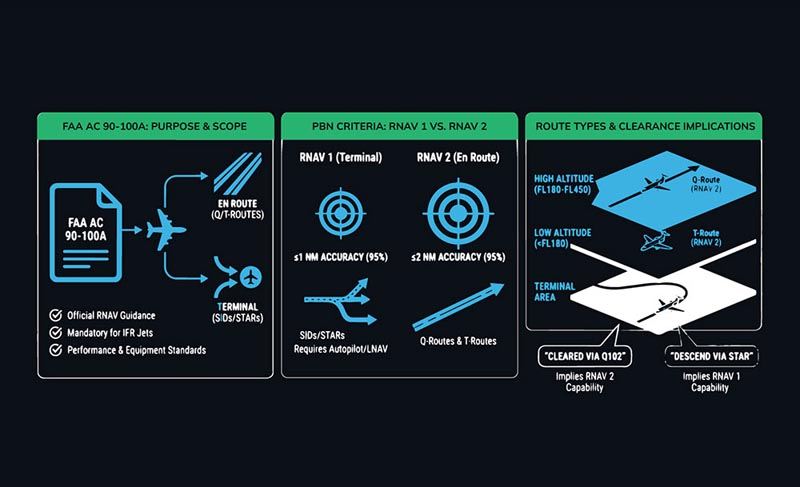
FAA Advisory Circular (AC) 90-100A is the official FAA guidance for operating on U.S. RNAV routes and procedures. It provides operational and airworthiness criteria for flying published RNAV airways (Q-/T-routes) and RNAV terminal procedures (SIDs/STARs). In short, any business jet flying IFR in U.S. airspace on Area Navigation (RNAV) routes or RNAV departure/arrival procedures must meet the performance and equipment standards set by AC 90-100A.
This AC does not change regulations, but clarifies how to comply with them when using RNAV. Notably, all U.S. RNAV fixes and routes are defined in WGS‑84 coordinates, and procedures rely on global navigation (Global Navigation Satellite System (GNSS) or Distance Measuring Equipment (DME) / Inertial Reference Unit (IRU)) instead of ground navaids.
RNAV (“Area Navigation”) allows an aircraft to fly any desired track by reference to onboard sensors (GPS, DME, INS) rather than flying from VOR to VOR. AC 90-100A adopts ICAO’s Performance-Based Navigation (PBN) criteria: it specifies RNAV 1 (95% accuracy ≤1 NM) for terminal procedures (SIDs/STARs) and RNAV 2 (95% ≤2 NM) for en route Q- and T‑routes. In practice, US RNAV SIDs/STARs are flown to RNAV 1 standards, and RNAV routes are RNAV 2 unless a chart explicitly states RNAV 1.
- RNAV 1 – ≤1 NM error 95% (used on RNAV DPs/STARS); typically requires autopilot or flight-director LNAV mode.
- RNAV 2 – ≤2 NM error 95% (used on RNAV en-route Q/T/Y-routes).
Published RNAV airways are depicted in blue on FAA IFR charts and identified by “Q” or “T” plus a number (e.g. Q13, T205). For example, Q‑routes (RNAV‑2) are available from FL180 up to FL450, while T‑routes (RNAV‑2) are available below FL180 (typically from 1,200 ft AGL up to FL180). (There are also Y‑routes in offshore areas.) RNAV SIDs and STARs always require RNAV 1 accuracy. Business jets planning IFR flights should be aware that a clearance such as “CLEARED VIA Q102” implies RNAV 2 capability, whereas an RNAV DEP/STAR clearance (e.g. “DESCEND VIA STAR”) implies RNAV 1.
RNAV Equipment and Certification
Business jets must have FAA‑approved RNAV avionics that meet AC 90-100A performance. Typically this means a GPS or Wide Area Augmentation System (WAAS) receiver and an IFR-capable FMS, or a Distance Measuring Equipment (DME) (with IRU) RNAV system that meets FAA criteria. In general:
GNSS (GPS/WAAS)
Any certified GPS (TSO‑C129/C129a) or WAAS (TSO‑C145a/C146a) sensor paired with an IFR-approved FMS (TSO‑C115a/b) satisfies RNAV 1/2 requirements. In fact, AC 90-100A explicitly lists typical compliant installations: e.g. “Aircraft with TSO‑C129/C129a and TSO‑C115b FMS … for IFR use IAW AC 20‑130A” are compliant. WAAS (SBAS) systems likewise meet the criteria when installed with an IFR FMS. These systems usually include Receiver Autonomous Integrity Monitoring (RAIM) or SBAS fault detection to ensure integrity.
DME/DME (±IRU)
Older RNAV may use DME pairs (with or without an Inertial Reference Unit). Appendix 1 of AC 90-100A defines the minimum DME/DME standards (e.g. dual-frequency DMEs, accuracy, updating, reasonableness checks). If the aircraft has DME/DME+IRU RNAV (with Appendix 2 performance), it may also be used. (In practice, modern jets rely on GPS; purely DME/IRU RNAV often requires special evaluation.)
Importantly, when using DME, the FAA publishes a Critical DME list: any DME marked critical means loss of that DME compromises RNAV. For example, “terminal RNAV DPs and STARs may be published with only two DMEs, in which case both are critical”. Pilots must monitor NOTAMs for critical DME outages and plan alternates if needed.
Aircraft eligibility is often documented in the AFM/POH. AC 90-100A notes that an AFM (or avionics manual) statement of AC compliance means the aircraft meets the RNAV criteria. European “P‑RNAV” approvals (EU RNAV‑2) based on GPS are accepted, but any DME-based P‑RNAV must still satisfy the FAA’s Appendix 1/2 requirements. In short, operators should verify their aircraft’s type certificate or STC lists RNAV‑1/2 capabilities, and refer to FAA guidance (the AFS-410 avionics list) to confirm compliance.
Operator Procedures and Documentation
AC 90-100A outlines what operators must do to fly RNAV procedures. Part 121/135 carriers need an FAA RNAV authorization (OpsSpec C063 or Management Spec). Part 91 (private/corporate) operators do not need an LOA or OpsSpec, but must still comply with the AC’s standards internally. Key requirements include:
- Equipment List: Maintain a configuration list of all RNAV-capable equipment on the aircraft. Have documentation (manufacturer data, STCs) proving each system meets AC 90-100A criteria. FAA posts compliance lists for avionics.
- Flight Manuals: Ensure the AFM/POH or avionics manual contains a statement or supplement authorizing RNAV-1/2 and specifying required equipment. If necessary, install updated AFM supplements.
- Procedures & Checklists: Standard Operating Procedures (SOPs) and checklists must cover RNAV operations (programming FMS, verifying fixes, failure procedures). Commercial operator manuals must describe the procedures in AC §10. Part 91 operators should train crews on those same items.
- Training: Crews (and dispatchers) need training on RNAV operations per AC §11. This includes programming RNAV SIDs/STARs, understanding RAIM alerts, deviation monitoring, and contingency actions. Training may be embedded in existing IFR training.
- Maintenance/MEL: Update the MEL if needed to address RNAV equipment. For example, if RNAV departure planning depended on a specific INS or GPS, the MEL should make that a dispatch item.
Flight Planning and Preflight Actions
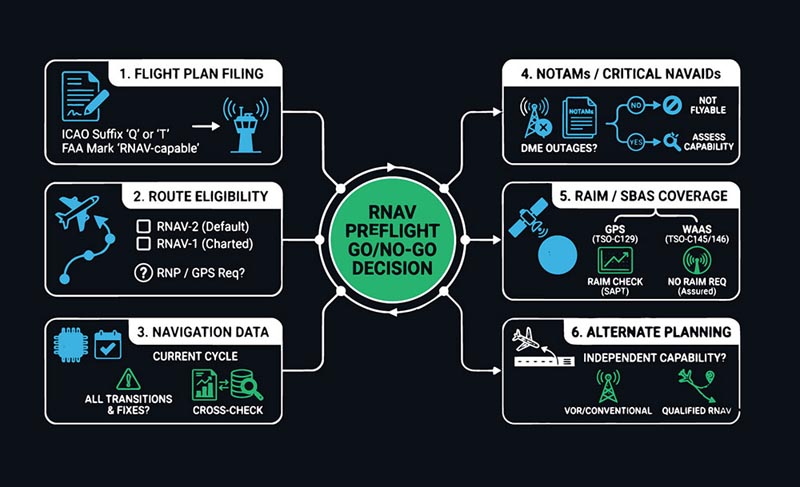
Before any RNAV operation, planners must ensure regulatory compliance and system readiness:
Flight Plan Filing
Include the RNAV suffix codes per the AIM. (For example, use the “Q” or “T” suffix on an ICAO flight plan, or mark the RNAV-capable box on FAA forms.) This lets ATC know you intend RNAV route usage.
Route Eligibility
Verify the assigned route/procedure is allowed with your equipment. For en route RNAV (Q/T routes), the FAA AIM notes that “Published RNAV routes… can be flight-planned for use by RNAV-capable aircraft”. Confirm whether the route is RNAV-2 or RNAV-1 as charted (default RNAV-2). If any segment requires RNP (rarely in the U.S. en route) or GPS, ensure those systems are certified.
Navigation Data
Ensure the onboard nav database is current and valid for the flight’s entire route. RNAV SIDs/STARs often have multiple runway transitions or fixes: the database must include all of them. The AC warns that if a STAR has multiple runway transitions and the database lacks them, do not file or accept that clearance. In practice, check that your AIRAC cycle covers the DP and STAR in your plan; if not, delay dispatch until charts catch up or omit that procedure. A prudent operator cross-checks the database against current charts (compare fixes, waypoints, altitudes) to catch errors.
NOTAMs/Critical NAVAIDs
Check NOTAMs for any navigation outages. In particular, AC 90-100A and the AIM emphasize critical DMEs on RNAV procedures. For example, a STAR might rely on two DMEs; both are then “critical”. If a NOTAM says one DME is out, the procedure may not be flyable. The AC advises: “Pilots should assess their capability to navigate (potentially to an alternate) in case of failure of critical DME while airborne.”
RAIM/SBAS Coverage
If using GPS (TSO‑C129/WAAS) as primary, run a RAIM prediction for the planned time and route. FAR 91.187 and AC 90-100A require verifying that GPS constellation geometry provides integrity. FAA provides RAIM prediction tools (SAPT) and NOTAMs for satellite outages. If a RAIM outage >5 min is predicted on any portion, AC 90-100A says “the flight should be delayed, canceled, or re‑routed”. (By contrast, if you have WAAS/LPV (TSO‑C145/146) and WAAS coverage is assured en route, no RAIM check is needed.)
Alternate Planning
Ensure legal alternate airports have required navigation capability (e.g. VOR or another RNAV solution). If the flight’s destination uses an RNAV approach or an RNAV STAR, the alternate must be reachable with available navaids (or GPS/WAAS qualified).
Operational Examples
Long-Range RNAV Route
A Gulfstream G650 departs from Seattle (KSEA) to Miami (KMIA) at FL350. ATC clears the flight via “Q65 Q4” (fictitious example). Before departure, the flight planner confirms the G650’s GPS/WAAS meets RNAV‑2. They file the IFR flight plan with the “Q” suffix (RNAV‑2), and run the RAIM prediction tool for the planned times on Q65/Q4. RAIM shows only 3-minute outage segments (acceptable).
The crew ensures the navigation database is on the latest Aeronautical Information Regulation And Control (AIRAC), checks that Q65/Q4 waypoints are loaded, and verifies no critical DMEs are out via NOTAMs.In flight, the autopilot stays in LNAV mode; the lateral deviation remains well within the 2 NM tolerance. When approaching Miami, a published RNAV STAR (RNAV‑1) is loaded by name. The crew switches to LNAV, tracks the STAR (±0.5 NM), and flies a “Descend via STAR” clearance precisely.
RNAV SID into Busy Airport
A Citation X departs Dallas (KDFW) for Denver (KDEN) on an RNAV SID. The clearance is “RADFR7 departure” (an RNAV‐1 SID). The crew programs RADFR7 by name, checks the depicted FMS plan against the chart, and confirms “DALLAS RWY 17” is selected. On the runway, they verify the overhead nav display shows the runway and first waypoint in proper geometry.
After takeoff, they engage LNAV (autopilot) for the RNAV path and monitor the deviation indicator. Because RADFR7 is RNAV‑1, they must remain within 1 NM (95%). If a GPS failure occurred, they would immediately report “Unable RNAV” as per the procedure and the controllers would vector them via VOR.
DME-Based RNAV
A legacy business jet, not GPS-certified, flies a southern route using DME/DME/IRU. They plan via a low-altitude RNAV (T-route) that is RNAV‑2. The crew checks the AC 90-100A “Critical DME” list: it shows that on the intended RNAV DP, two DMEs are required and are currently healthy.
However, a NOTAM later shows DME–7 is out. Because only two DMEs define that procedure, one is now missing. The crew realizes they cannot safely fly the RNAV DP using only one DME. They file an alternate departure (e.g. a conventional SID) to avoid the procedure. This illustrates why AC 90-100A urges checking DME NOTAMs and having alternate plans.
FAQs
1. Does FAA AC 90-100A apply to private (Part 91) business jet operations?
Yes. While Part 91 operators do not require formal FAA authorization, they must still meet all AC 90-100A equipment, performance, and procedural standards when operating on RNAV routes, SIDs, or STARs in U.S. airspace.
2. Is RNAV compliance aircraft-based or operator-based?
RNAV compliance is aircraft-based but supported by operator procedures. The avionics installation must meet RNAV accuracy requirements, while the operator is responsible for correct documentation, navigation database currency, crew procedures, and operational monitoring.
3. Can an aircraft approved for RNAV 2 automatically fly RNAV 1 procedures?
No. RNAV 1 requires higher lateral accuracy and operational monitoring than RNAV 2. Aircraft and procedures must specifically support RNAV 1, including appropriate flight guidance modes and documented authorization.
4. How does AC 90-100A address navigation database integrity?
The guidance requires operators to ensure the navigation database is current, validated, and compatible with published RNAV procedures. Operators must not fly RNAV procedures if required waypoints, transitions, or altitude constraints are missing or mismatched.
5. Are mixed navigation sensor operations permitted under AC 90-100A?
Yes. Aircraft may use multiple sensors such as GNSS, DME/DME, or inertial systems, provided the integrated RNAV system continuously meets the required accuracy and integrity performance throughout the intended operation.
6. What operational action is required if RNAV performance degrades in flight?
If the RNAV system no longer meets accuracy or integrity requirements, the crew must immediately advise air traffic control and request an alternate clearance using conventional navigation or radar vectors.
7. Does AC 90-100A impose specific maintenance or MEL requirements?
Indirectly. Operators must ensure RNAV-critical equipment is addressed in the MEL, and any deferred items do not compromise RNAV capability for the planned route or procedure.
8. How does AC 90-100A impact dispatch and flight planning decisions?
Dispatch must verify RNAV capability aligns with planned routes, altitude structure, and procedures. Inadequate RNAV compliance may require alternative routing, increased fuel planning, or exclusion from certain RNAV-dependent flows.
For business jet operators navigating increasingly RNAV-dependent airspace, regulatory clarity and operational readiness are no longer optional. Effective compliance with FAA AC 90-100A depends on coordinated planning, accurate documentation, and proactive operational oversight. At Just Aviation, we support business flight operations by translating RNAV regulatory requirements into practical, compliant, and reliable day-to-day operational planning.
Sources
- https://www.faa.gov/regulations_policies/advisory_circulars/index.cfm/go/document.information/documentID/73482
- https://www.faa.gov/documentLibrary/media/Advisory_Circular/AC_90-100A.pdf
- https://www.faa.gov/air_traffic/publications/atpubs/aip_html/part2_enr_section_3.3.html
- https://www.faa.gov/air_traffic/flight_info/aeronav/criticaldme/


 +971 4 5855 689