
Turkmenistan Overflight Permits: Direct Operator Submission and Documentation Requirements

08 November 2026
| By Just Aviation TeamA flight through Turkmenistan requires careful coordination between the operator’s proposed route, permit application and departure preparation. The application must describe the actual operation, while the issued permission must be checked against the flight the crew intends to conduct.
Before submitting a request, operators should establish the accepted application channel, who must send the correspondence and which supporting documents are required. These details are particularly important where direct operator communication is requested and a trip-support provider assists with preparation separately.
Just Aviation helps operators organize flight information, review documentation and coordinate the surrounding itinerary while respecting the authority’s applicable submission instructions.
Planning a route through Turkmenistan? Our flight permit support services can help identify the information and confirmations needed before departure.
Key Takeaways
- Who must submit the application and manage authority correspondence?
- Which application form and supporting documents apply to your operation?
- Do the requested entry point, exit point and timings match the intended route?
- Has the applicable notice period been confirmed before fixing the schedule?
- Which changes require coordination after permission is issued?
- How can Just Aviation support preparation when the operator must file directly?
What Should Operators Confirm Before Applying?
Start by obtaining current application instructions for the intended flight category.
Turkmenistan’s published aviation framework establishes permission requirements for international operations. The authority-linked AIP GEN 1.2 addresses entry, transit and departure procedures, including non-scheduled flights.
Before relying on an existing checklist, confirm:
- The accepted submission channel.
- Whether the operator must send the request directly.
- Whether third-party representatives may participate in correspondence.
- The applicable form and document package.
- Required notice and processing arrangements.
- The procedure for amendments and movement notifications.
Keep the instructions received with the application record. If they differ from older published material, resolve the difference before treating the request as ready for submission.
How Should Direct Operator Submission Be Managed?
Where the authority requires direct submission, assign responsibility to a named person within the operating organization.
The operator should control the application correspondence, monitor replies and provide requested clarifications. Confirm which operator address is acceptable and whether restrictions apply to copied recipients.
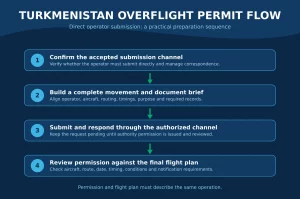
A practical division of work is:
| Task | Recommended Responsibility |
|---|---|
| Assemble aircraft and flight information | Operator, assisted by its appointed support team where agreed. |
| Check consistency and identify missing items | Operator and documentation-support team. |
| Send the formal application | The party permitted by current authority instructions. |
| Respond to authority questions | The authorized applicant through the accepted channel. |
| Review the issued permission | Operator, with planning assistance where required. |
| Update the wider itinerary | Operator and relevant service providers. |
Preparation assistance should not be confused with authority representation. If direct correspondence is required, a provider should not assume it may submit or remain copied simply because it helped assemble the documents.
Which Flight Details Belong in the Application?
Build the request around a complete, internally consistent movement brief.
The published Form 1 identifies information including aircraft registration state, aircraft type and registration, maximum take-off weight, flight number, operating date, adjacent airports, airspace entry and exit details, route, flight purpose, operator information, payment method and cargo particulars.
For practical preparation, organize the information as follows:
| Application Area | Details to Check |
|---|---|
| Operator | Correct legal identity and operating organization. |
| Aircraft | Type, registration and relevant aircraft particulars. |
| Movement | Flight identification, date and complete schedule. |
| Routing | Proposed entry point, route through Turkmenistan and exit point. |
| Timing | Consistent departure, entry, exit and onward-arrival estimates. |
| Purpose | Accurate description of the operation. |
| Persons or cargo | Information and declarations required for the flight category. |
| Administration | Requested supporting records and payment information. |
Separate estimates from confirmed details during preparation. Before submission, establish which items must be final.
What Supporting Documents Should Be Prepared?
Obtain the current document checklist rather than assuming every operator must submit the same package.
Documents to have available for review may include:
- Air Operator Certificate, where applicable.
- Evidence of aircraft ownership where requested.
- Aircraft registration certificate.
- Certificate of Airworthiness.
- Aircraft insurance documentation.
- Other certificates or declarations requested for the operation.
This is a preparation list, not a statement that every item is mandatory for every flight. Confirm which documents must accompany the application and which are required only on request.
Check validity dates, aircraft identification and operator names. Where ownership and operational control involve different organizations, prepare a clear explanation supported by the relevant records.
Do not assume that an AOC and proof of ownership are interchangeable. Establish what evidence the authority requires for the particular applicant.
How Should the Route Be Prepared?
The permit request should reflect the route the operator genuinely intends to fly.
Before applying, check the proposed entry and exit points, available ATS routing, expected timings and the surrounding airspace requirements. The operator’s flight-planning team must assess operational suitability and current restrictions.
Avoid using an old route simply because it supported a previous approval. Changes elsewhere in the itinerary can alter the timing or direction of transit through Turkmenistan.
Coordinate the full journey through a single working brief. Just Aviation’s trip planning services can support the connection between route preparation, permit enquiries and services at other stops.
How Much Time Should Be Allowed?
Confirm the applicable minimum notice and processing arrangements before committing to the flight.
Distinguish between:
- The latest permitted submission time.
- The period during which requests are reviewed.
- Time needed for document questions.
- Time available to assess alternatives if approval is unresolved.
A minimum notice period is not an approval guarantee. A request submitted before a weekend or holiday may also require a different planning margin from one submitted during normal processing activity.
Avoid relying on an assumed urgent service. If the schedule is compressed, establish whether the request can be considered before presenting the route as available.
The flight brief should identify the application as pending until the required permission has been received and reviewed.
How Should Special-Purpose Flights Be Assessed?
Declare the actual purpose and relevant characteristics of the operation.
Government, diplomatic, military-related, dangerous-goods and other special-purpose movements may require a separate authorization assessment. Do not treat them automatically as routine business aviation overflights.
Provide accurate information about the persons and cargo carried. If the application asks for a positive or negative declaration, obtain the information from the responsible operator or shipper rather than infer the answer.
Raise unusual circumstances early. Additional review discovered shortly before departure can affect both the preferred route and the alternatives.
What Must Be Checked When Permission Is Received?
Review the complete approval rather than recording only its reference number.
Check the permission against:
- Operating organization.
- Aircraft registration and type.
- Flight identification.
- Date and accepted timings.
- Authorized routing.
- Flight purpose.
- Conditions, validity and notification requirements.
Resolve discrepancies before departure. An approval containing a different aircraft or route should not be assumed to cover the intended operation.
Make the relevant conditions available to the crew and dispatch team. Keep a clear distinction between a request acknowledgement, a clarification exchange and issued permission.
How Should the Permit Connect with the Flight Plan?
The permit and flight plan should describe the same operation.
The published AIP addresses flight-plan submission following permission and specifies inclusion of the permission number in Item 18. Operators should verify the applicable filing instructions and any subsequent authority directions before use.
The final check should compare aircraft identification, route and schedule across the permit record and operational flight plan.
Filing a flight plan does not resolve a missing permission or an unaccepted amendment. Likewise, receiving an overflight permit does not remove other flight-planning or ATC requirements.
What If the Aircraft, Route or Schedule Changes?
Notify the authorized applicant immediately so the required coordination can begin.
The published AIP requires coordination when flight parameters change after permission has been received.
Changes requiring review can include:
- Aircraft substitution.
- Revised operating date.
- Different entry or exit points.
- Route changes.
- Earlier or later transit.
- A different flight purpose.
- Addition of a landing.
Reference the existing approval and identify the requested changes clearly. Establish whether an amendment or replacement permission is necessary.
Do not interpret a validity provision as unrestricted authority to change every aspect of the operation. Check the conditions and notification requirements attached to the actual approval.
What If the Flight Needs to Land in Turkmenistan?
Treat a planned landing as a separate permission and airport-service assessment. An overflight request should not be assumed to authorize a technical stop. Where a landing is proposed, assess airport acceptance, border formalities, parking, handling and crew requirements.
Just Aviation can coordinate enquiries for ground handling, aviation fuel and crew support within the agreed scope and subject to local confirmation.
A diversion remains an operational matter for the crew and operator under the applicable procedures. Advance contingency planning should identify practical airport options without presenting them as pre-authorized landings.
What Should Operators Do If Approval Remains Pending?
Maintain a clear decision point before departure.
Record the outstanding requirement, the responsible person and the latest authority response. Review whether the intended route remains achievable and what additional permissions an alternative would require.
If the operator selects another route, reassess fuel, flight time, crew implications and affected airport arrangements.
Use one updated operating brief so the crew, dispatch team and supporting providers do not work from different assumptions. Just Aviation’s irregular operations guidance provides related considerations for managing connected changes.
How Just Aviation Supports Turkmenistan Permit Preparation
Just Aviation can assist with the preparation and wider coordination surrounding a Turkmenistan overflight request.
Support can include:
- Organizing the aircraft and itinerary information.
- Reviewing documents for completeness and consistency.
- Identifying submission questions requiring authority confirmation.
- Helping prepare the operator’s application package.
- Reviewing received permission against the proposed flight.
- Coordinating requirements elsewhere on the itinerary.
- Updating supporting arrangements when the plan changes.
Where direct operator submission is required, formal correspondence remains with the operator through the accepted channel.
Send your aircraft details, proposed routing, UTC schedule and flight purpose to [email protected]
Our Operations Control Center can review the requested assistance and identify the information needed for preparation.
Frequently Asked Questions About Turkmenistan Overflight Permits
1. Who should submit the application?
Confirm the current instructions for the intended operation. Where direct operator filing applies, the operator must control the formal submission and authority correspondence.
2. Can Just Aviation help if the operator must apply directly?
Yes. Preparation assistance can include organizing flight information, reviewing documents and helping identify inconsistencies. The agreed support must respect restrictions on formal submission and correspondence.
3. Which application form should be used?
Confirm the current form for the flight category. The published AIP includes Form 1 for non-scheduled transit, but operators should verify whether additional instructions or documents apply.
4. Does every private aircraft operator need an AOC?
Do not assume a commercial operating certificate applies to every private operation. Establish which evidence of operator status or aircraft ownership is required for the applicant.
5. Can the operator rely on a previously approved route?
A previous approval is a reference, not confirmation for a different flight. Check current routing, restrictions and permission requirements for the proposed operation.
6. Is a submitted request enough to proceed?
No. Keep the application pending until the required permission is received and reviewed. An acknowledgement or request for further documents is not the issued approval.
7. What happens if the aircraft registration changes?
Review the permission immediately and seek the required coordination. Do not assume that an approval issued for one aircraft automatically covers a replacement.
8. Does an overflight permit authorize a technical landing?
Do not assume so. A planned landing requires its own permission assessment and airport arrangements, including applicable handling and border procedures.
Disclaimer
This article provides general operational planning guidance. Confirm the current submission procedure, documentation, notice periods and approval conditions directly with the responsible authority before applying. Overflight permission does not replace flight-plan requirements, ATC clearance or separate landing authorization. Operational decisions remain with the aircraft operator and flight crew.
Conclusion
Turkmenistan overflight preparation requires a consistent application, an accepted submission process and careful review of the resulting permission. Establishing responsibilities early and coordinating changes before departure helps operators keep the approved operation aligned with the flight they intend to conduct.


 +971 4 5855 689