
Strategies for Dealing with Irregular Operations (IROPs) in Aviation

16 January 2026
| By Just Aviation TeamIROPS (Irregular Operations) in aviation refers to any unplanned disruption that prevents flights from operating as scheduled, including delays, cancellations, diversions, and crew-related disruptions. A single thunderstorm, unexpected maintenance issue, or air traffic restriction can disrupt hundreds of flights within hours, affecting aircraft, crews, airport operations, and passengers across an airline’s network.
What is IROPs in aviation? Airline irregular operations (IROPs) refer to any unplanned disruption that causes flight delays, cancellations, diversions, missed connections, or schedule changes. Common causes include severe weather, aircraft maintenance issues, crew shortages, airport closures, and security incidents. Effective IROPs management helps airlines restore normal operations quickly, reduce operational costs, maintain regulatory compliance, and minimize the impact on passengers.
What Happens During an IROPS Event?
IROPs is an aviation industry term used to describe situations where scheduled flights cannot operate as originally planned. The IROP meaning includes any operational disruption that requires airlines to take corrective action, such as reassigning aircraft, replacing crews, updating flight plans, or rebooking passengers.
Examples of IROPs aviation events include:
• Weather-related delays and cancellations
• Aircraft technical problems
• Airspace restrictions imposed by ATC
• Crew duty time limitations
• Airport operational disruptions
• Security or regulatory incidents
The goal of every irregular operations airline response is to minimize disruption while maintaining safety and regulatory compliance.
Common Causes of Airline IROPS
Airlines face a wide range of operational challenges that can trigger airline IROPs events.
| Cause | Operational Impact |
|---|---|
| Severe weather | Delays, cancellations, diversions |
| Aircraft maintenance issues | Grounded aircraft, schedule changes |
| ATC restrictions | Flow control, rerouting, holding |
| Crew shortages | Flight delays or cancellations |
| Airport closures | Diversions and network disruption |
| Security events | Operational restrictions and delays |
According to IATA operational guidance, weather remains one of the leading causes of airline disruptions worldwide. Airlines continuously monitor METARs, TAFs, and severe weather advisories to anticipate operational impacts and activate contingency plans before conditions deteriorate.
Flight delays and cancellations, affecting approximately 20% of global flights due to irregular operations (IROPs), significantly impact travel, with the Federal Aviation Administration (FAA) noting that about 25% of passengers experience disruptions annually. These incidents incur substantial financial burdens, estimated at over $8 billion per year by the International Air Transport Association (IATA), encompassing expenses such as passenger compensation, and operational inefficiencies. Correct strategies and early intervention for irregular operations can eliminate these negative consequences.
How do IROPs Affect Airline Operations?
Because air travel operations are highly interconnected, a disruption in one location can create a chain reaction across the network. A delayed aircraft may affect multiple subsequent flights, crew assignments, gate availability, and passenger connections.
| Operational Area | Impact During IROPS |
|---|---|
| Flight Schedule | Delays, cancellations, diversions |
| Aircraft Utilization | Lower fleet efficiency |
| Crew Scheduling | Duty time limitations and repositioning |
| Passenger Experience | Missed connections and longer wait times |
| Airline Costs | Hotel accommodation, meals, compensation, fuel |
| Regulatory Compliance | Flight planning updates and operational documentation |
This interconnected nature of airline operations is why most airlines invest heavily in Operations Control Centers (OCC), advanced flight planning software, predictive analytics, and contingency planning to improve operational resilience during IROPS.
Why a Structured IROPs Response Matters
Every IROPs event has the potential to disrupt multiple flights, aircraft rotations, crew schedules, airport operations, and passenger itineraries across an airline’s network. A structured IROPs response enables airlines to assess disruptions quickly, coordinate air travel operations efficiently, and make informed operational decisions in real time. By following standardized procedures, airlines can minimize delays, control operational costs, maintain regulatory compliance, and restore normal operations with minimal impact on passengers.
Step-by-Step IROPs Operational Response Process Flow
Effective management of airline irregular operations relies on a structured recovery process that helps airlines detect disruptions, coordinate operational teams, recover aircraft and crews, reroute flights, support passengers, and restore normal operations as quickly and safely as possible. By following standardized response procedures, airlines can reduce delays, control operational costs, maintain regulatory compliance, and minimize the impact on passengers.
During an IROPs aviation event, the OCC coordinates the airline’s response by working closely with flight dispatchers, maintenance teams, crew schedulers, airport operations, ground handlers, and customer service representatives. While every disruption is unique, most airlines follow a similar sequence of operational recovery strategies.
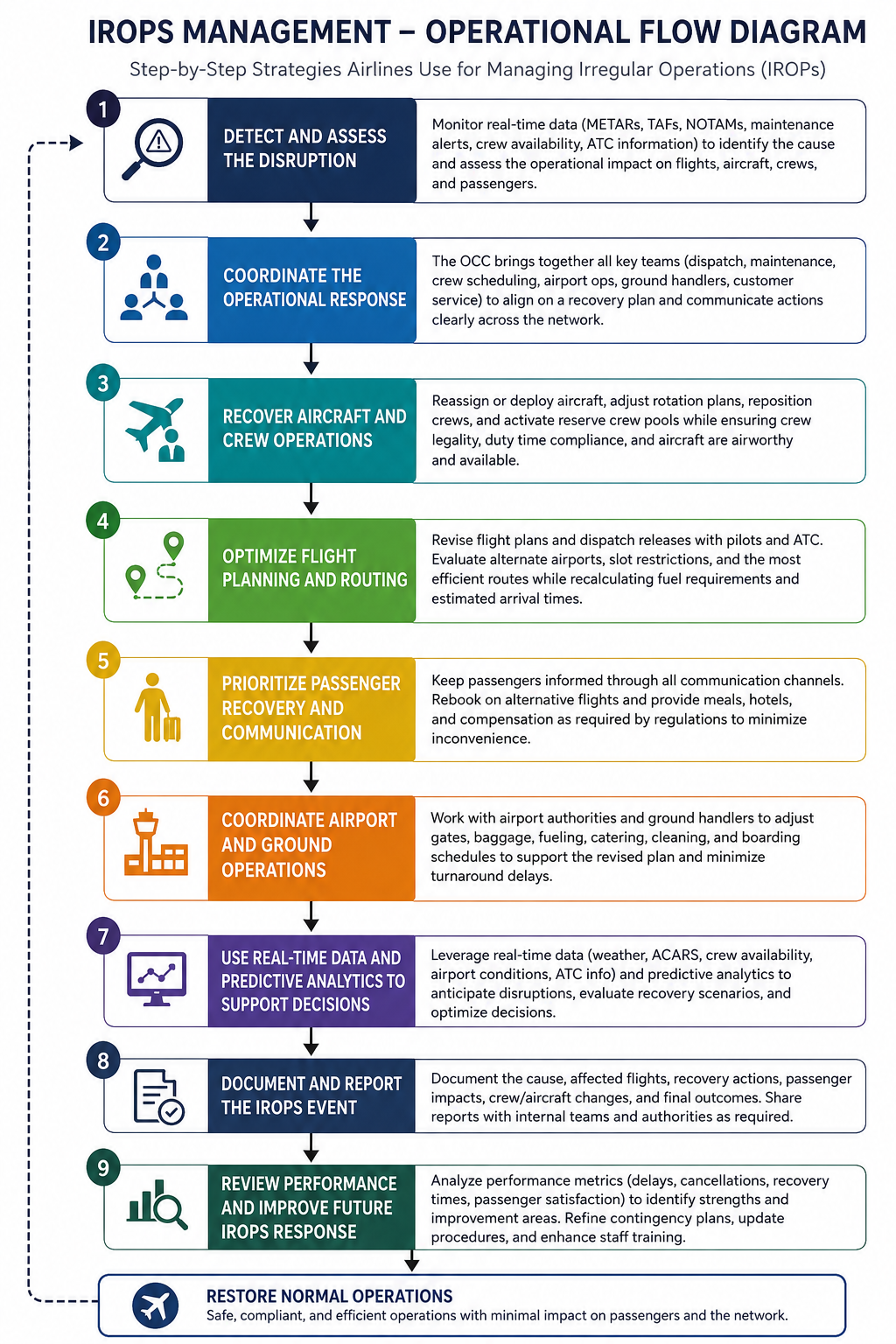
1. Detect and Assess the Disruption
Detecting and assessing the disruption is the first step in effective IROPs management. Airlines use real-time operational data, METARs, TAFs, NOTAMs, aircraft maintenance alerts, crew availability, and air traffic information to identify the cause and evaluate its impact. The OCC quickly determines how the disruption may affect flights, aircraft, crews, and passengers, allowing recovery procedures to begin promptly while maintaining safety and regulatory compliance.
2. Coordinate the Operational Response
Once the disruption has been assessed, the Operations Control Center (OCC) coordinates the airline’s response by bringing together flight dispatchers, maintenance teams, crew schedulers, airport operations, ground handlers, and customer service representatives. Each team works from a shared recovery plan to minimize delays and maintain operational continuity. Clear internal communication and rapid decision-making help airlines respond efficiently while ensuring safety, regulatory compliance, and consistent service across the network.
3. Recover Aircraft and Crew Operations
Recovering aircraft and crew operations is essential to restoring the flight schedule after an IROPs event. Airlines may reassign aircraft, deploy standby aircraft, adjust aircraft rotation plans, reposition crews, or activate reserve crew pools while ensuring crew legality and flight and duty time regulations are maintained. Maintenance requirements and aircraft availability are also considered to ensure every flight can operate safely. Effective aircraft and crew recovery reduces cancellations, limits operational disruptions, and improves overall network resilience.
4. Optimize Flight Planning and Routing
During IROPs in aviation, flight plans are often revised to avoid adverse weather, congested airspace, airport restrictions, or other operational constraints. Flight dispatchers work with pilots and air traffic control (ATC) to revise dispatch releases, evaluate alternate airports, accommodate slot restrictions, and determine the most efficient route while recalculating fuel requirements and estimated arrival times. Dynamic flight planning helps airlines minimize delays, reduce fuel consumption, and maintain safe, compliant operations throughout the disruption.
5. Prioritize Passenger Recovery and Communication
During large-scale weather disruptions, passenger recovery often becomes the airline’s most visible operational challenge. Airlines keep travelers informed through mobile apps, SMS, email, airport announcements, and customer service teams while providing timely updates on delays, cancellations, and revised schedules. When necessary, passengers are rebooked on alternative flights or offered meals, hotel accommodations, and compensation in accordance with applicable regulations. Transparent communication helps reduce uncertainty and improves the overall passenger experience during operational disruptions.
6. Coordinate Airport and Ground Operations
Efficient coordination between airport operations and ground handling teams helps minimize turnaround delays during IROPs. Gate assignments, baggage handling, aircraft fueling, catering, cleaning, and boarding schedules may all need to be adjusted to support the revised flight plan. Close collaboration with airport authorities and service providers ensures aircraft are prepared for departure as quickly and safely as possible, helping airlines restore normal operations more efficiently.
7. Use Real-Time Data and Predictive Analytics to Support Decisions
Modern airlines rely on real-time operational data and predictive analytics to make informed decisions throughout an IROPs aviation event. By analyzing weather forecasts, aircraft status through ACARS, crew availability, airport conditions, and air traffic information, operations teams can anticipate potential disruptions and evaluate multiple recovery options. This data-driven approach enables faster decision-making, improves resource allocation, and reduces the operational and financial impact of irregular operations.
8. Document and Report the IROPs Event
Airlines must document every IROPs aviation event to support regulatory compliance, operational accountability, and future performance analysis. Reports typically include the cause of the disruption, affected flights, recovery actions taken, passenger impacts, crew and aircraft changes, and final outcomes. This information is shared with relevant departments and, when required, with aviation authorities. Accurate documentation enables airlines to identify recurring issues, refine contingency plans, and improve future irregular operations (IROPs) response.
9. Review Performance and Improve Future IROPs Response
After normal operations have been restored, airlines review the IROPs event to evaluate the effectiveness of their response. Performance metrics such as delays, cancellations, recovery times, and passenger satisfaction are analyzed to identify operational strengths and improvement opportunities. The findings are used to refine contingency plans, update operational procedures, and enhance staff training, enabling airlines to respond more effectively to future disruptions.
Key Aviation Terms in IROPs Management
• OCC: Operations Control Center
• ACARS: Aircraft Communications Addressing and Reporting System
• METAR: Meteorological Aerodrome Report
• TAF: Terminal Aerodrome Forecast
• NOTAM: Notice to Air Missions
Flight Diversion Management During IROPs in Aviation
Flight diversions are among the most complex airline IROPS because they require rapid operational decisions while maintaining passenger safety, regulatory compliance, and operational efficiency. Diversions may result from severe weather, aircraft technical issues, medical emergencies, airport closures, security concerns, or air traffic control restrictions. Successfully managing a diversion requires continuous coordination between flight crews, dispatch teams, airport authorities, maintenance personnel, and air traffic control.
Once a diversion is initiated, the Operations Control Center (OCC) works closely with flight dispatchers, pilots, airport authorities, maintenance teams, and ground handlers to coordinate the aircraft’s arrival at the alternate airport and minimize downstream operational disruption.
Key Steps in Managing Flight Diversions
• Real-Time Operational Assessment: The OCC and flight dispatchers continuously monitor operational data, including METARs, TAFs, NOTAMs, aircraft status through ACARS, air traffic conditions, and airport capacity, to assess the safest and most efficient diversion strategy. This real-time information helps determine the most suitable alternate airport and supports informed operational decision-making
• Flight Planning and Navigation Updates: Once a diversion is approved, flight dispatchers prepare a revised flight plan by evaluating alternate airports, route restrictions, airspace availability, and fuel requirements. The updated routing is coordinated with ATC, while the flight crew updates the Flight Management Computer (FMC) and Electronic Flight Bag (EFB) based on the approved flight plan and operational clearances
• Fuel and Aircraft Performance Review: Dispatch teams recalculate fuel requirements to account for the revised route, expected holding patterns, alternate airport procedures, and regulatory reserve fuel requirements. Aircraft performance, weather conditions, and operational limitations are also reviewed to ensure the diversion can be completed safely and efficiently
• Crew and Operational Coordination: Diversions often require adjustments to aircraft rotations and crew schedules. Airlines use crew management systems to ensure compliance with flight and duty time limitations while coordinating maintenance support, ground handling services, gate availability, and passenger assistance at the alternate airport
• Air Traffic Control and Passenger Communication: Throughout the diversion, continuous coordination with ATC ensures updated routing, altitude assignments, and arrival clearances. At the same time, airlines provide passengers with timely updates regarding the diversion, expected arrival time, onward travel arrangements, and available assistance to minimize inconvenience
Key Strategies Airlines Use for Managing Irregular Operations (IROPs)
Improving response time during Irregular Operations (IROPs) requires proactive planning, efficient communication, and data-driven decision-making. IATA guidance, including principles reflected in the IATA Operational Safety Audit (IOSA) Standards Manual, emphasizes contingency planning, cross-functional coordination, and standardized disruption management procedures to minimize operational and passenger impacts.
Proactive Planning and Preparation
In line with IATA operational guidance and airline industry best practices, operators should develop comprehensive IROPs contingency plans and response manuals covering severe weather, technical failures, crew shortages, airport disruptions, and other operational scenarios. Key sections to include are:
• Scenario Analysis: Detailed procedures for different types of disruptions
• Response Protocols: Step-by-step actions for each department
• Resource Allocation: Predefined allocation of resources like spare aircraft and crew
Coordination with Stakeholders
IATA also encourages collaborative decision-making (CDM) among airlines, airports, air navigation service providers (ANSPs), and ground service providers to improve situational awareness and accelerate recovery during disruptions.
• Joint Operations Centers (JOCs): Consistent with guidance in IATA’s Airport Handling Manual (AHM), airlines should establish clear coordination procedures between airport authorities, ground handlers, and operational teams. Set up JOCs to facilitate communication and coordination among airlines, airport authorities, and ground handlers during IROPs
• Memorandums of Understanding (MOUs): Establish MOUs with local hotels, transportation providers, and other service providers to ensure quick response during disruptions
Resource Allocation
Many airlines maintain standby crews, reserve aircraft, and predefined resource allocation procedures as part of their operational resilience strategies, enabling faster recovery while maintaining safety and regulatory compliance.
• Staff Augmentation: Define procedures for augmenting staff during IROPs, including calling in off-duty staff and reallocating personnel from less critical areas
• Equipment Readiness: Ensure that backup equipment (e.g., tow trucks, de-icing machines) is maintained and ready for use
By following IATA-recommended operational principles and established airline best practices, operators can significantly improve their IROP response time, ensuring a more efficient and effective handling of disruptions.
Examples Scenarios for Irregular Operations (IROPs) Operations
Just Aviation plays a key role in helping operators navigate time-critical operational disruptions, ensuring that every change is handled efficiently and in full compliance with regulatory procedures. The examples below illustrate the types of actions required in challenging situations, while emphasizing the importance of having expert support to manage them smoothly. With experienced oversight, operators can keep flights on schedule and avoid costly missteps:
Last-Minute Slot Change
A business jet awaiting departure at a slot-coordinated airport learns only 1–2 hours before block time that its runway slot has shifted. The operator must immediately verify the new slot and re-file the flight plan:
- First, contact the airport slot coordinator (as per the AIP) and ATC tower to confirm the revised slot time.
- Update the Estimated Off-Block Time (EOBT) in the system and re-file or amend the IFR flight plan via the official flight‐planning service (FAA Flight Service or NM IFPS) to reflect the new slot.
- Ensure the filed slot is included in the flight plan (per Eurocontrol guidance) to avoid downstream ATFM issues.
- If the new slot is much later than planned, use the European Network Manager’s e-Helpdesk or equivalent (e.g. ATC flow management contact) to request an improved slot or exemption.
Keep all stakeholders (flight crew, ramp handling, OCC) informed of the change and adjust scheduling accordingly.
Customs/Immigration Delay
On an international flight (e.g. into the U.S.) the passengers or aircraft clearance is held up by slow customs/immigration processing. The operator must amend arrival information immediately:
- Check that Advance Passenger Information (API/APIS) was filed at least 60 minutes before departure (required by ICAO and FAA for U.S. arrivals).
- If the flight will be delayed, contact Customs–Border Protection (or the destination authority) via the approved channel (FAA Flight Service or CBP airline liaison) to amend the APIS manifest and arrival ETA.
- Simultaneously, update the IFR flight plan’s Estimated Time En Route (ETE) and arrival time by contacting ATC or flight service (per AIP/AIM instructions). Notify the destination ground handler and immigration services of the new ETA.
- If crew duty times or connections are affected, coordinate crew scheduling changes now. Maintain communication with the captain and passengers; for example, send updated arrival information via the company Ops system.
In short, use the official APIS system and flight-plan amendment procedures to keep all authorities informed of the delay
Airspace Congestion and Flow Control
Heavy en-route traffic or weather forces an ATFM regulation (ground delay/holding pattern) along the route. The operator must seek an approved reroute or relief:
- Review NOTAMs and ATFM messages (e.g. via the ATC or ATFM portal) to understand the congestion.
- Consult the flight planning system for available alternate routes or higher flight levels. If rerouting, file an amended flight plan promptly through the official filing channel (FAA or EUROCONTROL IFPS).
- Contact the responsible ATC center (e.g. approach/ACC) to negotiate a more direct path or preferred altitude; if that is not possible, use the NM Network Manager’s e-Helpdesk to request slot relief or exclusion from the restriction.
- Meanwhile, notify dispatch and cabin crew of any expected delay so they can manage fuel and passenger needs. Keep the Flight Management System updated with the revised plan and use ATC re-clearances as they become available.
Throughout, follow the official re-routing and ATC clearance procedures in the AIP/AIM and ATC instructions to ensure an authorized solution.
Unexpected Passenger Arrival
A VIP passenger books a flight but then calls to say they will arrive at the airport 4 hours later than planned (or, conversely, 2 hours early). The operator must adjust without violating regulations:
- Immediately assess crew duty/rest limits and airport operating hours. If departing later, amend the EOBT and flight plan ETA accordingly, filing the change through ATC (e.g. updated IFR plan via Flight Service or European flight plan system).
- If arriving early and an earlier departure is possible, request an earlier slot from ATC or slot coordinator. In either case, notify the captain and ground handling of the new schedule. Re-check fuel requirements for the change in timing or routing.
- Contact the ATC tower or FBO to ensure ground services (fuel, catering, crew transport) are reset for the new time.
- Throughout, follow official communication procedures: for example, use the airline’s OCC to relay slots or plan changes to ATC rather than direct pilot-ATC calls (Eurocontrol advises dispatchers to handle such requests via NMOC rather than cockpit calls).
Confirm the updated schedule with the crew and passenger, and document the change in the operations log.
Airport Parking Unavailability
Upon arrival at the destination airport, there are no immediate parking stands (e.g. a VIP hangar is full due to a local event). The operator must secure alternate parking:
- First, check the Aerodrome Information Publication (AIP) for nearby alternate stands or remote parking options.
- If the airport has an A-CDM (Collaborative Decision Making) system, view the current stand assignment for the flight; in A-CDM the airport dynamically assigns stands and shares this with operators.
- Contact the airport’s ground control or handling agent to request an alternate parking assignment or remote stand (“follow-me” escort).
- Confirm with the ramp agent whether tow equipment or remote gate space is needed. If the aircraft must park elsewhere, coordinate a marshaller or tug and update ATC with the new stand number.
- Remind passengers that disembarkation may take a few extra minutes due to remote parking. (Note: EUROCONTROL A-CDM guidance emphasizes that stand and gate plans are managed by airport operators but that the aircraft operator is responsible for coordinating stands and boarding.)
Finally, adjust the aircraft’s next flight plans and ATC slot if the new parking location affects block-on time. Document the change in operations logs per standard procedure.
FAQs
What is IROPS in aviation?
IROPS stands for Irregular Operations, which refer to any disruptions in airline service, including delays, cancellations, and other operational issues that affect flight schedules.
How do I manage IROPS as a traveler?
To manage IROPS effectively, travelers should stay informed about their flight status in real-time, utilize mobile apps for updates, and communicate with airline agents for rebooking or reaccommodation options.
What should I do if my flight is delayed or canceled?
If your flight is delayed or canceled, contact your airline’s customer care for assistance. They can provide solutions such as rebooking you on a new flight or issuing a refund.
How do airlines handle irregular operations?
Airlines manage IROPS by implementing operational guidelines, enhancing communication with passengers, and utilizing automation to process ticket changes and refunds efficiently.
What is the impact of IROPS on passenger experience?
IROPS can significantly affect a passenger’s travel experience, leading to delays and cancellations. Airlines aim to enhance customer satisfaction by providing timely updates and efficient recovery solutions.
Can I rebook my flight if there is an IROPS event?
Yes, during IROPS events, airlines typically allow passengers to rebook their flights without additional fees. It’s advisable to check with your airline or travel agency for specific policies and available options.
Are there compensation policies for IROPS?
Many airlines have compensation policies for delays and cancellations caused by IROPS. Passengers may be eligible for refunds, fare waivers, or other forms of compensation depending on the circumstances.
How can travel agents assist during IROPS?
Travel agents can help manage IROPS by rebooking flights, providing real-time updates, and offering alternative transportation solutions to ensure travelers reach their final destination smoothly.
What should I do if my flight is affected by weather conditions?
If your flight is affected by weather conditions, monitor the airline’s communication for updates and alternate travel options. Airlines often provide solutions such as rebooking or compensation for impacted flights.
What causes IROPS?
IROPs can be caused by severe weather, aircraft maintenance issues, crew shortages, air traffic control (ATC) restrictions, airport congestion, security incidents, medical emergencies, or airport closures. Airlines use contingency plans and real-time operational data to respond quickly and minimize disruptions.
Just Aviation specializes in delivering comprehensive flight support services, ensuring seamless and efficient operations amid Irregular Operations (IROPs) and flight diversions. Our dedication to excellence and implementation of advanced, proactive strategies enable flight operators to effectively manage disruptions, including diversions, sustain high levels of passenger satisfaction, and adhere to stringent safety standards. Our expert team provides timely and reliable guidance to navigate unexpected changes and maintain operational efficiency. Rely on Just Aviation for professional support in all aspects of aviation operations, including expert management of flight diversions.


 +971 4 5855 689