
High-Value Air Cargo Flight Support: Airport Handling, Permits and Route Planning

09 November 2026
| By Just Aviation TeamBy Just Aviation Team | November 2026
A high-value cargo flight can carry precision equipment, aircraft components, artwork or printed materials tied to an important delivery deadline. The shipment’s importance may come from its replacement cost, limited availability or the consequences of arriving late. Each mission needs a flight-support plan that reflects those practical requirements.
For the aircraft operator, the challenge is connecting cargo readiness with flight permissions, suitable airports, loading arrangements, fuel and crew availability. An aircraft may be ready to depart while equipment remains unconfirmed at the destination. An available airport may introduce an impractical ground transfer or an additional technical stop.
Just Aviation coordinates the supporting services around these movements, bringing airport and supplier enquiries into one operating schedule.
Planning a high-value cargo flight? Explore our trip planning and flight-support services to coordinate the requirements for your proposed route.
Key Takeaways
- What makes a high-value cargo flight different from a routine freight movement?
- Which shipment details are needed before airport and handling enquiries begin?
- How should permits, airport slots and parking fit the delivery schedule?
- Can the selected airports provide the equipment and services the aircraft requires?
- How can fuel, technical stops and crew arrangements support the mission?
- What needs to be reassessed when cargo readiness or the flight schedule changes?
What Makes High-Value Cargo Flight Planning Different?
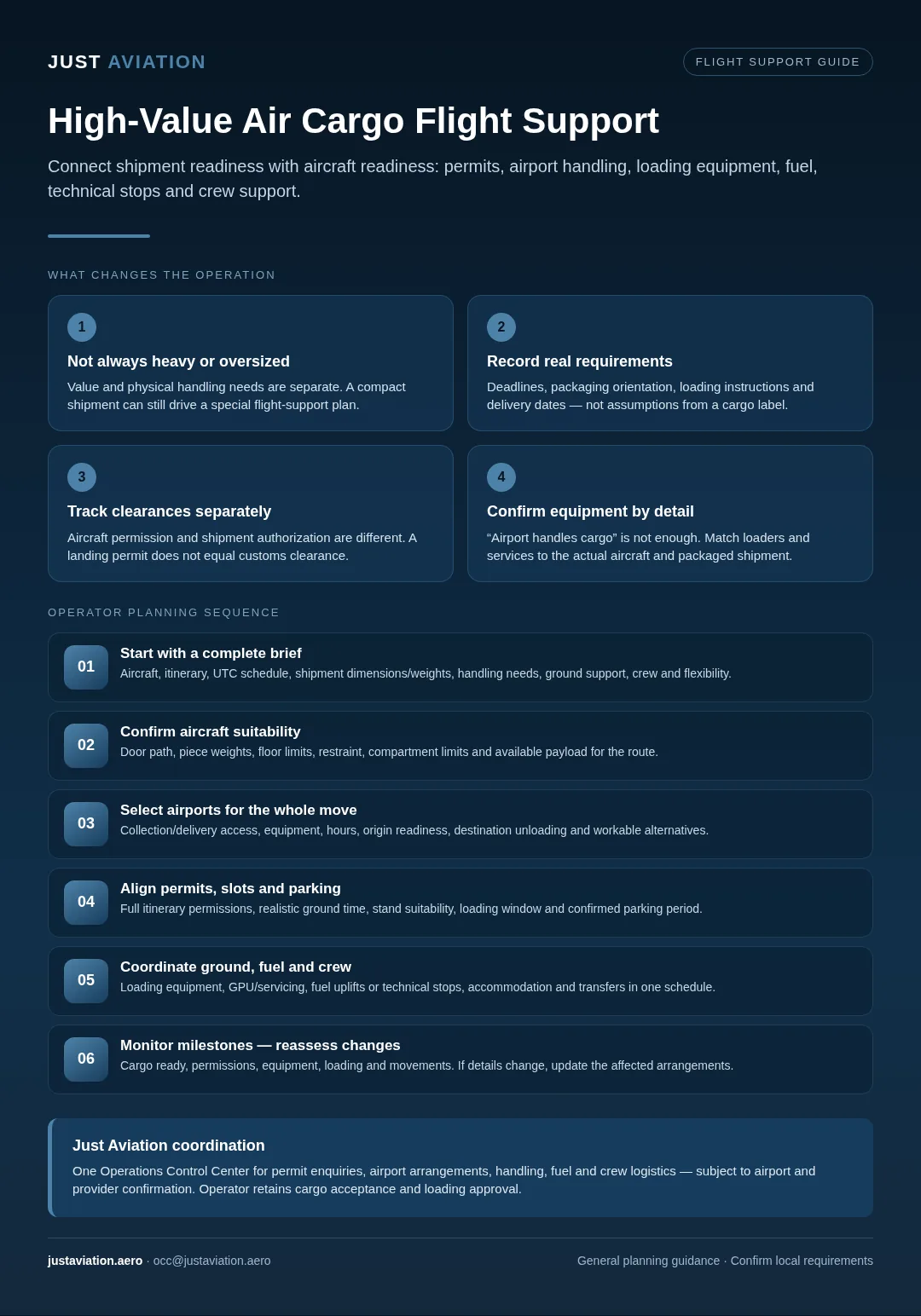
High-value cargo is not necessarily oversized, unusually heavy or urgent. A compact shipment may have significant commercial importance, while a large industrial component may require specialist loading arrangements regardless of its declared value.
The planning task is to identify what changes the operation.
For an aircraft component, this could be a delivery deadline linked to an aircraft recovery. For artwork, it could be packaging orientation and handling instructions. For printed materials, it may be a fixed distribution date. These requirements should be recorded individually rather than assumed from the cargo description.
Just Aviation’s guide to types of air cargo explains the broader categories. For a specific flight, the operator and supporting providers need the shipment’s actual characteristics and the conditions under which it can be accepted.
What Information Should Operators Provide First?
A complete initial brief makes it easier to identify suitable airport services and obtain meaningful quotations.
| Planning Item | Information Required |
|---|---|
| Aircraft | Type, registration, operator and relevant configuration details. |
| Itinerary | Origin, destination, positioning sectors and proposed technical stops. |
| Schedule | Preferred dates, UTC timings, cargo-ready time and delivery constraints. |
| Shipment | Accurate description, piece count, packaged dimensions and gross weights. |
| Handling | Loading instructions, equipment specifications and any restrictions on movement or storage. |
| Ground requirements | Parking duration, fuel, aircraft servicing and requested station support. |
| Crew | Crew numbers, planned changes, accommodation and transport requirements. |
| Flexibility | Acceptable alternative timings, airports or operating dates. |
Use final packaged measurements wherever possible. Crates, pallets and protective structures can change the dimensions and weight used during early planning.
If details remain provisional, identify them clearly and state when they will be confirmed. Changes must reach the operator and affected providers before arrangements are treated as final.
How Should Aircraft Suitability Be Established?
The aircraft operator must assess whether the proposed shipment can be carried in the intended configuration. A payload figure alone does not establish loading feasibility.
The review may need to address:
- Cargo-door dimensions and the loading path.
- Individual piece weights and load distribution.
- Floor-loading limits and support requirements.
- Restraint arrangements.
- Cargo-compartment limitations.
- Payload available for the proposed route and conditions.
The FAA Advisory Circular AC 120-85B – Carriage of Cargo provides guidance covering bulk cargo, unit load devices, special cargo and cargo loading systems. It is advisory guidance, is not mandatory and does not constitute a regulation.
Once the operator has established the aircraft and shipment requirements, Just Aviation can relay the specifications to local ground-handling providers and coordinate enquiries for compatible equipment, subject to airport and provider confirmation. Cargo acceptance, load planning, weight-and-balance calculations and final loading approval remain the responsibility of the operator and its authorized personnel.
How Can Airport Selection Improve the Operation?
Airport selection should consider the complete movement from cargo collection through aircraft departure and destination handling.
Proximity to the collection or delivery point matters, but so do equipment availability, airport access, operating hours and the time needed to process the shipment. A geographically convenient airport may introduce additional ground time if essential services cannot be confirmed.
Origin Airport Readiness
Establish when the shipment will reach the receiving facility and when it can be made available for loading. Check that the requested handling team and equipment can support that schedule.
Cargo-ready time should allow for the applicable acceptance process. The aircraft’s departure preference should not be built around the assumption that freight arriving at the airport can immediately be loaded.
Destination Handling
Confirm who will receive the aircraft, unload the shipment and coordinate its transfer through the applicable airport process.
Where specialist equipment is needed, request confirmation against the actual shipment and aircraft details. A general statement that an airport handles cargo is insufficient to confirm a particular unloading requirement.
Alternative Airports
Assess alternatives before a disruption makes them necessary. The operator must determine operational suitability, while support enquiries establish permissions, handling, fuel and other services.
Compare the total effect on delivery, including ground transportation and receiving-facility availability.
How Are Flight Permits Coordinated for Cargo Operations?
Permit planning should follow the full itinerary, including positioning flights and technical stops.
Just Aviation’s flight permit services support cargo operators with landing and overflight applications, document enquiries and authority follow-up. Application status and outstanding requirements are communicated as the request progresses.
Provide the correct flight purpose, aircraft details and routing from the outset. Include cargo information where required by the relevant procedure.
Aircraft clearance and shipment authorization should be tracked separately. Depending on the goods and jurisdictions involved, the shipper or appointed specialist may need to address import, export or transit requirements. Those matters should not be assumed complete because a landing permit has been issued.
If the route, date or aircraft changes, review the existing permissions before relying on them for the revised movement.
How Should Airport Slots and Parking Fit the Schedule?
Where airport slots apply, the requested timings need to reflect cargo readiness and a realistic ground operation.
Review arrival and departure together. A suitable arrival allocation may leave insufficient time for the requested loading activity. A later departure may extend parking beyond the period originally accepted.
Before committing to the schedule, establish:
- Required airport allocations.
- Accepted parking duration.
- Aircraft stand suitability.
- Planned loading or unloading time.
- Equipment and personnel availability.
- Any repositioning requirement.
Just Aviation’s guide to securing airport slots explains the application and confirmation process.
Keep each status clear. A submitted slot request, a provisional parking enquiry and an accepted handling arrangement are different stages of preparation.
What Ground Handling Services Can Just Aviation Coordinate?
Just Aviation’s ground handling services cover cargo and aircraft-side support through local handling providers. The service package should be established for each station rather than assumed to be identical across the route.
Loading and Unloading Equipment
Specify the equipment needed for the aircraft and shipment. Relevant details may include loading height, capacity, platform dimensions and any operator-approved supporting equipment.
Just Aviation coordinates equipment enquiries with local providers; cargo acceptance, load planning, weight-and-balance calculations and final loading approval remain with the operator and its authorized personnel.
Confirm availability for the operating period, including revised timings if the flight changes. Equipment present at an airport may already be committed to another movement.
Ground Power and Aircraft Servicing
Include required ground power, stairs, towing assistance, potable water, lavatory servicing and cabin preparation in the handling brief.
Provide aircraft-specific specifications where compatibility matters. Separate essential services from optional requests so unresolved items can be assessed appropriately.
Turnaround Coordination
Agree on the sequence of activities around the aircraft. Cargo operations, fuel, crew preparation and other servicing must be organized around the operator’s procedures and the conditions at the station.
Identify dependencies early. If one task cannot begin until another is complete, the ground schedule should reflect that sequence.
How Should Fuel and Technical Stops Be Planned?
The operator determines the fuel requirement and operational flight plan. Just Aviation coordinates the associated supplier arrangements through its aviation fuel services, including uplift enquiries, releases, quotations and payment terms.
For each uplift, provide the required grade, aircraft details, expected quantity and preferred servicing time. Confirm whether the quotation includes relevant charges and how changes in quantity or timing will be handled.
Where a technical stop is required, assess more than fuel availability. The stop also needs suitable airport access, permissions, handling and sufficient ground time.
If the shipment remains on board, communicate that clearly. Any proposed unloading, inspection or extended stay requires a separate review of the supporting arrangements.
What Crew Support May Be Needed?
Crew arrangements should follow the operator’s duty, rest and positioning plan.
Through its crew support services, Just Aviation coordinates accommodation, airport transfers and travel-document assistance alongside the wider itinerary.
For overnight stops, provide expected hotel arrival, required departure time and transport needs. A room booking alone does not establish that the arrangement suits the planned rest period.
Where a crew change is involved, identify the incoming crew’s arrival arrangements and the outgoing crew’s onward travel. Delays should trigger a review of both groups rather than only the aircraft’s next departure.
How Should Cargo Readiness and Flight Progress Be Monitored?
Agree on operational milestones before the movement begins. Each update should describe a meaningful change in readiness or status.
Useful milestones include:
- Final shipment details received.
- Operator acceptance completed.
- Required permissions confirmed.
- Cargo available at the agreed facility.
- Handling team and equipment ready.
- Loading or unloading completed.
- Aircraft arrival or departure reported.
- Outstanding requirements resolved.
Assign responsibility for supplying each update. Aircraft tracking does not establish whether cargo has completed an airport process or whether destination equipment is ready.
Communicate delays with their likely effect and the action required. This helps the operator and service providers make decisions using the same information.
What Should Happen When Plans Change?
A change should prompt a review of the arrangements it affects, rather than a general message that the itinerary has moved.
| Change | Items to Reassess |
|---|---|
| Cargo becomes available later | Airport timings, handling attendance, equipment bookings and crew implications. |
| Shipment dimensions or weight change | Operator acceptance, loading plan and equipment requirements. |
| Aircraft is substituted | Permit details, parking suitability, loading compatibility and fuel requests. |
| Route or stop changes | Permissions, airport services, fuel and the destination schedule. |
| Ground stay is extended | Parking, accommodation, equipment and departure preparation. |
| Flight is cancelled | Allocation release, supplier cancellations and applicable charges. |
For disruption affecting several sectors, Just Aviation’s irregular operations guide provides related planning considerations.
Maintain one current brief showing accepted changes and pending requests. Earlier instructions should be clearly superseded.
What Should a Cargo Flight-Support Quotation Clarify?
A useful quotation identifies the services included, the assumptions behind them and the items awaiting confirmation.
Check whether the scope covers:
- Permit and coordination services.
- Airport and handling charges.
- Specialist equipment.
- Parking and additional ground time.
- Fuel and payment terms.
- Crew accommodation and transportation.
- Out-of-hours attendance.
- Amendment, waiting-time or cancellation charges.
Clarify which costs are fixed and which depend on actual service use. If the aircraft, cargo or schedule changes, obtain revised acceptance and pricing where necessary.
This gives the operator a clearer basis for comparing options than a total figure without an itemized scope.
How Just Aviation Supports High-Value Cargo Flights
Just Aviation brings the supporting requirements of a cargo movement into one coordination process. Our Operations Control Center connects permit enquiries, airport arrangements, handling, fuel and crew logistics with the operator’s proposed schedule.
Support can include:
- Reviewing the itinerary and required flight permissions.
- Coordinating airport-slot and parking enquiries.
- Coordinating enquiries with local ground-handling providers for equipment matching the operator’s specifications, subject to airport and provider confirmation.
- Arranging fuel and technical-stop services.
- Coordinating crew accommodation and transfers.
- Communicating schedule amendments and outstanding requirements.
- Following up on station readiness and service confirmations.
Send your aircraft details, proposed route, UTC schedule, cargo summary and requested services to [email protected]
Include any firm cargo-ready or delivery deadline. Our team will review the brief, identify missing information and coordinate availability and quotations for the agreed scope.
Frequently Asked Questions About High-Value Air Cargo Flight Support
1. What does high-value cargo flight support include?
It can include permits, airport timings, parking, handling, loading-equipment enquiries, fuel and crew services. The required package depends on the aircraft, shipment and itinerary.
2. Is high-value cargo always heavy or oversized?
No. Value and physical handling requirements are separate considerations. Provide the actual packaged dimensions, weights and instructions so the operator and providers can assess the shipment correctly.
3. Who approves the cargo for carriage?
The aircraft operator determines load acceptance and aircraft suitability under its applicable procedures. Ground-service coordination supports that assessment and the resulting operational requirements.
4. What information is needed to request loading equipment?
Provide aircraft type, individual package dimensions, gross weights and relevant handling instructions. Include the equipment specification where the operator has identified a particular requirement.
5. Can Just Aviation coordinate a technical stop without unloading?
Yes. The request can cover permissions, handling, fuel and crew requirements for the stop. Specify that the cargo will remain on board and identify any other planned activity.
6. Does a landing permit cover the shipment’s customs requirements?
Do not assume so. Aircraft permission and shipment clearance serve different purposes. The relevant parties should establish which cargo documents and authorizations apply to the route and goods.
7. Can several airports be included in one support request?
Yes. Submit the complete itinerary, including positioning sectors and technical stops. This allows the arrangements at each station to be assessed against one operating schedule.
8. What if cargo details change after services are booked?
Send the revised information immediately. Changes in weight, dimensions or packaging may require renewed operator acceptance and different handling equipment, timings or quotations.
9. Can urgent cargo flights receive short-notice support?
Short-notice requests can be assessed, subject to permissions, airport capacity and provider availability. A complete brief and realistic alternatives help the operations team evaluate workable options.
Disclaimer
This article provides general flight-support planning guidance. Requirements and service availability vary by aircraft, airport, jurisdiction and shipment. Confirm applicable permissions, airport procedures and NOTAMs before operating. Cargo acceptance, loading approval and operational decisions remain with the responsible operator and authorized personnel. Requested services are subject to provider confirmation.
Conclusion
High-value cargo operations need a practical connection between shipment readiness and aircraft readiness. Accurate details, suitable airport services and clear confirmations help operators identify constraints before they affect the flight. Just Aviation supports that process by coordinating the permissions and ground arrangements around the agreed mission.


 +971 4 5855 689