
CARICOM MDEX Requirements for Business Aviation: Passenger Reporting and Flight Planning

10 November 2026
| By Just Aviation TeamBy Just Aviation Team | November 2026
Business aviation operators flying to participating Caribbean destinations must prepare passenger and crew reporting alongside the rest of the trip. CARICOM MDEX provides the reporting platform, while operators need an approved filing arrangement, verified information and a clear process for managing changes before departure.
Effective preparation connects the manifest with the actual aircraft, itinerary and persons travelling. Reporting responsibilities should be established early, with permits, airport acceptance and border formalities tracked separately.
Preparing a Caribbean flight? Just Aviation’s trip planning and flight-support services help operators coordinate destination requirements with the practical arrangements for each sector.
Key Takeaways
- Who is responsible for submitting and checking your MDEX passenger and crew manifest?
- Is the responsible filing account approved for live submissions?
- Can verified passenger and crew information reach the filer before the deadline?
- Which destinations and sectors require a reporting assessment?
- How will schedule changes, manifest corrections and cancellations be managed?
- Which permits, customs procedures and airport arrangements require separate action?
What Are the Main MDEX Requirements?
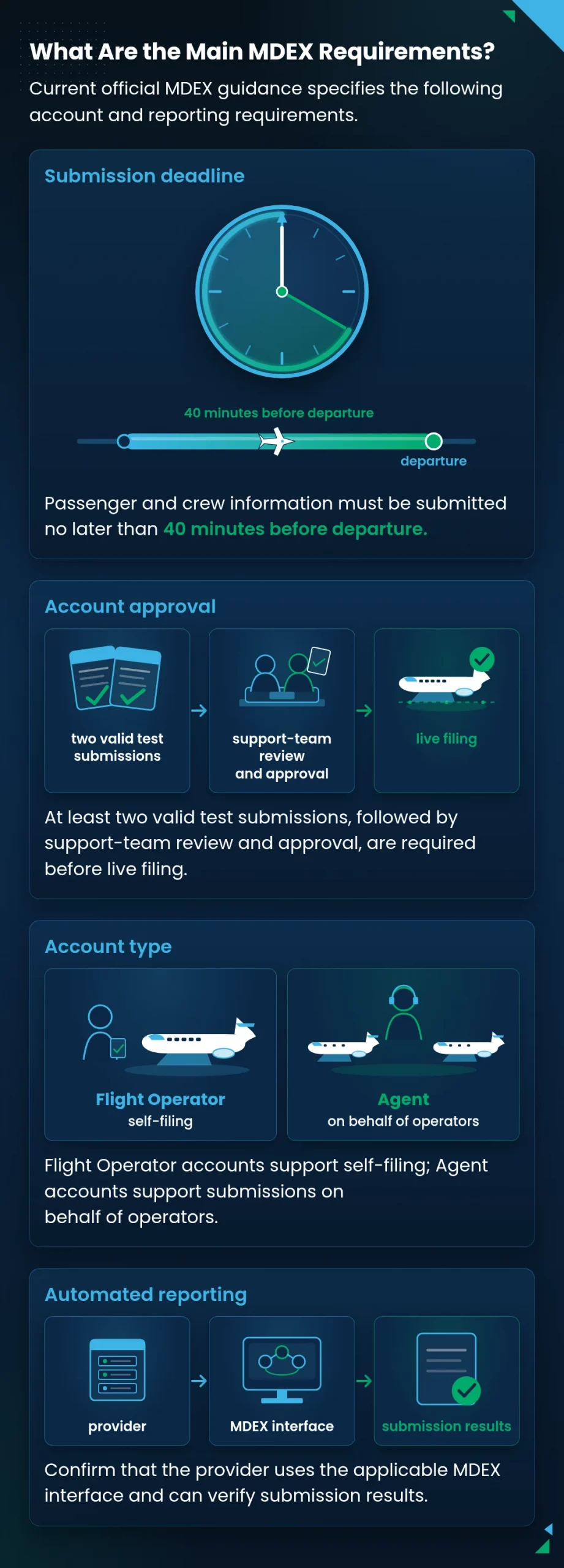
Current official MDEX guidance specifies the following account and reporting requirements.
| Requirement | What Operators Need to Know |
|---|---|
| Submission deadline | Passenger and crew information must be submitted no later than 40 minutes before departure. |
| Account approval | At least two valid test submissions, followed by support-team review and approval, are required before live filing. |
| Account type | Flight Operator accounts support self-filing; Agent accounts support submissions on behalf of operators. |
| Automated reporting | Confirm that the provider uses the applicable MDEX interface and can verify submission results. |
Build these checks into the flight department’s working instructions. Account access, manifest preparation, submission and review of the result should each have a clearly identified status.
Which Caribbean Destinations Participate?
The official MDEX guidance lists 19 participating countries and territories:
- Antigua and Barbuda
- The Bahamas
- Barbados
- Belize
- British Virgin Islands
- Cayman Islands
- Curaçao
- Dominica
- Grenada
- Guyana
- Haiti
- Jamaica
- Montserrat
- St. Kitts and Nevis
- Saint Lucia
- St. Vincent and the Grenadines
- Suriname
- Trinidad and Tobago
- Turks and Caicos Islands.
Assess each proposed movement against current destination instructions. Participation does not mean that customs, immigration, airport access or other national procedures are identical.
For a multi-island itinerary, prepare a sector-by-sector reporting assessment. Do not assume that a manifest for the first arrival automatically covers subsequent departures or onward movements.
How Should Operators Establish Their Filing Arrangement?
Decide who will manage reporting before the trip becomes time-critical. Operators filing directly should register through the official MDEX portal, complete the required testing and obtain approval for live submissions.
The former CARICOM eAPIS portal was decommissioned on 30 September 2026. From 1 October 2026, passenger and crew manifest submissions through the portal must be made using MDEX. Existing eAPIS credentials do not transfer, so portal users must create a new MDEX account. Organisations using legacy eAPIS web-service integrations should transition to the MDEX REST API before the legacy web services are decommissioned on 31 December 2026, as stated in the official MDEX guidance.
Why Should Filing Readiness Be Confirmed Before Departure?
Reporting access should be treated as an operational dependency. Complete the published onboarding process early enough to resolve unsuccessful tests, account questions or unfamiliar submission procedures. Avoid using a live departure as the first opportunity to establish whether the reporting arrangement works.
Before relying on an account or provider, confirm that the responsible team can:
- Access the appropriate service.
- Use the required submission method.
- Identify test activity separately from live operations.
- Retrieve submission results.
- Recognize errors and escalate them.
A shift handover should identify who has the current reporting task and what remains outstanding. Staff should not need to reconstruct the account’s status while passengers are preparing to board.
How Should the Reporting Deadline Be Built into the Schedule?
Set an internal information deadline ahead of the published submission limit. The collection process needs time for missing details, document checks and corrections. Work backwards from the planned departure and identify when the manifest must be ready for review.
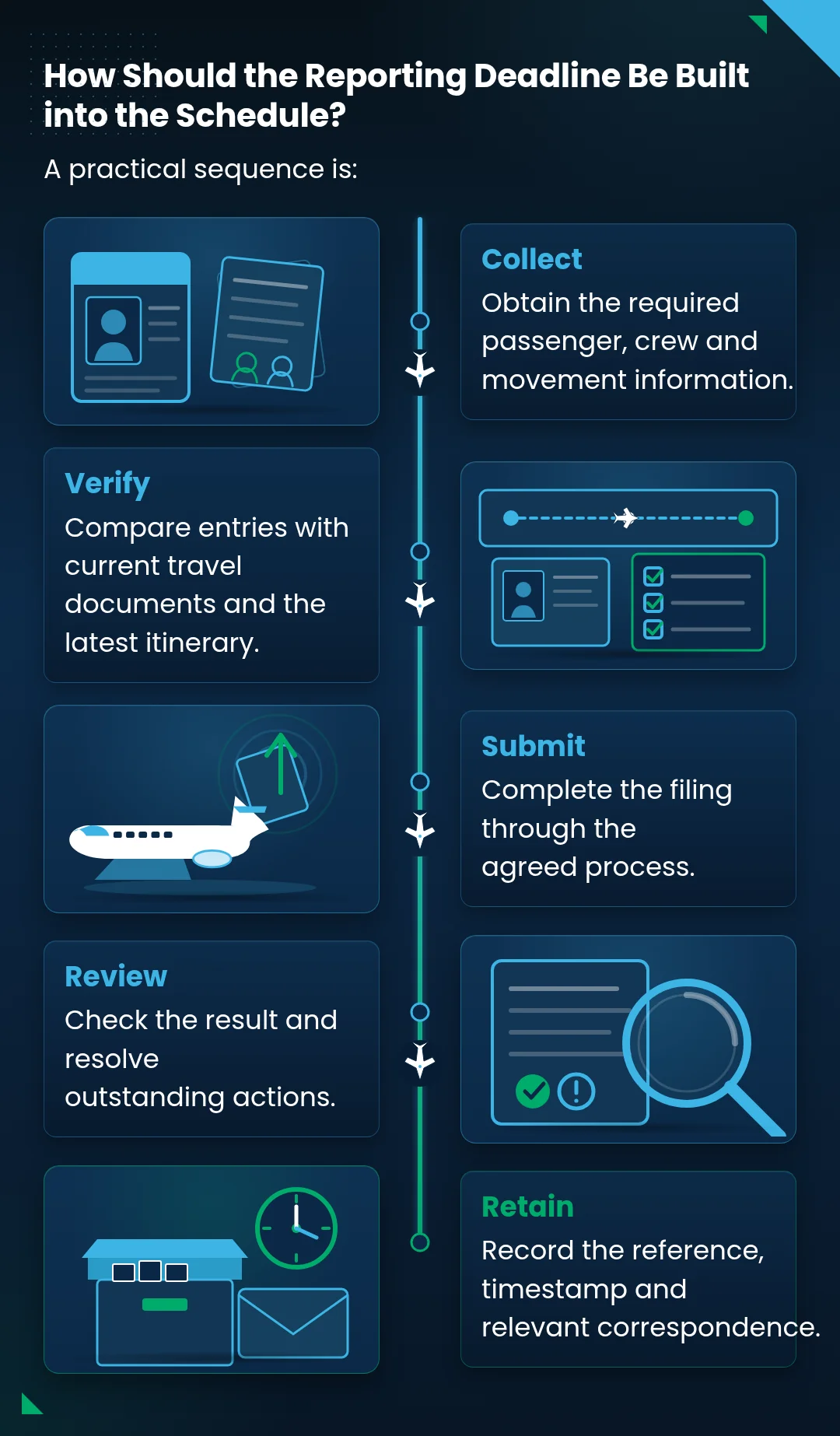
A practical sequence is:
| Stage | Required Check |
|---|---|
| Collect | Obtain the required passenger, crew and movement information. |
| Verify | Compare entries with current travel documents and the latest itinerary. |
| Submit | Complete the filing through the agreed process. |
| Review | Check the result and resolve outstanding actions. |
| Retain | Record the reference, timestamp and relevant correspondence. |
If departure moves earlier, reassess the reporting schedule immediately. An internal deadline based on the original flight time may no longer be suitable.
Where airport allocations apply, connect this review with the process for securing airport slots. Passenger reporting and airport timing requests should remain separately controlled.
What Passenger and Crew Information Should Be Checked?
Use the current platform fields and instructions to establish the mandatory information. The working collection process should cover the required identity, travel-document, passenger or crew status, and movement details.
Check particularly for:
- Missing or incorrectly divided names.
- Dates entered in the wrong format.
- Incorrect document numbers.
- Confusion between nationality and document-issuing country.
- Expired details copied from stored profiles.
- Incorrect passenger or crew classification.
- A manifest attached to the wrong sector.
Verify the document that will actually be presented for the journey. A previous passenger profile can help preparation, but it should not replace a current check.
Transfer personal information through the agreed controlled channel. Limit circulation to those who need it for the operation and follow applicable privacy and retention procedures.
How Should MDEX Reporting Connect with Permits and Airport Services?
Maintain a common itinerary, but track each permission and service separately.
A permit application, airport-slot request, handling confirmation and passenger manifest serve different purposes. Completing one should not cause the others to be marked complete automatically.
Review consistency across:
- Aircraft registration and type.
- Flight identification.
- Departure and arrival airports.
- Operating dates and timings.
- Passenger and crew information.
- Flight purpose where relevant.
Just Aviation’s flight permit services can be coordinated alongside airport arrangements. If the aircraft or route changes, establish which approvals need amendment.
Likewise, ground handling coordination should reflect the current arrival, border-processing plan and requested services. The receiving provider needs the latest accepted schedule, not an earlier version retained in a separate booking.
What Should Happen When the Manifest or Flight Changes?
Send changes promptly to the person responsible for reporting. Identify the affected flight and explain exactly what has changed.
A useful change notice distinguishes between:
- A passenger joining or leaving the flight.
- Corrected travel-document details.
- A crew substitution.
- An aircraft replacement.
- A revised airport or operating date.
- An earlier or later departure.
The filer should establish the required correction or resubmission action under current instructions. Do not assume that editing a dispatch system, flight plan or handling request updates the manifest.
Keep an amendment record showing the information received, the action taken and the resulting status. Circulate the latest operating brief with pending matters clearly identified.
What If the Flight Is Cancelled After Reporting?
The official MDEX FAQ currently states that the platform has no cancellation-reporting function and does not specify an alternative cancellation workflow. Seek instructions through the responsible filer or official support process. Retain a record of the cancellation and the instructions received. Do not assume that removing the flight from another system changes the submitted reporting record.
Deal with the wider trip separately. Review airport allocations, parking, handling, fuel and crew bookings, including applicable cancellation terms.
What Should Operators Using Automated Reporting Review?
Operators using integrated reporting should verify that their provider supports the applicable MDEX submission process. A manifest appearing in a scheduling system does not, by itself, demonstrate successful transmission or processing.
Ask the provider to confirm:
- The reporting connection is operational.
- Required testing and account approval are complete.
- Submission results are visible to the responsible team.
- Errors generate a clear notification.
- Technical escalation and contingency instructions are documented.
- Changes to platform requirements are monitored and implemented.
Distinguish between information saved internally, information transmitted and a result received. Where processing remains unresolved, identify the required action before treating reporting as complete.
Keep credentials and technical access details within the appropriate controls. Dispatch staff should have clear instructions for identifying a problem, notifying the responsible party and communicating its effect on the flight.
Does MDEX Replace Customs, Immigration or US Reporting?
Keep regional manifest reporting separate from destination-specific entry and departure requirements. The trip assessment should identify applicable visas, travel-document conditions, customs arrangements and airport procedures. Where a US sector is involved, check the relevant US reporting requirements independently.
A submission record should not be described as immigration admission, customs clearance or permission to operate. Positioning sectors also need an assessment. The absence of passengers should not lead the team to disregard crew or aircraft reporting requirements without checking the applicable instructions.
What Should the Operations Team Do If Reporting Remains Unresolved?
Identify the problem before attempting repeated submissions. Establish whether the issue concerns missing data, account access, file validation, transmission or uncertainty about the result. Record the relevant message without unnecessarily distributing passenger information.
The operations team should then:
- Identify the affected sector.
- Assign responsibility for resolution.
- Escalate through the agreed reporting process.
- Assess the effect on departure.
- Update related airport and service arrangements.
- Brief the crew on the outstanding requirement.
Do not assume that a system interruption waives the obligation or authorizes email filing. Obtain the applicable instructions.
Just Aviation’s irregular operations guide explains the wider coordination needed when disruption affects connected sectors and ground services.
How Just Aviation Supports Caribbean Flight Planning
Just Aviation coordinates the supporting requirements of Caribbean itineraries, helping operators connect destination preparation with the flight schedule.
Our Operations Control Center can assist with:
- Reviewing itinerary requirements and identifying outstanding enquiries.
- Coordinating landing and overflight permit requests.
- Following up on airport slots, parking and handling.
- Arranging aviation fuel around accepted timings.
- Coordinating crew support and transfers.
- Communicating changes across affected service providers.
Confirm the appointed MDEX filer separately from Just Aviation’s trip-support services. Any requested reporting assistance must be expressly included in the agreed service scope, with submission and follow-up responsibilities identified before departure.
Contact [email protected] with your aircraft details, routing, UTC schedule, passenger and crew numbers, and service requirements. Identify the appointed reporting party so responsibilities can be incorporated into the trip brief.
Frequently Asked Questions About CARICOM MDEX Requirements
1. What should an operator verify before its next Caribbean flight?
Check destination applicability, the responsible filer, operational account readiness and the information deadline. Then connect reporting preparation with permits, airport arrangements and the actual itinerary.
2. Can a provider manage reporting on an operator’s behalf?
Confirm the provider’s current filing capability and the agreed service scope. Specify who supplies verified information, who submits it and who communicates corrections or unresolved results.
3. Should repeat travellers’ passport details be checked again?
Yes. Stored information may no longer match the current document. Verify the details intended for the journey, particularly when a passport has been renewed or a different document will be used.
4. Should each sector of a multi-island itinerary be reviewed separately?
Yes. Identify reporting requirements for the actual movement sequence. A regional itinerary can involve several destinations, different local procedures and changes in the persons on board.
5. What happens if a passenger is added close to departure?
Notify the responsible filer immediately. Establish the applicable update action and reassess timing before treating the revised operation as ready.
6. Does amending a flight plan update the passenger manifest?
Do not assume that it does. Verify how the reporting arrangement works and ensure relevant changes reach the person controlling the submission.
7. Does a manifest submission replace airport or border approval?
No. Keep reporting separate from flight permissions, airport acceptance and the applicable customs and immigration processes.
8. What reporting records should the operator retain?
Keep the relevant submission result, reference, timestamps, amendment history and instructions received. Handle supporting personal information according to applicable data-management requirements.
Disclaimer
This article provides general operational planning guidance. Reporting procedures, platform functions and destination requirements may change. Confirm current CARICOM IMPACS instructions, applicable national requirements and flight-specific procedures before operating. Manifest submission does not replace required permits, customs formalities, immigration checks or airport acceptance.
Conclusion
Effective MDEX preparation depends on clear filing responsibility, verified information and timely action when the flight changes. Integrating those tasks into the trip plan helps operators identify unresolved reporting before departure and keep passenger information aligned with the aircraft, itinerary and airport arrangements.


 +971 4 5855 689