
When to Outsource Aircraft Maintenance: Key Considerations for Operators

26 October 2026
| By Just Aviation TeamOutsourcing aircraft maintenance can be practical when an operator requires specialist expertise, approved facilities or additional maintenance capacity. However, the decision involves more than comparing quotations. Aircraft downtime, provider approvals, parts availability and positioning requirements can affect the overall cost and operational schedule.
For business aviation and charter operators, selecting an appropriate maintenance arrangement requires balancing technical capability, regulatory responsibilities and aircraft availability. This guide examines when outsourcing is suitable, how to evaluate MRO providers and what operators should consider before contracting maintenance services.
Key Takeaways
- When does outsourcing aircraft maintenance make more operational sense than keeping the work in-house?
- Which maintenance activities are suitable for external providers?
- How should operators compare maintenance costs and aircraft downtime?
- What regulatory approvals and technical capabilities need verification before selecting an MRO?
- How should maintenance contracts, aircraft records and release-to-service procedures be managed?
- When is a combination of in-house and outsourced maintenance more appropriate?
When Does Outsourcing Aircraft Maintenance Make Sense?
Outsourcing is worth considering when required maintenance exceeds an operator’s existing capabilities or when maintaining those capabilities internally is impractical. Fleet size, aircraft types, maintenance frequency and operating locations influence the decision.
An operator with a small fleet and occasional heavy maintenance requirements may have different needs from one managing several aircraft of the same type at a permanent base.
Specialist Maintenance Requirements
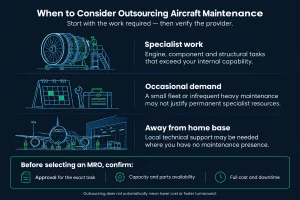
Engine shop visits, component overhauls, structural repairs and specialist inspections can require facilities, tooling and personnel beyond the operator’s internal capability. Under the EASA Part-145 framework, maintenance organisations operate within an approved scope of work. The provider needs to be appropriately approved for the aircraft, component and task involved.
For operators, outsourcing specialist work can avoid developing facilities and technical capabilities used infrequently. However, an external provider still needs suitable capacity, equipment and approval for the specific work package.
Limited Fleet Size or Irregular Maintenance Demand
An in-house maintenance operation involves continuing expenditure on facilities, approved personnel, tooling, training and quality or compliance functions.
Where maintenance demand is intermittent, outsourcing selected work can reduce the need to maintain those resources internally. This does not establish that outsourcing is cheaper, because provider charges, aircraft positioning and downtime need to be included in the comparison. Operators with recurring maintenance demand may find it practical to retain certain capabilities internally and contract additional work when required.
Maintenance Away From the Home Base
An aircraft operating internationally can develop a technical defect at an airport where the operator has no permanent maintenance presence. In this situation, an external maintenance organisation can provide the relevant local capability, subject to its approval, available personnel, equipment and parts.
For aircraft-on-ground (AOG) events, the priority is establishing the defect, identifying an appropriately authorized maintenance provider and coordinating the required technical support. Any aircraft movement before rectification needs to follow the applicable airworthiness and flight authorization procedures.
Which Aircraft Maintenance Activities Can Be Outsourced?
Maintenance activities involve different levels of technical work, and the appropriate arrangement depends on the aircraft’s approved maintenance programme and the provider’s authorization.
| Maintenance activity | Outsourcing consideration |
|---|---|
| Line maintenance | Useful when an aircraft operates away from its regular maintenance base |
| Scheduled base maintenance | Relevant when work requires hangar capacity, extensive inspection or specialist facilities |
| Engine maintenance | Specialist providers can undertake work requiring approved engine capabilities and equipment |
| Component maintenance | External workshops can repair or overhaul components within their approved ratings |
| Specialist inspections and repairs | Appropriate when dedicated tooling, qualifications or processes are required |
Line Maintenance
Contracted line maintenance can support aircraft operating away from their regular maintenance base. Activities may include troubleshooting, defect rectification and permitted component replacements, subject to the provider’s approved scope and available resources.
Base Maintenance and Major Repairs
Base maintenance requires suitable facilities, personnel and planned aircraft downtime. Operators need to confirm the maintenance slot, work scope and procedures for additional findings that could affect completion.
Engine and Component Maintenance
Engine and component work may require separate approvals, specialist equipment and facilities. Operators need to verify the provider’s ratings and capabilities for the specific tasks.
Outsourced Versus In-House Aircraft Maintenance
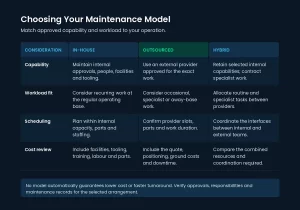
The decision between internal and external maintenance is best made against the operator’s actual fleet, maintenance workload and available capability.
| Factor | In-house maintenance | Outsourced maintenance |
|---|---|---|
| Facilities and tooling | Requires internal investment and upkeep | Uses the selected provider’s approved facilities and equipment |
| Technical personnel | Requires recruitment, training and authorization | Depends on provider qualifications and staffing availability |
| Scheduling | Managed within internal capacity | Depends on agreed slots and provider capacity |
| Specialist tasks | Requires appropriate internal approval and capability | Can use a provider approved for the required task |
| Aircraft downtime | Depends on internal workload, parts and technical capacity | Includes provider scheduling, positioning and work duration |
| Regulatory oversight | Internal functions remain subject to applicable approvals and controls | Provider selection, contractual interfaces and continuing-airworthiness controls require attention |
Neither arrangement guarantees a lower cost or faster maintenance turnaround. For example, keeping line maintenance close to the aircraft’s regular operating base can support routine defect management, while outsourcing major component work can avoid maintaining rarely used specialist capability.
Comparing the Full Cost of Outsourced Maintenance
The cost of outsourced maintenance extends beyond the quoted work package. Operators need to consider aircraft positioning, ground expenses, downtime and potential additional work when comparing external providers with internal capabilities.
Direct Maintenance Costs
Direct costs can include labour, parts, consumables, inspections, component repair and applicable specialist services. The quotation needs to define the included work and the method for approving additional tasks identified during maintenance. Without a clear scope, comparing two providers by the initial quoted amount can be misleading.
Aircraft Positioning and Ground Costs
Where the selected MRO is located away from the aircraft’s operating base, positioning can introduce additional fuel, airport, handling, crew and parking expenses. For international movements, flight permits and other operating requirements can also form part of the positioning plan. These costs need to be considered alongside the maintenance price when evaluating the provider.
Downtime and Schedule Exposure
Aircraft downtime involves more than the hours required to perform maintenance. The full period can include waiting for a slot, aircraft induction, technical findings, parts delivery, inspection and release documentation.
For charter operators, the effect on committed aircraft availability is particularly relevant. The operator needs to consider whether the proposed maintenance period conflicts with scheduled flights and what arrangements would be required if completion takes longer than planned.
How to Evaluate an Aircraft Maintenance Provider
Selecting an MRO requires confirmation of its regulatory approval, technical scope and ability to complete the intended work. A provider’s general experience with an aircraft manufacturer does not establish authorization for every aircraft type, component or maintenance task.
Maintenance Approvals and Scope of Work
Under EASA Part-145, approved maintenance organisations are subject to requirements concerning facilities, personnel, equipment, maintenance data, certification and organizational controls.
The FAA’s Part 145 repair station framework similarly establishes requirements for certificated repair stations. FAA approval involves ratings, limitations and operating specifications that determine the work a repair station is authorized to perform.
For the proposed maintenance event, the operator needs to confirm the provider’s:
- Current approval and relevant aircraft or component ratings.
- Authorization for the exact maintenance tasks and location.
- Access to appropriate maintenance data, facilities and equipment.
- Qualified personnel and applicable certification privileges.
- Capacity to complete the work during the required period.
Where the aircraft is registered in another jurisdiction, the acceptance of the provider’s approval and the resulting release documentation also needs to be established.
Maintenance Capacity and Parts Availability
Regulatory approval does not confirm that a provider has an available maintenance slot or the necessary parts for the intended work.
Before accepting a maintenance proposal, the operator needs to establish the planned induction date, expected work duration, parts requirements and arrangements for handling additional findings. For time-sensitive operations, the provider’s ability to obtain necessary components and respond to technical changes can be as important as its quoted completion date.
Maintenance History and Communication
Aircraft maintenance records, previous defects, applicable airworthiness directives and the approved maintenance programme need to be considered when defining the work package.
The operator and provider should establish how technical findings, additional work requests, parts substitutions and schedule changes will be communicated. This allows engineering decisions and operational scheduling to be based on the same maintenance information.
Regulatory Responsibilities When Maintenance Is Outsourced
Contracting maintenance to an external organisation changes who performs the work, but it does not remove the continuing-airworthiness obligations assigned to the aircraft owner, operator or approved continuing-airworthiness management organisation under the applicable rules.
Responsibility needs to be assessed according to the aircraft’s registration, operating category and regulatory framework.
EASA Continuing-Airworthiness Requirements
Under Regulation (EU) No 1321/2014, continuing-airworthiness management and maintenance performance are distinct functions.
For aircraft subject to the relevant requirements, an approved Continuing Airworthiness Management Organisation (CAMO) manages assigned continuing-airworthiness tasks, including arranging maintenance through appropriately approved organisations.
The division of responsibilities depends on the applicable Part-M, Part-ML, Part-CAMO and maintenance organisation requirements. A contracted MRO is responsible for the maintenance activities and certification performed under its approval. The operator and any responsible CAMO retain their respective obligations under the applicable framework.
Contracted Maintenance Versus Subcontracted Maintenance
EASA distinguishes between contracting work to another approved maintenance organisation and subcontracting tasks under an existing Part-145 organisation’s management system. When maintenance is contracted to another approved organisation, that organisation performs and releases the relevant work under its own approval.
When work is subcontracted under an approved Part-145 organisation’s procedures, the subcontractor operates within the controlling organisation’s management system and approval arrangements. The original Part-145 organisation retains responsibility for the subcontracted activities and their release under its approval. These distinctions affect provider authorization, technical oversight and release documentation. They need to be addressed in the maintenance arrangement rather than treating every external provider as an independent approved MRO.
Maintenance Release and Aircraft Records
Following maintenance, the applicable certification process needs to be completed by appropriately authorized personnel. Under EASA Part-145, maintenance release requirements are addressed in 145.A.50, while FAA-regulated maintenance follows the relevant return-to-service rules.
The operator needs to ensure that completed work is reflected in the required aircraft records and that outstanding defects, limitations and maintenance requirements are assessed before the next flight. A certificate of release to service addresses the maintenance covered by that certification. It is not a substitute for the operator’s separate preflight and operational responsibilities.
What Should an Outsourced Maintenance Contract Cover?
A written maintenance agreement should define the scope of work, technical responsibilities, certification requirements and communication procedures between the operator, responsible continuing-airworthiness management function and maintenance provider.
EASA’s continuing-airworthiness guidance provides the applicable framework for maintenance contracting and related responsibilities.
| Contract element | What needs to be established |
|---|---|
| Scope of work | Aircraft, maintenance tasks and applicable maintenance programme |
| Regulatory approval | Provider approval, work location and certification responsibilities |
| Scheduling | Induction date, estimated completion and notification of delays |
| Additional findings | Process for technical review and approval of added work |
| Parts and materials | Supply arrangements, traceability and applicable release documentation |
| Records and release | Maintenance records, certification and document handover |
| Aircraft return | Completion status, remaining defects and return arrangements |
| Commercial terms | Pricing, payment conditions and treatment of additional costs |
The operator should also establish who communicates maintenance progress to flight operations and how a change in completion timing affects the aircraft schedule. This is particularly relevant where an aircraft is being maintained away from its regular base or where multiple specialist organisations contribute to the same maintenance event.
When Is a Hybrid Maintenance Arrangement Appropriate?
A hybrid maintenance arrangement combines internal capabilities with contracted services. An operator may retain appropriately authorized personnel for routine line maintenance while using an approved MRO for major inspections, engine work or maintenance at other locations.
The arrangement depends on fleet requirements, internal resources, regulatory approvals and external provider availability.
Making the Maintenance Decision
The following questions provide a useful basis for evaluating the options.
| Decision question | Operational significance |
|---|---|
| Can the operator perform the work within its existing approvals and capabilities? | Establishes whether internal maintenance is a viable option |
| Is the maintenance requirement recurring or occasional? | Helps assess the value of maintaining internal resources |
| Does the external MRO hold the necessary approval and capacity? | Establishes technical and scheduling suitability |
| What is the total cost, including positioning and downtime? | Supports a complete financial comparison |
| How will maintenance records and release documentation be managed? | Establishes the necessary continuing-airworthiness controls |
The resulting arrangement can differ between aircraft types and maintenance events. Operators do not need to adopt one maintenance model for every task if a combination better fits their approved capabilities and operating requirements.
Flight Support and Coordination for Maintenance Positioning Operations
Just Aviation provides 24/7 operational support for aircraft movements to and from maintenance facilities, coordinating international flight requirements through its trip planning services.
The Operations Control Center assists with:
- Coordinating landing and overflight permits for approved positioning flights.
- Arranging ground handling services, airport access and parking requests.
- Coordinating aviation fuel requirements with local providers.
- Arranging crew accommodation and transportation.
- Updating flight and ground arrangements when maintenance schedules change.
Just Aviation coordinates associated operational services but does not perform or certify aircraft maintenance. Technical assessments, airworthiness determinations and maintenance certification remain with the responsible operators, maintenance organizations and authorized personnel.
For maintenance positioning flights and international operational coordination, contact Just Aviation’s Operations Control Center at [email protected]
Frequently Asked Questions About Outsourcing Aircraft Maintenance
1. Is outsourcing aircraft maintenance cheaper than keeping it in-house?
The cost depends on the maintenance workload, internal resources and external service arrangements. An accurate comparison includes labour, tooling, facilities, parts, aircraft positioning, downtime and contract management rather than relying only on the quoted maintenance price.
2. What types of aircraft maintenance are suitable for outsourcing?
Line maintenance, base maintenance, engine work, component repairs and specialist inspections can be contracted to external providers where permitted under the applicable regulations. The provider needs the approval, capabilities and resources required for the specific tasks.
3. Can an FAA-approved repair station maintain an EASA-regulated aircraft?
An FAA repair station certificate does not independently establish acceptance of every maintenance release for an aircraft regulated under the EASA framework. The relevant approval, applicable international arrangements, work scope and release requirements need to be verified for the particular maintenance activity.
4. Who is responsible for continuing airworthiness when maintenance is outsourced?
Responsibility depends on the applicable regulatory framework and the roles assigned to the owner, operator and any approved CAMO. Contracting maintenance does not remove obligations that remain with those parties, while the maintenance organisation is responsible for work and certification performed under its approval.
5. What causes delays during outsourced maintenance?
Delays can result from additional technical findings, parts procurement, maintenance capacity constraints or work requiring further specialist services. The provider’s initial completion estimate therefore needs to be considered alongside the process for communicating and managing changes.
6. Can an aircraft fly to a maintenance facility with an unresolved defect?
The ability to conduct the flight depends on the defect, applicable airworthiness requirements and any authorized operating provisions. If a special flight permit or equivalent authorization is required, it needs to be obtained under the applicable regulatory process. The operator and authorized technical personnel determine whether the proposed movement is permissible.
Disclaimer
This article provides general operational guidance on aircraft maintenance outsourcing. Maintenance approvals, continuing-airworthiness requirements and release-to-service procedures may change following updates by the relevant aviation authorities. Requirements also vary according to aircraft registration, operating category and regulatory jurisdiction. Operators and authorized maintenance organizations remain responsible for complying with applicable regulations and approved maintenance procedures.
Conclusion
Aircraft maintenance outsourcing is most practical when external providers offer the approved capabilities, facilities or capacity required for specific maintenance activities. The decision should consider the full maintenance cost, aircraft downtime and the arrangements necessary to return the aircraft to service.
For business aviation and charter operators, a combination of internal and external maintenance may be appropriate depending on fleet requirements and available resources. Clear maintenance responsibilities, suitable provider approvals and complete technical records are essential to effective maintenance planning.


 +971 4 5855 689