
The Future of Aviation Operations Control Centers: Combining Technology and Human Expertise

25 October 2026
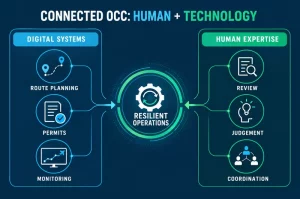
| By Just Aviation TeamAviation Operations Control Centers (OCCs) coordinate flight planning, aircraft movements, crew requirements and operational changes across multiple locations. As flight operations become increasingly data-dependent, integrated digital systems help OCC teams manage information, monitor developments and coordinate responses.
For business aviation and charter operators, AI-assisted analysis and automation offer opportunities to improve operational efficiency and decision support. Their effective use depends on reliable data, clearly defined responsibilities and qualified personnel. This blog examines how emerging technologies are shaping OCC functions, the role of human expertise, and the operational considerations involved in adopting new systems.
Key Takeaways
- How are digital systems changing aviation Operations Control Centers?
- Which OCC activities benefit from automation and AI-assisted analysis?
- What operational decisions require human expertise and regulatory oversight?
- How can connected systems support flight planning, crew coordination and disruption management?
- What risks need to be addressed when introducing AI into flight operations?
- How should operators evaluate and implement new OCC technology?
How Are Aviation Operations Control Centers Evolving?
An OCC supports the planning and coordination of aircraft operations, including activities before departure, during a flight and after arrival. Its responsibilities depend on the operator’s structure, aircraft activity and applicable regulatory requirements.
Traditional OCC workflows often involve separate flight planning applications, aircraft schedules, crew records, airport information and communication with local service providers. When these systems are not connected, personnel need to compare information manually and communicate changes between departments.
Modern OCC development focuses on making this information accessible through coordinated operational workflows rather than replacing each existing system with a single platform.
From Separate Systems to Connected Operations
An OCC can receive information about a flight from several sources, including weather services, aeronautical information, aircraft tracking systems, crew scheduling applications and ground handling providers.
For example, a departure delay affects more than the planned off-block time. It can change crew duty calculations, the arrival slot, aircraft parking requirements and passenger transportation arrangements.
A connected system can help identify which records and services are affected by the revised schedule. OCC personnel then determine which actions are needed and coordinate them with the responsible parties. The priority is to maintain accurate operational information and clearly identify the actions required when flight schedules change.
Which OCC Functions Benefit From Digital Integration?
Technology is most useful when it supports tasks involving multiple information sources, repeated checks or frequent schedule changes.
The following areas are relevant to international flight operations.
| OCC function | Role of digital systems | Human responsibility |
|---|---|---|
| Flight planning | Consolidate route, weather and aeronautical information | Review planning options under applicable procedures |
| Flight permits | Track applications, documentation and authorization status | Resolve discrepancies and coordinate authority requirements |
| Crew coordination | Connect schedules, qualifications and duty information | Assess assignments, restrictions and operational feasibility |
| Flight monitoring | Identify changes affecting planned aircraft movements | Evaluate operational consequences and required responses |
| Ground services | Maintain service requests and supplier confirmations | Coordinate unresolved requirements and schedule changes |
| Disruption management | Compare affected flights and available recovery options | Select and authorize actions within assigned responsibilities |
Flight Planning and Aeronautical Information
Flight planning systems bring together information needed to assess route options, airspace restrictions and operating conditions.
For international flights, the planning process can involve multiple airspace jurisdictions, airport procedures and applicable flight permissions. Digital integration can reduce the need to check separate records manually, but planning information still requires appropriate validation and review.
The ICAO flight operations framework addresses operational control, aircraft performance, flight documentation and the functions of flight operations officers and dispatchers. The allocation of planning and approval responsibilities depends on the applicable operator and regulatory framework.
The ICAO flight operations framework addresses operational control, aircraft performance, flight documentation and the functions of flight operations officers and dispatchers. The allocation of planning and approval responsibilities depends on the applicable operator and regulatory framework.
Flight Permit and Airport Coordination
Permit processing involves aircraft documentation, intended routing, flight schedules and communication with relevant authorities. A centralized workflow can help personnel track outstanding documents, application progress and changes requiring additional coordination.
For example, when an aircraft registration changes, the OCC needs to identify the affected permit applications and airport service requests. The international flight permit process still depends on the authorization procedures of the relevant countries. A digital record of an application does not establish that permission has been granted.
Crew and Aircraft Scheduling
Crew planning requires current information about qualifications, availability, duty periods and positioning arrangements. Digital scheduling systems can compare these details with the intended flight schedule and identify conflicts requiring review. Just Aviation’s crew management systems guide examines how scheduling, legality checks, crew positioning and operational recovery interact.
For OCC personnel, the important distinction is between a system identifying a potential scheduling problem and an authorized person approving a revised crew assignment.
What Role Can AI Play in Future OCC Operations?
Artificial intelligence can support the analysis of operational information, including the identification of changes and comparison of possible responses.
Its application needs to be considered according to the specific task, the quality of available data and the consequences of an incorrect result. The EASA Artificial Intelligence Roadmap 2.0 establishes a human-centric approach to the development of aviation AI, addressing safety, human factors and trustworthiness.
In June 2026, EASA released Proposed Issue 03 of its AI Concept Paper for consultation; the consultation closed on 12 August 2026. Its scope includes AI assistance, human-AI cooperation and more advanced automation concepts. The proposal is part of an evolving technical and regulatory framework, not evidence that these applications have received blanket operational approval.
Identifying Relevant Changes
An AI-assisted system can be designed to compare operational information and draw attention to conditions requiring review.
For example, a flight may face deteriorating destination weather, a change in airport availability and a restriction affecting an alternative route. Instead of reviewing each issue independently, an integrated system could identify that several changes affect the same itinerary. The OCC team can use these alerts to review the affected flight arrangements and coordinate the necessary response with the operator and flight crew.
Supporting Disruption Analysis
Operational disruptions can produce several possible responses, each affecting different resources. An aircraft delay might require a revised arrival time, another crew assignment or a change in ground servicing. Decision-support software can assist in comparing the consequences of these alternatives using available operational data.
However, a recommended option remains dependent on current information, regulatory requirements and the operator’s procedures. Where information is incomplete or circumstances fall outside the system’s design, human review becomes particularly important.
Reducing Repetitive Administrative Work
Some OCC activities involve repeated processing of structured information, such as checking document expiry dates, updating service records or identifying changes in flight schedules. Automation can assist with these tasks when reliable inputs and defined validation procedures are available.
The level of review should correspond to the consequences of an error. A reminder concerning a document renewal is different from information affecting aircraft eligibility or the conduct of a flight. Automating a process should therefore begin with understanding its purpose and the personnel responsible for the result.
Why Does Human Expertise Remain Essential?
Aviation operations involve changing conditions that cannot be assessed solely through automated data processing. OCC personnel interpret information within the context of the aircraft, operation, applicable procedures and available alternatives.
The ICAO guidance on human performance in automated systems identifies several relevant concerns, including overreliance on automation, changes in workload and the need for users to understand system behavior. ICAO also emphasizes that automation needs to support human performance and preserve appropriate opportunities for intervention.
Understanding Operational Context
A digital system can identify that a permit remains outstanding or that an airport service request has not been confirmed.
The OCC professional determines what that means for the planned operation. For instance, an outstanding fuel request can have different consequences depending on the intended uplift, aircraft schedule, available suppliers and next operating sector. The response requires coordination with the operator and relevant providers, not simply acknowledgment of a system alert.
Evaluating Conflicting Information
Operational information can arrive from authorities, airports, service providers and automated systems at different times.
When two sources conflict, personnel need to determine which information is current and authoritative. A revised airport restriction, for example, needs verification through the applicable official operational information before it is used to change the flight plan. Automation can assist in identifying discrepancies, but the process for resolving them needs a clearly assigned responsibility.
Maintaining Operational Authority
The distinction between decision support and operational control remains important as OCC systems develop. Under EASA’s Air Operations rules, operational control and contracted services are governed by the operator’s applicable requirements and approved procedures.
Technology can support personnel carrying out assigned functions. It does not independently assume the regulatory authority of the aircraft operator, dispatcher or pilot-in-command.
How Can Connected OCC Systems Improve Disruption Management?
Disruption management is one of the clearest applications for integrated operational information because a change to one flight can affect several later activities.
For business aviation, short-notice itinerary changes can involve passengers, crews, aircraft availability and services arranged across different countries. An effective OCC workflow identifies the change, determines which activities are affected and coordinates the revised plan through the relevant parties.
Example: An International Charter Flight Delay
Consider an international charter flight delayed after parking, fuel and passenger transportation have been arranged at the destination. The revised arrival time requires the OCC to assess the affected services and coordinate changes with the responsible parties.
The following workflow illustrates the main coordination steps.
| Stage | Operational action |
|---|---|
| Identify | Establish the revised flight information and source of the delay |
| Assess | Determine effects on crew duty, permits, airport arrangements and subsequent sectors |
| Coordinate | Request relevant changes from authorities and local providers |
| Confirm | Establish the status of revised services and outstanding requirements |
| Communicate | Provide the operator and crew with current operational information |
| Close | Reconcile completed changes and maintain an accurate operational record |
A connected system can track outstanding changes and service confirmations. However, an updated flight schedule does not establish that revised permits, airport slots or ground arrangements have been accepted. These require confirmation through the relevant authorities and service providers.
What Risks Need Attention When Introducing AI and Automation?
New technology can introduce operational risks alongside its intended benefits. An aviation OCC needs to consider these risks before relying on automated recommendations or connecting new applications with operational processes.
Data Accuracy and Traceability
A system’s output depends on its input information and processing method. Outdated aircraft records, incorrect flight times or incomplete airport information can produce misleading recommendations. Operators should establish which sources feed the system, how information is updated and whether personnel can trace a recommendation back to its supporting data. A reliable interface needs to distinguish confirmed information from estimates and unresolved requests.
Automation Bias and Alert Management
Users can become overreliant on systems that routinely produce correct results. ICAO’s human-performance guidance identifies the risk of automation bias and the limitations of relying on personnel primarily as passive system monitors.
Excessive alerts can also distract from operationally significant information. System design therefore needs to consider which events require notification, how alert priority is determined and what action is expected from the recipient.
System Availability and Cybersecurity
An OCC that depends on connected applications needs procedures for unavailable systems, interrupted communications and incorrect or compromised information. For applicable EASA operators, Regulation (EU) 2023/203 establishes information security management requirements concerning risks that can affect aviation safety.
The relevant controls depend on the operator and the systems involved. Practical measures include appropriate access permissions, controlled information exchange, incident procedures and alternative arrangements for essential coordination activities. The ability to continue operating during a system interruption remains an important consideration when adopting new technology.
How Should Operators Introduce New OCC Technology?
Technology selection should begin with an operational requirement rather than a particular software feature. An operator considering a new OCC application needs to identify which existing process requires improvement, how the proposed system will support personnel and what evidence is needed before it can be relied upon.
Define the Operational Use Case
A system intended to track flight permits has different requirements from one supporting crew legality checks or flight planning. The operator needs to establish the inputs, expected output, responsible personnel and consequences of an incorrect result. This provides a basis for deciding whether automation, improved system integration or a procedural change is appropriate.
Validate the System Against Actual Workflows
Before implementation, the operator should evaluate the system using representative operating scenarios, including incomplete information and schedule changes.
The evaluation needs to consider whether alerts are understandable, whether information can be verified and whether personnel can intervene when required. For safety-related functions, validation and approval requirements depend on the applicable regulatory framework.
Establish Responsibilities and Training
Personnel need to understand what the system performs, which information requires independent confirmation and how unexpected results are handled.
Training should include normal operations and relevant abnormal conditions. A system’s introduction can change existing workflows and responsibilities, so the operator also needs to update applicable procedures and oversight arrangements.
Review Performance After Implementation
System performance should be assessed using measures connected to the original operational objective.
For example, a permit-tracking application can be evaluated for documentation accuracy and the identification of outstanding requests. A flight-monitoring tool can be assessed for the relevance of alerts and the timeliness of information reaching the responsible personnel. The review should include problems introduced by the system, not only improvements associated with its use.
International Flight Operations and OCC Coordination Support
Just Aviation provides 24/7 operational support through its trip planning services, coordinating international flight arrangements with operators, relevant authorities and local service providers.
The Operations Control Center assists with:
- Coordinating landing and overflight permits and supporting documentation.
- Arranging ground handling services and airport requirements.
- Coordinating aviation fuel requests with local suppliers.
- Arranging crew accommodation and transportation.
- Updating assigned services when flight schedules, aircraft details or destinations change.
These activities support the operator’s flight coordination process. Operational control, technical decisions and regulatory responsibilities remain with the operator and authorized personnel.
For international flight support and OCC coordination, contact Just Aviation’s Operations Control Center at [email protected]
Frequently Asked Questions About Aviation Operations Control Centers and AI
1. What is an Aviation Operations Control Center?
An OCC is an operational function that supports aircraft scheduling, flight planning, crew coordination, flight monitoring and responses to changes. Its precise responsibilities depend on the operator’s organisation and applicable regulatory requirements.
2. Can AI replace flight dispatchers or OCC personnel?
AI can assist with information analysis and operational decision support. The authority to perform regulated duties and approve operational decisions remains subject to applicable regulations, approved procedures and personnel qualifications.
3. What is the main benefit of connecting OCC systems?
Connected systems help personnel maintain consistent flight information across planning, crew coordination, permits and ground services. They can also support the identification of changes affecting several parts of an itinerary.
4. What is the main risk of using AI in flight operations?
A significant concern is relying on an incorrect or insufficiently verified result. Data quality, system limitations, human oversight and traceability need to be addressed according to the consequences of the application.
5. How should operators evaluate new OCC technology?
Operators should define the intended use, assess regulatory applicability, validate the system against real operational scenarios and establish responsibilities for monitoring its performance.
6. How can an OCC continue operating during a technology outage?
Operators need alternative communication procedures, access to essential flight information and clearly assigned responsibilities for maintaining critical coordination activities. The contingency arrangements should reflect the systems affected and the operator’s approved procedures.
7. Does an AI-generated flight planning recommendation require human approval?
Approval requirements depend on the function, applicable regulations and operator procedures. Where operational authorization rests with designated personnel, an AI-generated recommendation remains supporting information and must be reviewed through the required decision-making process.
Disclaimer
This article provides general operational guidance on aviation Operations Control Centers and emerging technologies. AI applications, regulatory requirements and operational procedures may change as aviation authorities issue updates. Emerging guidance and proposals should not be treated as binding requirements unless formally adopted. Operators remain responsible for complying with applicable regulations and approved operational procedures.
Conclusion
The development of aviation Operations Control Centers increasingly involves integrating digital systems with operational expertise. AI-assisted tools and connected platforms can improve information management, flight coordination and responses to operational disruptions.
For business aviation and charter operators, technology adoption should be guided by operational needs, system reliability and clearly defined responsibilities. Effective OCC performance depends on combining suitable technology with qualified personnel and established operating procedures.


 +971 4 5855 689