
How to Plan a Business Jet Turnaround at an APU-Restricted Airport

18 November 2026
| By Just Aviation TeamAt an airport that limits auxiliary power unit (APU) use, a business jet’s ground plan needs to cover the period between arrival and engine start. Electrical power, cabin conditioning and any external start support must be available at the correct position and time.
A confirmed parking stand alone leaves several questions open. Fixed power may be unavailable at the assigned position, a mobile unit may need a separate reservation, or cabin conditioning may require different equipment. These details become especially important during extended waits, overnight stops and departures with passengers boarding before APU use is permitted.
Just Aviation’s ground handling services coordinate equipment enquiries and service arrangements with local providers around the operator’s aircraft requirements.
Key Takeaways
- Which APU rule applies to the assigned stand?
- What should a ground power reservation specify?
- How should cabin conditioning and engine-start support be arranged?
- What changes after a stand reassignment or departure delay?
- Which confirmations should reach the crew before arrival?
What Should Operators Check in the Airport’s APU Rules?
Start with the effective aerodrome entry in the Aeronautical Information Publication (AIP), relevant NOTAMs and airport operating instructions. Check the provisions for the actual apron or stand.
The planning brief should identify:
| Rule element | What to establish |
|---|---|
| Arrival limit | How the permitted period is measured and when the handover to external services needs to occur. |
| Departure limit | When APU operation may begin and which time reference determines that window. |
| Stand-specific conditions | Whether the rule changes with the apron, aircraft category or available alternative equipment. |
| Use of alternatives | Whether available fixed or mobile equipment must be used under the local procedure. |
| Failure or incompatibility | What provision applies when equipment fails or cannot support the aircraft. |
| Exceptions | Applicable conditions, decision authority and any notification or evidence requirements. |
Record the publication and provision used in the assessment. If the stand is assigned later, identify who will check the rule again and pass the result to the crew.
Why Does the Published Time Reference Matter?
Airports can use different references for their departure limits. Dispatch needs to identify the relevant time before calculating when APU use can begin.
The French AIP illustrates this distinction.
| Airport | Published departure provision |
|---|---|
| Paris Le Bourget – LFPB | Uses Estimated Off-Block Time (EOBT). The published limits are 10 minutes before EOBT at stands with alternative electrical power and cabin conditioning, including qualifying mobile equipment, and 45 minutes before EOBT at stands without alternative power or cabin conditioning. |
| Nice Côte d’Azur – LFMN | Outside the KILO apron, uses Target Off-Block Time (TOBT). The published limits are 10 minutes before TOBT at stands with alternative equipment and 30 minutes before TOBT at stands without alternative power or cabin conditioning. KILO has separate instructions. |
Review the complete provision, including arrival conditions and exceptions, for the intended movement. When departure moves, determine whether the controlling time reference has changed. Then update equipment bookings and the crew brief accordingly.
Which Services Should Be Requested Separately?
Break the aircraft’s ground requirements into electrical power, cabin conditioning and engine-start support. The operator should establish the approved configuration and specifications before the handling provider allocates equipment.
| Service | Purpose in the turnaround | What to confirm |
|---|---|---|
| Fixed electrical ground power | Supplies external electrical power at an equipped stand. | Serviceability, compatible output and connector, cable reach and access at the parking position. |
| Mobile ground power unit (GPU) | Provides electrical power where fixed supply is unavailable or unsuitable. | Required output, capacity, connector, delivery time and reservation period. |
| Pre-conditioned air (PCA) | Provides cabin heating, cooling or ventilation through a compatible connection. | Connection, hose reach, suitable capacity and the service window. |
| External engine-start support | Supports the aircraft’s approved start procedure where required. | Equipment type, capacity, personnel and permitted start location. |
Heathrow’s operational guidance identifies fixed electrical ground power and pre-conditioned air as alternatives within its ground-power arrangements. Its APU instruction also establishes a local equipment hierarchy. Check the equivalent requirements at the destination airport.
What Makes a Ground Power Confirmation Useful?
A confirmation should describe what the equipment can support and when it will be available.
Provide the handler with the aircraft type, registration, intended use and operator-specified electrical requirements. Ask the provider to verify:
- Voltage and AC frequency, where applicable.
- Continuous capacity and any separate starting requirement.
- Connector compatibility and cable reach.
- Availability at the assigned stand.
- Personnel for positioning and connection.
- The period for which the unit is reserved.
- Replacement arrangements if the allocated unit fails.
Clarify whether the equipment is dedicated to the aircraft or shared between movements. A unit provided for the arrival handover may need another reservation for departure preparation.
If the operator needs uninterrupted power for a defined task, include that requirement in the booking and agree how the provider will communicate a service interruption.

How Should Cabin Conditioning Be Planned?
Establish how the cabin will be prepared before passengers board and maintained during any ground wait. The operator should confirm which onboard systems can operate in the approved external-power configuration and whether separate cabin air is required. The provider then needs to confirm compatible equipment, connection arrangements and availability.
Discuss the intended boarding time, expected passenger wait, ambient conditions and any aircraft-specific restrictions. For an overnight stop, establish when the crew needs access and how long cabin preparation is expected to take.
Keep cabin heating and technical preheating requirements clearly identified in the service request. Just Aviation’s winter ground equipment planning guide explains the additional preparation questions relevant to cold-weather stops.
If cabin conditioning becomes unavailable, obtain the replacement time and give the operator the information needed to assess boarding and departure.
How Should the Turnaround Be Sequenced?
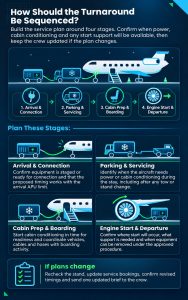
Build the service plan around four stages.
1.Arrival and Connection
Confirm whether the provider will have equipment staged near the stand or ready for connection. Agree how the crew will be advised that the external service is available. For mobile equipment, account for positioning and personnel. The arrival APU limit should be considered when assessing whether the proposed connection time is workable.
2.Parking and Servicing
Identify when the aircraft needs electrical power or cabin conditioning during the stay. Include cleaning, catering preparation or other tasks that depend on the approved ground configuration. If the aircraft will be towed, establish which services are available before and after the move. Confirm how the move affects cable and hose connections, passenger access and departure preparation.
3.Cabin Preparation and Boarding
Set the equipment start time around the operator’s cabin-readiness requirement. Coordinate the location of vehicles, cables and hoses with other ramp activities. Where several services use the same access area, agree the sequence with the crew and handler. Just Aviation’s ramp operations guide provides related context for coordinating ground activities.
4.Engine Start and Departure
Confirm where start will occur, what external support is needed and when the equipment can be removed under the operator’s procedure. The crew, handler and dispatch should have the same service and timing information before boarding begins.
What Changes if the APU Is Inoperative?
An APU defect introduces an aircraft dispatch assessment as well as a ground-service requirement.
The operator should establish the applicable approved Minimum Equipment List conditions and procedures, where relevant, including the support needed at departure and subsequent stops. The handler can then confirm whether the station can provide the specified equipment and personnel.
The service request should identify:
| Requirement | Information needed from the operator or provider |
|---|---|
| Electrical support | Approved external-power configuration and required capacity. |
| Cabin preparation | How heating, cooling and ventilation will be provided. |
| Engine start | Approved method and any separate air-start or electrical-start equipment. |
| Start position | Where the procedure can be conducted and how the aircraft reaches that location. |
| Recovery option | Available response if the booked equipment fails or the start cannot be completed. |
| Onward support | Whether another station in the itinerary needs the same arrangements. |
The operator determines dispatch suitability. Equipment availability and local service confirmation provide inputs to that decision.
How Should Stand Changes and Delays Be Managed?
Review the affected services as soon as a change is advised.
| Change | Required follow-up |
|---|---|
| Move to a stand without fixed power | Confirm a compatible mobile unit and recheck the local APU provision. |
| Move to a different apron | Review apron-specific instructions, equipment access and the departure position. |
| Earlier arrival | Check whether equipment and personnel can meet the revised connection time. |
| Longer ground stay | Extend reservations or establish when shared equipment will return. |
| Later departure | Recheck the applicable APU time reference, cabin-conditioning period and start-support booking. |
| Equipment failure | Obtain replacement availability and apply the local failure procedure. |
| Aircraft substitution | Verify the replacement aircraft’s requirements against the allocated equipment. |
At Le Bourget and Nice, the published rules address use of alternatives and specified exceptions. Assess the actual circumstances against the relevant provision and retain any required explanation or confirmation.
What Does a Practical Recovery Plan Look Like?
For example, a business jet is scheduled to arrive at 14:00 with boarding planned for 14:45. Shortly before arrival, the handler advises a change to a remote stand.
A compatible GPU can be connected on arrival, but cabin air will become available at 14:40. The coordinator confirms the new stand’s operating conditions and passes both service times to the operator.
The operator assesses whether the cabin can be prepared within the available period. The team can then revise boarding, request another compatible unit or assess a different stand. The updated brief records the chosen arrangement, provider confirmation and revised service times. That gives the crew a clear basis for managing arrival and passenger preparation.
How Should Equipment Charges Be Agreed?
Ask the provider to identify what the handling package includes and how additional use is billed.
Check connection charges, minimum booking periods, hourly or block rates, operator attendance, standby time and cancellation terms. Clarify whether cabin conditioning and engine-start support are separate items.
If a delay extends equipment use, obtain the revised charge and approval under the operator’s commercial process. Retain the original request, amendments and service records for invoice review.
Just Aviation’s business jet ground handling cost breakdown explains the wider charging items to reconcile with the accepted service scope.
What Should the Crew Receive Before Arrival?
Provide a concise station brief containing:
- Assigned stand or apron and the status of any provisional allocation.
- Applicable arrival and departure APU limits.
- The time reference used for the departure window.
- Confirmed equipment and connection times.
- Cabin-conditioning and start-support arrangements.
- Any tow or stand change.
- Outstanding items and the agreed process for updates.
How Just Aviation Supports APU-Restricted Turnarounds
Just Aviation coordinates ground services around the operator’s aircraft specifications and turnaround schedule.
Support can include:
- Checking stand and equipment availability.
- Relaying requirements for power, cabin conditioning and start support.
- Coordinating arrival and departure service windows.
- Following up on substitute equipment or stand options.
- Communicating amendments and outstanding confirmations.
Equipment and service delivery remain subject to local confirmation. Aircraft compatibility, approved procedures, technical acceptance and dispatch decisions remain with the operator and its authorised personnel.
For a stop that depends on a particular power source or start arrangement, contact the Just Aviation Operations Control Center at [email protected]
Frequently Asked Questions About APU-Restricted Turnarounds
1. Does a GPU reservation include cabin conditioning?
Check the accepted service scope. Establish how the aircraft will receive cabin heating or cooling and whether separate equipment is booked.
2. Can the same GPU support electrical systems and engine start?
Have the operator specify the approved requirements for each task. The provider should confirm that the allocated equipment meets those requirements.
3. What if the stand is still provisional?
Ask which positions are being considered and what equipment can support them. Reconfirm the service plan once the stand is assigned.
4. Should mobile equipment be ready before the aircraft arrives?
Agree the required connection time with the handler. Account for safe positioning, personnel and the applicable arrival APU limit.
5. Can a delayed departure change the permitted APU start time?
Check the time reference in the local rule and whether it has been revised. Update the crew brief and equipment booking accordingly.
6. What if the ground power cable cannot reach the aircraft?
Ask the handler to assess the parking position and connection arrangement. A compatible mobile unit or another position may be required.
7. How should a long wait with passengers on board be planned?
Confirm the approved power and cabin-conditioning arrangement for the expected duration, including equipment availability if departure moves.
8. Does an equipment failure automatically permit extended APU use?
Apply the airport’s failure and exception provisions to the actual circumstances. Complete any required coordination or documentation.
9. Which records support the final invoice review?
Retain the service order, equipment confirmations, approved amendments, usage records and any agreed additional charges.
Disclaimer
This article provides general ground-support planning guidance. Apply the effective aerodrome publications, NOTAMs, local operating instructions and approved aircraft documentation for the movement. Confirm equipment and personnel availability for the specific service window.
Conclusion
A workable turnaround plan establishes how the aircraft will receive power, cabin conditioning and start support at each stage. Confirm the equipment at the assigned position, align its availability with the published operating window and update the crew whenever the arrangement changes.


 +971 4 5855 689