
Business Jet Ground Handling Cost Breakdown: Airport Fees, Parking Charges and Additional Services

09 November 2026
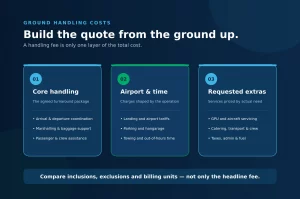
| By Just Aviation TeamA business jet handling quotation is only useful when the operator knows what it includes. A base handling fee may cover an agreed turnaround package, while landing, parking, ground power, aircraft servicing and third-party services appear as separate charges. Another provider may bundle several of those items into one price.
Comparing the headline handling fee alone can therefore produce a misleading result. The practical task is to compare the complete service package for the same aircraft, schedule and ground stay, then identify which charges can change before departure.
Plan the stop around your flight. From parking and ground equipment to passenger and crew arrangements, Just Aviation’s ground handling services bring the services your aircraft needs into one coordinated plan.
Key Takeaways
- Which airport and handling charges belong in the total ground budget?
- What is included in the base handling fee, and what is additional?
- How are parking periods, equipment use and overtime calculated?
- When does repositioning cost more than remaining at the destination?
- Which changes can increase the final invoice?
- What should operators verify before accepting a quotation?
What Does a Business Jet Ground Handling Fee Include?
The base handling fee covers the services specified in the provider’s quotation or agreement. Depending on the station and package, these may include arrival coordination, marshalling, passenger and crew assistance, baggage handling and departure support.
Do not assume that every provider includes the same activities. Request a written list of inclusions, service limits and exclusions. Confirm whether the fee covers both arrival and departure, a single movement or a defined turnaround period.
Just Aviation’s ground handling service information distinguishes the handling fee and requested extras from airport charges that may be shown separately. Confirm the applicable package for each stop.
Which Charges Make Up the Total Ground Cost?
Use the following categories to organize the quotation. Not every item applies to every flight, and some may already be included in a package.
| Cost category | What to confirm |
|---|---|
| Base handling | Included tasks, aircraft category, movement coverage and any turnaround limit. |
| Landing and airport charges | Applicable tariff, aircraft data, minimum charges and any noise or emissions component. |
| Parking | Chargeable period, free allowance if any, billing blocks and stand category. |
| Hangarage and towing | Availability, separate parking treatment, towing movements and associated attendance. |
| Ground support equipment | Equipment specification, delivery, connection, duration and minimum billing unit. |
| Aircraft servicing | Lavatory, potable water, cleaning and other requested services; included quantities or limits. |
| Passenger and crew services | Terminal use, screening, transport, catering and accommodation where requested. |
| Additional attendance | Out-of-hours, holiday, waiting-time and short-notice charges where applicable. |
| Administration and payment | Coordination fees, third-party disbursement charges, currency conversion and payment costs. |
| Taxes and levies | Applicable treatment, supporting requirements and whether the quoted total includes tax. |
Ask whether navigation, passenger or government charges will be invoiced separately. A consolidated handling invoice does not necessarily include every charge associated with the flight.
How Do Aircraft Details Affect the Price?
Provide the aircraft type, registration and maximum take-off weight, together with any other data required by the local tariff. Verify the weight basis and units used in the quotation rather than substituting the aircraft’s expected landing weight.
Aircraft dimensions and configuration can also affect stand suitability, equipment requirements and towing arrangements. A lower equipment rate has little value if the quoted unit cannot support the aircraft at the assigned stand.
Where a tariff differentiates by noise certification, emissions or flight category, supply the relevant evidence requested by the airport or provider. A charging category should not be assumed from the aircraft model alone.
How Are Parking Charges Calculated?
Ask the provider to state when parking starts and ends, which time zone applies and how partial billing periods are treated. Check whether the tariff uses elapsed hours, fixed blocks, calendar days or another method.
For an overnight stay, establish:
- Any free parking allowance and when it expires.
- Whether part of a billing period is charged as a full period.
- The applicable aircraft weight or size category.
- Whether a stand change or extended stay changes the rate.
- Whether towing is required and charged separately.
- What happens if departure is delayed.
Parking availability needs separate confirmation. A quoted parking rate does not establish that space has been reserved for the requested period.
For airports with allocation requirements, coordinate parking with airport slots and the accepted operating schedule.
Is Repositioning Cheaper Than Staying at the Destination?
Compare the complete alternatives before deciding. Lower parking charges at another airport may be offset by extra sectors, fuel, crew time, airport fees and handling at both locations.
A useful comparison is:
| Option | Costs to include |
|---|---|
| Remain at the destination | Destination parking or hangarage, required ground services and crew arrangements. |
| Reposition to another airport | Additional flight costs, extra airport and handling charges, alternative parking, crew logistics and return-sector arrangements. |
The operator must assess aircraft performance, crew limitations and operational suitability. Just Aviation can coordinate enquiries for the supporting airport services.
Any potential saving should be assessed against the passenger schedule and the practical consequences of a return delay.
Which Additional Services Need Clear Pricing?
Ground Power and Cabin Conditioning
Request compatible equipment and identify the expected period of use. Confirm delivery and connection charges, minimum time, billing increments and whether standby time is chargeable.
Where local APU restrictions affect the turnaround, check the current operating instructions and equipment availability. Budgeting for a GPU does not establish that the required unit will be available at the stand.
Lavatory, Water and Cleaning Services
State the required service rather than requesting general aircraft servicing. Ask whether the rate is per visit, per service or quantity-based, and whether repeat attendance is additional.
Aircraft servicing instructions and acceptance remain with the operator and its authorized personnel.
De-icing and Anti-icing
If these services may be needed, request the charging basis, mobilization terms and any minimum charge. Identify which elements depend on actual treatment, such as equipment time or fluid used.
The final requirement follows aircraft condition and applicable operating procedures. A provisional budget should not be presented as a fixed treatment price unless the provider expressly agrees that scope.
Catering, Transport and Crew Arrangements
Check delivery fees, minimum orders, waiting time, cancellation terms and any airside access or escort charges. Confirm whether third-party costs attract an administration fee.
Keep crew support aligned with the actual duty and rest plan. A schedule extension can affect both accommodation and transport bookings.
Should Fuel Be Included in the Handling Comparison?
Show fuel separately so that different quotations remain comparable. Confirm the grade, expected uplift, unit of measurement, price validity, applicable taxes and any delivery, infrastructure or minimum-uplift charges.
If a handling discount depends on fuel purchase, request the qualifying conditions in writing. Compare the combined fuel and ground-service cost before treating the discounted handling fee as a saving.
Just Aviation’s aviation fuel services can be coordinated with handling and the planned servicing time. Fuel requirements and operational decisions remain with the operator.
What Does an Itemized Ground Budget Look Like?
An itemized budget shows how each service contributes to the total and which charges depend on time or usage.
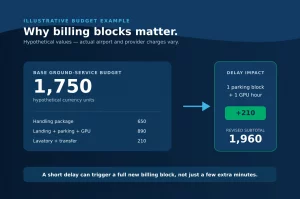
For example, a ground-service budget could be calculated as follows. The amounts are hypothetical and use a common currency for demonstration; actual rates depend on the airport, provider and requested services.
| Illustrative item | Calculation | Amount in hypothetical currency units |
|---|---|---|
| Handling package | One agreed package | 650 |
| Landing charge | One movement under the assumed tariff | 350 |
| Parking | Three chargeable blocks at 120 each | 360 |
| GPU | Two chargeable hours at 90 each | 180 |
| Lavatory service | One attendance | 85 |
| Passenger transfer | One agreed transfer | 125 |
| Subtotal | 1,750 |
Fuel, taxes, other applicable airport charges and unrequested services are excluded from this illustration. An actual quotation must identify those items before a final total can be established.
If a delay adds one parking block and one chargeable GPU hour under these same hypothetical terms, the subtotal increases by 210 to 1,960. The calculation shows why billing units matter alongside quoted rates.
What Should Operators Check Before Accepting a Quote?
Compare quotations against one common brief: aircraft, arrival and departure times, passenger and crew numbers, parking duration and requested services.
Ask each provider to identify:
- Included, additional and excluded services.
- Rate, quantity and billing unit for each charge.
- Estimate validity and items subject to actual use.
- Currency, taxes, deposits and payment terms.
- Cancellation, amendment and waiting-time conditions.
- Outstanding airport, stand or supplier confirmations.
Do not apply a blanket tax assumption to international operations. For example, Farnborough Airport’s published terms state that charges exclude VAT and require VAT to be paid where chargeable. That is a local contractual example, not a universal tax rule.
Why Can the Final Invoice Exceed the Quotation?
A higher total may reflect a changed operation, actual service consumption or an item omitted from the initial estimate. Establish the reason for each difference.
| Change or invoice item | Record to check |
|---|---|
| Longer parking stay | Actual movement times and applicable billing periods. |
| Additional equipment use | Service record, duration and agreed minimums. |
| Out-of-hours attendance | Revised schedule and charging window. |
| Repeat transport or catering | Additional request, delivery record and cancellation terms. |
| Extra towing | Stand or hangar change and movement record. |
| Unfamiliar administration charge | Quotation, agreement and underlying third-party cost. |
Compare the invoice with the latest accepted service order, not only the original estimate. Ask for clarification where an item appears duplicated, unsupported or already included in the package.
How Just Aviation Supports Ground-Cost Planning
Just Aviation coordinates ground handling through local FBOs and handling providers, connecting requested airport services with the operator’s itinerary.
Support can include obtaining itemized quotations, clarifying service inclusions, coordinating parking and equipment enquiries, arranging fuel and crew services, and communicating amendments affecting the agreed scope.
Airport allocations, supplier availability and final charges remain subject to the applicable confirmations and terms. The operator retains responsibility for aircraft suitability, operational decisions and authorization of requested services.
Contact [email protected] with your aircraft type and registration, relevant weight data, airports, UTC schedule, passenger and crew numbers, ground duration and required services. Identify any flexibility in timing or airport choice so alternatives can be compared on the same basis.
Frequently Asked Questions About Business Jet Ground Handling Costs
1. Is the handling fee the total airport cost?
Not necessarily. The handling fee covers the agreed service package, while landing, parking, equipment, terminal services, taxes and third-party charges may be additional. Request an itemized quotation showing what is included and excluded.
2. Is there one standard price for a business jet turnaround?
No. Pricing varies by airport, aircraft, schedule, ground duration and requested services. Compare quotations using the same itinerary and service requirements.
3. Does paying for handling guarantee parking?
Payment alone does not establish parking availability. Obtain written confirmation for the aircraft and the full parking period, and reconfirm availability if the schedule changes.
4. Are ground power and lavatory service always extra?
They may be included in a handling package or charged separately. Check the service allowances, equipment-use limits and any minimum billing period.
5. Can a delay create another full parking charge?
Yes, where the tariff charges each started billing block in full. A delay that crosses into the next block may trigger another charge, even if the additional stay is brief.
6. Does buying fuel remove the handling fee?
Some providers offer a handling discount or waiver linked to fuel purchase. Confirm the minimum uplift, qualifying conditions and which charges remain payable. Compare the combined fuel and ground-service cost before choosing the arrangement.
7. Should a technical stop receive a separate quotation?
Yes. Specify the expected ground time, fuel uplift and required services. A short stop may still incur landing, handling and equipment charges, so the quotation should reflect the actual turnaround plan.
8. What should be retained for invoice review?
Keep the accepted quotation, service order, amendments, applicable terms, movement times and relevant service records. Compare the final invoice with the latest agreed scope and actual service use, and query unexplained or duplicate charges.
Disclaimer
This article provides general planning guidance. Charges, tax treatment, billing methods and service availability vary by airport, provider, aircraft and operation. Obtain current quotations and confirm applicable terms before committing. The numerical example is illustrative only.
Conclusion
Effective ground-cost planning connects the aircraft’s requirements, airport arrangements and service package with the operating schedule. Itemized quotations help operators compare options, while confirmed parking, equipment and handling arrangements support the planned stop. Recording changes and reviewing the final invoice keeps the budget aligned with the services delivered.


 +971 4 5855 689