
Winter Business Jet Ground Equipment Planning: Aircraft Heating, GSE Availability and Departure Readiness

11 November 2026
| By Just Aviation TeamBy Just Aviation Team | November 2026
A winter stop needs a ground plan that works through to departure. Parking may be confirmed while the required heating arrangement, compatible ground power or towing equipment remains unresolved. An overnight stay can also introduce preparation requirements that do not arise during a short turnaround.
Winter ground equipment planning connects the aircraft’s requirements with local capability, personnel and service timing. The useful confirmation is not simply that an airport has equipment, but that a suitable unit can support the aircraft at the required position and time.
Plan the ground arrangements before the winter stop begins. Just Aviation’s ground handling services help operators coordinate equipment enquiries, parking and servicing schedules with local providers.
Key Takeaways
- Which aircraft details should guide winter equipment requests?
- How do cabin heating and technical preheating differ?
- What should operators verify about ground power and towing?
- What does a useful hangar confirmation include?
- How should deicing fit into departure preparation?
- Which changes require the ground plan to be checked again?
What Should Operators Establish Before Requesting Winter Equipment?
Prepare one aircraft-specific service brief covering the aircraft type and registration, UTC schedule, expected ground duration and proposed parking arrangement.
The operator should identify heating, power, servicing and protection requirements from current aircraft documentation and its operating procedures. The local provider can then assess its capability against those specifications.
| Planning information | What it establishes |
|---|---|
| Aircraft type, variant and registration | Relevant equipment compatibility and servicing requirements. |
| Arrival and departure schedule | Equipment attendance, staffing and possible out-of-hours support. |
| Ground duration | Requirements for a turnaround, overnight stay or extended parking. |
| Parking arrangement | Equipment access, towing needs and exposure to conditions. |
| Heating requirements | Permitted method, supporting equipment and preparation needs. |
| Electrical requirements | Required output, capacity, connector and intended use. |
| Requested servicing | Fuel, cabin, lavatory, potable-water and other services to coordinate. |
| Operating constraints | Matters such as APU restrictions, limited access or service hours. |
Keep requested services separate from confirmed arrangements. Record outstanding enquiries so dispatchers, crew and providers can identify what remains unresolved.
How Should Aircraft Heating Be Planned?
Aircraft heating can describe cabin warming, engine or system preheating, or protection during an extended ground stay. Specify the task before selecting equipment.
Cabin Heating
Establish the permitted method and the support needed to use it. This may involve aircraft systems, a manufacturer-permitted external arrangement or suitable hangar conditions.
Confirm power requirements, aircraft access, personnel and when preparation should begin. Cabin comfort does not demonstrate that all technical requirements for operation have been satisfied.
Engine and System Preheating
Where preheating is required, identify the affected components, permitted method and applicable limitations.
There is no single temperature threshold or heating duration suitable for every business jet. Requirements depend on the aircraft and its documentation, as well as the conditions and exposure involved.
Heating Equipment Compatibility
A locally available heater is not automatically suitable for the aircraft.
Before requesting cabin heating, the operator should establish the permitted method and equipment specifications from the aircraft’s current operating and maintenance documentation. Confirm any applicable temperature limits, connection requirements and restrictions on external or portable heaters.
Relay these specifications to the handling provider and obtain confirmation that compatible equipment is available for the planned service window. Technical acceptance remains with the operator and its authorized personnel.
What Should Be Confirmed About Ground Power?
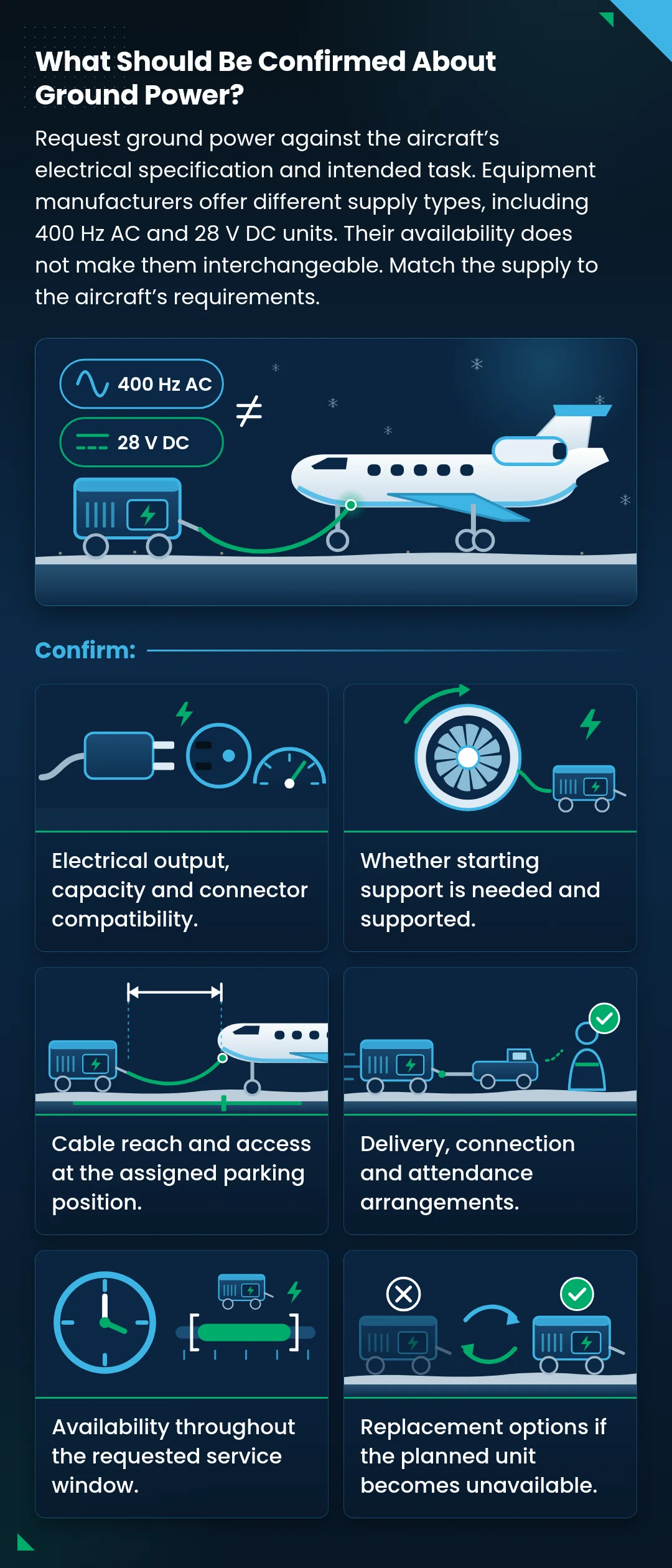
Request ground power against the aircraft’s electrical specification and intended task. Equipment manufacturers offer different supply types, including 400 Hz AC and 28 V DC units. Their availability does not make them interchangeable. Match the supply to the aircraft’s requirements.
Confirm:
- Electrical output, capacity and connector compatibility.
- Whether starting support is needed and supported.
- Cable reach and access at the assigned parking position.
- Delivery, connection and attendance arrangements.
- Availability throughout the requested service window.
- Replacement options if the planned unit becomes unavailable.
Ground power and cabin conditioning should be confirmed separately. A ground power unit supplies electricity; whether it can support the intended heating arrangement depends on the aircraft systems and procedures.
Check auxiliary power unit restrictions alongside this plan. Where preparation depends on APU use, a local restriction or aircraft limitation may change the services required.
What Does a Useful Hangar Confirmation Include?
Confirm the accommodation being offered rather than relying on a general statement that hangarage is available.
Aircraft fit, heating conditions, access and towing all affect whether the arrangement meets the operator’s needs.
| Hangar consideration | What to confirm |
|---|---|
| Aircraft fit | Wingspan, tail height, door clearance and positioning restrictions. |
| Booking period | When space becomes available and when it must be vacated. |
| Heating | Whether heating is provided and the conditions agreed. |
| Access | Crew, inspection and servicing access during the stay. |
| Towing | Compatible equipment, personnel and movement arrangements. |
| Departure preparation | Where preparation will take place and when the aircraft will move outside. |
| Commercial terms | Hangarage, towing, attendance and amendment charges. |
Hangarage can limit exposure, but it does not remove the need to assess contamination before departure. Transport Canada’s ground-icing guidance explains that warm aircraft surfaces can cause precipitation to melt and adhere when an aircraft leaves a heated hangar. The transition outside therefore needs to be considered in the operator’s preparation and treatment plan.
Which Other Ground Equipment Needs Aircraft-Specific Confirmation?
Towing capability deserves early attention when hangar access, remote parking or departure from the assigned stand requires an aircraft movement.
Confirm the tractor, towbar and towbar head, or suitable towbarless capability. Establish the personnel and aircraft-specific procedures needed for the movement.
| Equipment or service | Planning check |
|---|---|
| Towing equipment | Aircraft compatibility, attachments, capacity and personnel. |
| Passenger stairs | Suitable height, positioning and safe winter access. |
| Baggage equipment | Aircraft access and protection during handling. |
| Lavatory and potable-water services | Availability and applicable winter servicing or draining requirements. |
| Access platforms | Suitability for requested inspections, covers or servicing tasks. |
| Passenger transport | Transfers where direct walking access is unsuitable or restricted. |
Equipment must also be usable in the prevailing conditions. Ramp snow, ice and restricted access can affect positioning and movement even when the correct unit is available. The handling team should confirm the serviceability and deployment arrangements for the requested equipment.
How Should Deicing and Anti-Icing Be Coordinated?
Plan contamination-control capability alongside heating and servicing while keeping their purposes distinct.
Cabin warming does not establish that external aircraft surfaces are free of frost, ice or snow. The operator must apply the inspection and treatment procedures relevant to its aircraft and operation.
Ask the provider to confirm:
- Equipment suitability and access to the aircraft’s treatment areas.
- Available fluid types and products.
- Treatment location and operating hours.
- Qualified personnel.
- Expected demand and service-order arrangements.
- Post-treatment communication and documentation.
The FAA’s Aircraft Ground Deicing resources include the 2026–2027 holdover-time guidelines and accompanying general information. Operators using FAA guidance should consult the applicable current material, including revisions, alongside their procedures. These publications are guidance, not standalone regulations.
Holdover time estimates fluid protection under specified conditions. It is not a guaranteed departure window or a replacement for required checks. Weather changes, treatment effectiveness and aircraft conditions remain relevant.
How Should Winter Services Be Sequenced Before Departure?
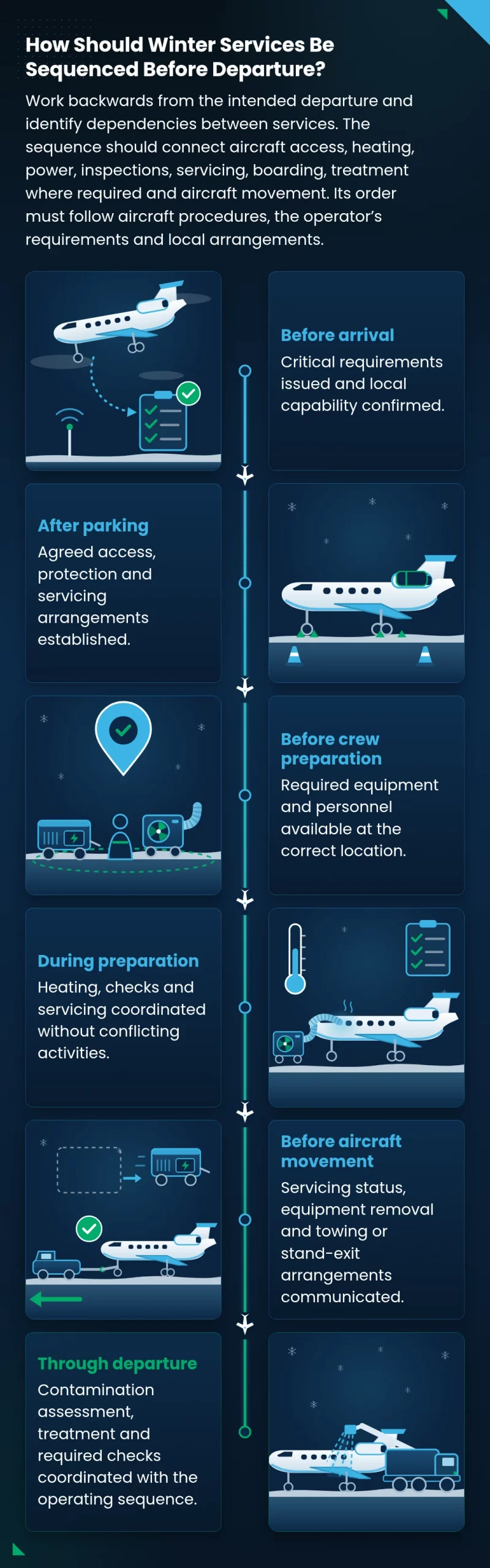
Work backwards from the intended departure and identify dependencies between services. The sequence should connect aircraft access, heating, power, inspections, servicing, boarding, treatment where required and aircraft movement. Its order must follow aircraft procedures, the operator’s requirements and local arrangements.
| Coordination point | What the plan should establish |
|---|---|
| Before arrival | Critical requirements issued and local capability confirmed. |
| After parking | Agreed access, protection and servicing arrangements established. |
| Before crew preparation | Required equipment and personnel available at the correct location. |
| During preparation | Heating, checks and servicing coordinated without conflicting activities. |
| Before aircraft movement | Servicing status, equipment removal and towing or stand-exit arrangements communicated. |
| Through departure | Contamination assessment, treatment and required checks coordinated with the operating sequence. |
Do not impose one fixed order for boarding and deicing across all operations. Establish the sequence for the aircraft and treatment location concerned.
For wider trip preparation, align the ground arrangements with winter route optimization and fuel planning.
What Might an Overnight Winter Ground Plan Look Like?
For example, a business jet is scheduled to remain outside overnight and depart the following morning. The operator first defines the applicable protection, heating and power requirements. The provider then confirms suitable equipment, personnel, access and attendance windows.
The shared plan identifies when preparation begins, which tasks depend on power or heating, how servicing will be completed, and how contamination-control services will be coordinated if required.
If departure moves earlier, the team checks whether equipment and personnel can attend sooner. If the required preparation cannot be completed, the operator reassesses the schedule or other arrangements. An amended flight time should trigger a review of affected ground services. It should not be treated as automatic confirmation that every booking has moved with it.
What Should Operators Check Before Accepting the Arrangement?
Compare the provider’s response with the original aircraft brief. Clarify any confirmation that describes general capability rather than the service being supplied.
Check:
- Equipment specifications, intended use and service window.
- Parking or hangar location and access.
- Personnel and coordination responsibilities.
- Items awaiting airport or supplier confirmation.
- Alternatives for critical services and realistic response times.
- Charging units, minimum attendance and waiting time.
- Cancellation and schedule-amendment terms.
Retain the latest service order and confirmations. A single updated plan helps prevent the crew and local providers from working to different versions.
What Happens if Equipment Becomes Unavailable?
Identify the operational consequence before accepting a substitute. A replacement heater must still meet the aircraft’s requirements. An alternative power arrangement must provide the required output and capacity. A change from hangarage to outdoor parking may require the operator to reassess protection and preparation needs.
Where a critical requirement cannot be met, the operator should assess alternatives such as revised timing, different parking arrangements or another suitable airport. Coordination can establish the options. It does not make an unsuitable substitute acceptable.
How Just Aviation Supports Winter Ground Equipment Planning
Just Aviation coordinates winter ground services through local FBOs and handling providers, aligning arrangements with the operator’s itinerary.
Support can include:
- Relaying heating, power and towing specifications.
- Coordinating equipment, parking and hangar enquiries.
- Clarifying service windows and communicating schedule changes.
- Following up on availability and outstanding arrangements.
Bring your winter stop into focus with Just Aviation. Contact our Operations Control Center at [email protected] to discuss aircraft requirements, local options and preparation priorities.
Availability remains subject to airport and provider confirmation. Technical acceptance and operational decisions remain with the operator and its authorized personnel.
Frequently Asked Questions About Winter Business Jet Ground Equipment
1. Does every business jet need preheating in winter?
Requirements vary by aircraft, conditions and exposure. Use current aircraft documentation to establish whether preheating is required and which method is permitted.
2. Does a GPU provide cabin heating?
A GPU supplies electrical power. Whether it supports the intended heating arrangement depends on the aircraft and procedures. Confirm power and heating separately.
3. Can any portable heater be used?
No. The equipment and method must be suitable under the aircraft manufacturer’s instructions for the intended task.
4. Does hangar availability mean heated storage is available?
Not necessarily. Confirm heating conditions, aircraft fit, access times and towing arrangements as part of the booking.
5. Should operators carry their own towbar?
This depends on the aircraft and confirmed local capability. Establish whether compatible towing equipment is available before deciding what must be carried.
6. Does cabin heating remove the need for deicing?
No. Cabin preparation and external contamination control are separate tasks. Apply the operator’s required inspections and treatment procedures.
7. How far ahead should winter equipment be requested?
Lead time depends on local capability and demand. Request critical services during trip planning and obtain confirmation before relying on them.
8. Does a schedule change require new equipment confirmation?
It can. Reconfirm affected equipment, staffing, hangar access and servicing windows when arrival or departure times change.
9. Who determines whether the aircraft is ready to depart?
The operator and its authorized personnel determine readiness under applicable aircraft documentation, procedures and operating requirements. Equipment bookings do not constitute operational approval.
Disclaimer
This article provides general planning guidance. Equipment requirements, service availability and operating restrictions vary by aircraft, airport, provider and conditions. Use current aircraft documentation and applicable operator procedures, and confirm local arrangements before relying on them.
Conclusion
A reliable winter ground plan starts with aircraft-specific requirements and confirmed local services. Matching heating, power, hangarage and towing arrangements to the departure sequence gives operators a clearer view of what is ready, what remains unresolved and which changes require action.


 +971 4 5855 689