
Jet A vs Jet A-1 in Europe: What Business Jet Operators Should Confirm Before Uplift

28 November 2026
| By Just Aviation TeamBy Just Aviation Team | November 2026
Jet A-1 is the established fuel grade at many European airports, while Jet A is widely used in North America. For a business jet operating between the two regions, fuel planning depends on the grade actually supplied, the aircraft’s approved limitations and the fuel remaining from previous sectors.
The difference becomes particularly relevant when a supplier offers another grade, an aircraft carries mixed fuel, or a long sector introduces low fuel-temperature considerations. Dispatch, the flight crew and the supplier need consistent information before the uplift begins.
Confirm the fuel arrangement as part of the flight plan. Just Aviation’s aviation fuel services coordinate supplier enquiries, fuel releases, pricing, payment and delivery timing around the operator’s requirements.
Key Takeaways
- What distinguishes Jet A from Jet A-1?
- Which aircraft approvals and operating limitations need checking?
- How should remaining fuel and mixed grades be assessed?
- What should the supplier confirm before dispatch relies on the uplift?
- Which delivery records should be checked and retained?
What Is the Difference Between Jet A and Jet A-1?
Jet A and Jet A-1 are kerosene-type aviation turbine fuels. Their principal operational distinction is the maximum permitted freezing point. Both grades are covered by ASTM D1655, while DEF STAN 91-091 specifies Jet A-1. Other specification and additive requirements also need consideration.
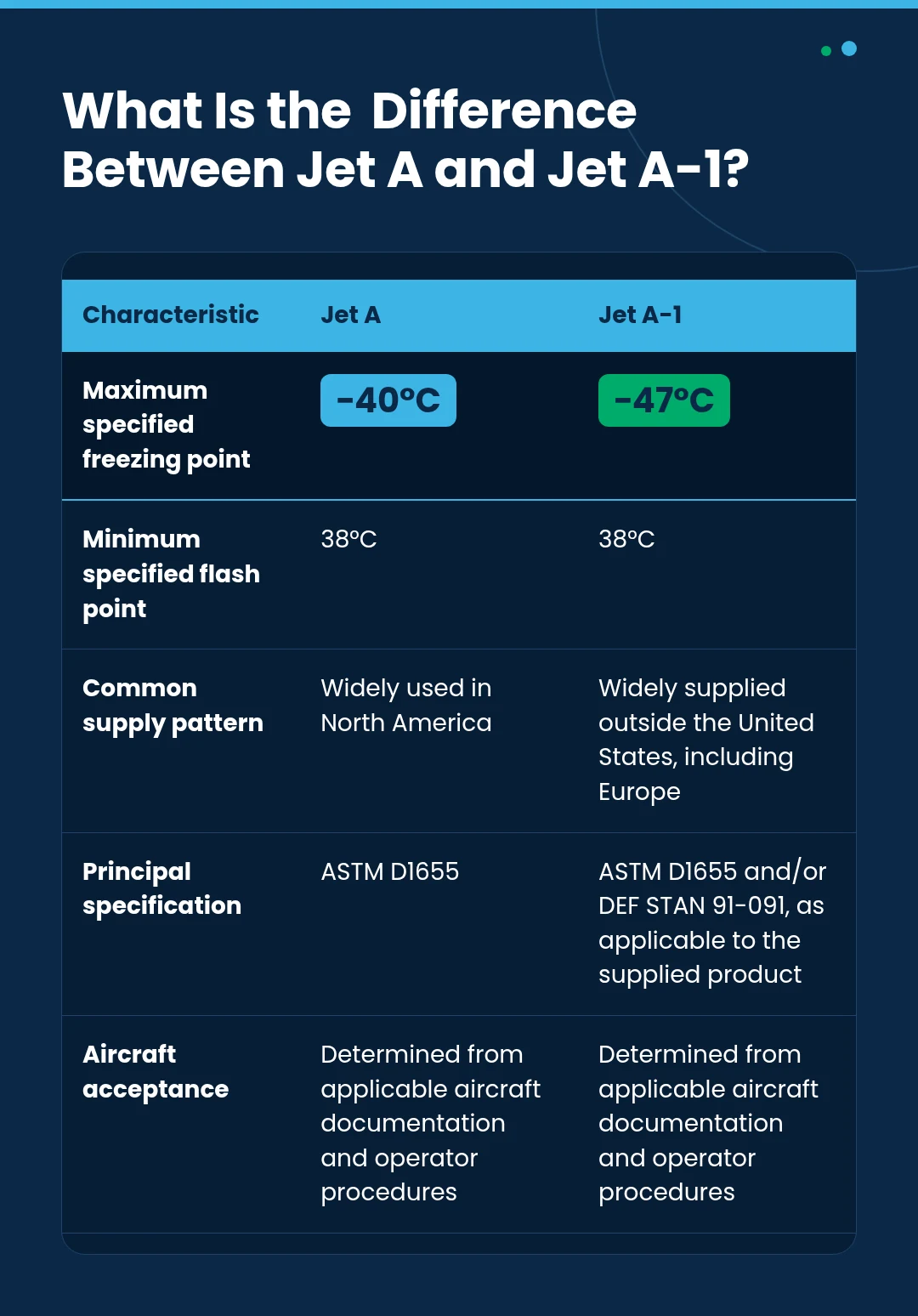
The freezing-point figures are specification limits. A particular batch can have a lower measured freezing point, but any use of that value in flight planning needs appropriate documentation and an aircraft-approved method. The lower specification limit for Jet A-1 gives it different cold-temperature characteristics from Jet A.
What Should Operators Confirm About Fuel Supply in Europe?
Ask the supplier to identify the actual grade and specification available for the planned uplift. A previous delivery, standing contract or airport listing should be checked against the current arrangement when a grade change is proposed.
IATA’s guidance addresses the introduction of Jet A at locations traditionally supplied with Jet A-1. It identifies the need for local change management, correct grade identification, coordination with airport infrastructure and review of contractual requirements. A supplier’s ability to source Jet A therefore needs to be assessed alongside the arrangements for delivering it at that location.
For the trip file, record the confirmed grade, supplier, into-plane provider and service window. If the supplier advises a change, obtain the revised details before the operator completes its acceptance review.
Which Aircraft Approvals Should Be Checked?
The operator should establish which fuel grades and specifications are approved for the particular aircraft and engine installation. Use the current Aircraft Flight Manual (AFM), applicable supplements, manufacturer instructions and operator procedures.
The review should address:
- Approved fuel grades and specifications.
- Any required or restricted additives.
- Fuel-temperature limitations and monitoring procedures.
- Instructions for mixed-grade fuel.
- Relevant aircraft modifications or operating limitations.
EASA identifies aircraft type certification and the AFM as the basis for determining permitted fuel grades and specifications. Its guidance also emphasises accurate communication of the grade to the crew. The associated Safety Information Bulletin provides advisory recommendations for managing Jet A in a Jet A-1 environment.
A fuel coordinator can obtain supplier information and communicate the proposed arrangement. The operator and its authorised personnel assess aircraft suitability and the resulting dispatch conditions.
How Does Freezing Point Affect Flight Planning?
A freezing-point limit describes a fuel property established by a specified laboratory test. It should be considered alongside the aircraft’s fuel-temperature limitations and procedures.
The planning review should consider the anticipated flight duration, temperature profile, route and fuel already on board. For a long sector or an operation through colder air masses, the operator may need to assess how fuel temperature will be monitored and what actions are available under its approved procedures.
Jet A’s maximum specified freezing point is 7°C higher than Jet A-1’s. That difference can affect the planning assumptions used for cold-temperature operations. The actual aircraft operating limit and required margin come from the applicable aircraft documentation.
Before dispatch relies on a batch-specific freezing point, establish whether suitable quality documentation is available and whether the operator’s procedures permit its use. If the necessary information is unavailable, refer the decision to the operator’s responsible technical or flight operations function.
What Happens When Jet A and Jet A-1 Are Mixed?
Mixed-grade conditions can arise when an aircraft arrives with Jet A from a previous sector and takes on Jet A-1, or when the supply system contains commingled fuel.
The operator needs to establish the applicable treatment of the fuel remaining in the aircraft. Record the previous grade where known, the remaining quantity and the new uplift. Apply the manufacturer’s instructions for mixed grades before assigning fuel-temperature limits.
EASA recommends following the design approval holder’s instructions for mixtures and applying the most conservative limits where instructions are unavailable. Its guidance also addresses correct designation of commingled fuel within airport supply systems.
A partial Jet A-1 uplift alone does not establish that all fuel in the tanks meets Jet A-1’s freezing-point specification. The crew briefing and dispatch records should reflect the assessment made under the approved procedure.
Which Additive Requirements Need Separate Confirmation?
The fuel grade does not answer every additive question. Confirm the aircraft’s requirements and whether the supplier can meet them through an approved delivery arrangement.
| Additive consideration | Purpose | Pre-uplift check |
|---|---|---|
| Static dissipator additive (SDA) | Controls the accumulation of static electrical charge during fuel handling. | Confirm the supplied specification and applicable conductivity controls with the provider. |
| Fuel system icing inhibitor (FSII) | Reduces the freezing point of water that may be present in the fuel system. | Verify aircraft approval, required concentration and the supplier’s dosing capability where applicable. |
| Other approved additives | May address properties such as oxidation stability or lubricity. | Check compatibility and requirements against aircraft documentation and the supplied specification. |
Shell explains the different purposes of static dissipator and fuel system icing inhibitor additives. FAA Advisory Circular 20-29C provides guidance on the approval and use of FSII in aircraft and engines.
If FSII is required, include it explicitly in the fuel request. Confirm whether it is supplied premixed or added during delivery, how the concentration is controlled and what record will be provided.
What Should a Fuel Confirmation Include?
A commercially accepted request should give dispatch enough information to assess whether the uplift can support the flight.
| Confirmation item | Information to establish |
|---|---|
| Aircraft and movement | Registration, airport, operating date and requested service time. |
| Fuel grade and specification | Exact product to be delivered and the specification under which it is supplied. |
| Quantity | Requested amount, units and any supply restriction. Distinguish an uplift request from a target total fuel-on-board instruction. |
| Additives | Required additive, supplier capability and documentation where applicable. |
| Into-plane service | Provider, stand access, operating hours and expected delivery window. |
| Fuel release and payment | Release reference or agreed payment arrangement, including acceptance by the delivering provider. |
| Price and additional charges | Currency, pricing basis, validity, applicable taxes and separately charged services. |
| Changes | Process for revising the aircraft, quantity, grade or service time. |
If the supplier can confirm the grade but has yet to confirm the requested quantity or delivery window, record those items as outstanding. The turnaround estimate should reflect the service that has actually been confirmed.
How Should Quantity, Density and Delivery Units Be Reconciled?
Aircraft fuel requirements are commonly managed by mass, while commercial deliveries may be measured or priced by volume. Record the units at each stage so dispatch, the crew and accounts payable can reconcile the same uplift.
For example, 3,000 litres at a density of 0.800 kilograms per litre represents 2,400 kilograms. This example assumes the volume and density use the same temperature basis.
For the actual uplift, use the delivery information and the operator’s approved reconciliation method. Check whether the volume is observed or temperature-corrected, identify the units used and resolve any unexplained difference with the provider.
A clear request should also establish whether the supplier is being asked to deliver a fixed quantity or fuel the aircraft to a specified total. The final required fuel quantity remains the operator’s responsibility.
Which Records Should Be Checked at Delivery?
The fuel ticket should accurately identify the product delivered. Compare it with the confirmed order before accepting the record as evidence for the trip file.
Check the:
- Aircraft registration, airport and delivery date.
- Fuel grade and delivered quantity.
- Units and density information where provided or required.
- Additive details where applicable.
- Supplier, ticket number and relevant release reference.
IATA recommends clear communication of the actual grade throughout the delivery process and alignment of markings and documentation with the product supplied. It also identifies contracts and insurance provisions as matters to review when a different grade is introduced.
If the ticket identifies Jet A while the order specifies Jet A-1, establish the actual product and refer the discrepancy to the operator’s authorised personnel before relying on the planned fuel assumptions.
How Do SAF and ReFuelEU Affect the Uplift?
A sustainable aviation fuel arrangement still needs an identified aviation fuel grade and specification. EASA explains that fuel meeting the applicable ASTM D7566 blending and certification requirements is redeclared and treated as ASTM D1655 Jet A or Jet A-1. Ask the supplier to distinguish the technical fuel certification from sustainability documentation.
Where ReFuelEU Aviation applies, the operator should assess its refuelling and reporting obligations separately. Article 5 establishes an annual requirement at each relevant Union airport to uplift at least 90% of the yearly aviation fuel required, subject to the regulation’s provisions and exceptions. Applicability depends on the defined operator and airport scope.
For a specific stop, confirm the physical product available, the requested quantity and any documentation needed for the operator’s reporting. A supplier-wide regulatory obligation alone does not confirm a particular uplift.
How Should a Proposed Grade Change Be Managed?
Consider a business jet scheduled for a long sector from Europe. The fuel order specifies Jet A-1, but the supplier advises that Jet A is available for the requested delivery.
The coordinator obtains the exact specification, proposed delivery details and supporting information. The operator checks aircraft approval, fuel remaining on board, temperature limitations and the route implications. Procurement verifies whether the contract and release cover the proposed grade.
If the operator accepts the arrangement, update the order, crew information and delivery records consistently. If the review remains unresolved, assess another supplier, a revised service time or another uplift location. Any changed fuel stop also needs review against the itinerary’s airport, permit and handling arrangements.
How Just Aviation Supports European Fuel Coordination
Just Aviation coordinates fuel arrangements with suppliers and local providers around the operator’s approved requirements.
Support can include:
- Confirming available grades, specifications and requested quantities.
- Coordinating fuel releases, quotations and payment arrangements.
- Relaying additive requirements and obtaining provider confirmation.
- Aligning delivery with handling and departure preparation.
- Following up on revised requests and delivery records.
Availability and delivery remain subject to supplier and airport confirmation. Aircraft approval, fuel planning, technical acceptance and final operational decisions remain with the operator and its authorised personnel.
For a European stop with a specific grade, additive or delivery requirement, contact the Just Aviation Operations Control Center at [email protected]
Frequently Asked Questions About Jet A and Jet A-1 Uplifts in Europe
1. Can a business jet approved for Jet A-1 also use Jet A?
Check the aircraft’s approved grades and specifications. Acceptance depends on the applicable aircraft documentation, limitations and operator procedures.
2. Does Jet A-1 always have a freezing point of exactly −47°C?
Its specification requires a freezing point of −47°C or below. Individual batch results can differ.
3. Should dispatch request a batch-specific freezing-point result?
Request supporting quality information when the operator’s approved planning method requires it. Establish availability early enough for the technical assessment to be completed before departure.
4. Does Jet A-1 automatically include FSII?
Specify any aircraft-required FSII separately and obtain confirmation from the supplier. The aircraft approval and additive delivery arrangement both need checking.
5. What should be checked after an aircraft substitution?
Reconfirm approved fuel grades, additive requirements, quantity, delivery connection and release details for the replacement aircraft.
6. Can another supplier use the existing fuel release?
Obtain confirmation that the delivering provider accepts the release and that its registration, location, date and commercial details remain applicable.
7. What if the airport listing and supplier confirmation show different grades?
Ask the provider to establish the actual product available for delivery and obtain the relevant documentation. The operator should assess the flight using the confirmed product.
8. How should a supplier’s quantity limit be handled?
Pass the confirmed limit to the operator for a revised fuel assessment. Any resulting stop or route change should then be coordinated across permits, airport access and ground services.
9. Which documents should be retained after uplift?
Keep the accepted order, release or payment confirmation, delivery ticket, relevant quality or additive records and any amendments affecting the operator’s fuel assessment.
Disclaimer
This article provides general operational planning guidance. Fuel acceptance depends on current aircraft documentation, operator procedures, applicable requirements and the product supplied. Confirm local availability and supporting documentation for each uplift.
Conclusion
A European uplift should be planned around a confirmed grade, specification, quantity and delivery window. When the proposed supply changes, complete the aircraft and operational assessment, update the commercial arrangement and give the crew consistent information before the fuel is accepted.


 +971 4 5855 689