
Regional Flight Coordination at Ouani Airport, Comoros: Planning Inter-Island Operations With Limited Airport Services

07 October 2026
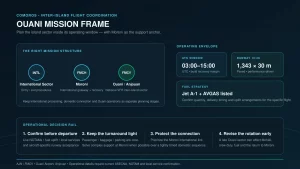
| By Just Aviation TeamOuani Airport (AJN/FMCV) serves Anjouan as part of the Comoros domestic air network. The current ASECNA aerodrome directory classifies Ouani for national VFR traffic, with a paved runway of approximately 1,343 × 30 metres and published ATS hours from 0300 to 1500 UTC. For operators, the main planning challenge is not complex ground handling. It is keeping the aircraft, fuel strategy, passenger connection and inter-island schedule inside a relatively compact operating environment where Moroni remains the country’s principal international gateway.
Key Takeaways
- How should an international itinerary be structured when continuing to Ouani?
- What does Ouani’s VFR and domestic classification mean for charter planning?
- How much schedule margin is useful around the published operating period?
- How does the 1,343-metre runway affect aircraft and payload planning?
- What does the published runway-use pattern mean for flight preparation?
- How should a delayed inter-island flight be recovered without breaking the next sector?
- When does Moroni become the practical support or recovery point?
Treat Ouani as an Inter-Island Airport, Not an International Gateway
The first planning distinction is regulatory and operational. ASECNA currently lists Ouani as national and VFR, while Prince Said Ibrahim Airport in Moroni is published for international and national IFR/VFR operations.
For international itineraries, operators should structure the trip around an airport authorized for the required international arrival or departure procedures, with Moroni providing the principal international gateway before a domestic continuation to Anjouan where applicable.
A typical itinerary may look like: International sector → Moroni → inter-island sector → Ouani
The return trip works in reverse. This keeps international processing, landing authorization and domestic island connectivity as separate parts of the trip rather than assuming that Ouani provides the same entry functions as Moroni.
The Published Operating Day Sets the Rhythm of the Trip
Ouani’s published ATS operating hours are currently 0300–1500 UTC. Operators should separately confirm the availability of the other services required for the planned movement. Flights planned later in the published ATS period also need sufficient margin for passenger reporting, inbound delays, aircraft turnaround, weather variation and any onward sector. For a late-afternoon operation, build enough room for:
- Passenger reporting
- Any inbound delay from Moroni or Mohéli
- Aircraft turnaround
- Weather variation
- The next planned sector
A delay that consumes the remaining operating window can affect the complete inter-island sequence rather than only one arrival time.
Ouani Has a Specific Runway-Use Pattern
ASECNA published a time-limited NOTAM in early 2026 closing RWY 10/28 during specified periods for works. That notice has expired and should not be treated as a current closure. Operators should nevertheless check the live NOTAMs for the planned operating date.
It means flight crews need to work from the current Ouani aerodrome information and weather picture rather than assuming normal interchangeable use of both runway directions. Wind, aircraft performance and current local conditions remain part of the operator’s assessment.
For trip planning, the practical point is simple: Ouani’s runway arrangement is specific enough that the current airport data belongs in the flight review, not just the airport coordinates and runway length.
Aircraft Choice Matters More at Ouani Than at Moroni
Ouani’s primary runway is approximately 1,343 metres long and 30 metres wide. That does not make the airport unsuitable for charter flying, but it changes the aircraft-selection discussion. A light turboprop operating an inter-island passenger sector creates a different performance case from a heavier business aircraft carrying substantial fuel.
The operator’s assessment may need to consider:
- Landing and takeoff weight
- Temperature
- Wind
- Payload
- Fuel required for the next sector
- Runway condition
- Published pavement information
- Available operating margin
For business aviation, “Can the aircraft reach Anjouan?” is not the useful question. The useful question is: Can the aircraft operate the complete Ouani arrival and departure at the planned weights and conditions?
Fuel Is Listed, but the Uplift Still Needs Confirmation
ASECNA’s aerodrome directory lists Jet A-1 and AVGAS among Ouani’s published fuel facilities. Operators should confirm current availability, quantity, delivery timing and arrangements for the specific flight.
For a flight that depends on local fuel, obtain the aircraft-specific uplift status before departure. This is especially relevant where Ouani is the middle sector of a longer island rotation.
For example: Moroni → Ouani → Mohéli → Moroni
If the second or third sector depends on fuel at Ouani, the fuel confirmation becomes part of the route plan, not merely a turnaround service. Where local uplift is uncertain, the operator may instead evaluate carrying additional fuel from the supporting airport, subject to aircraft performance and payload.
Keep the Ouani Turnaround Light
Ouani works best when the aircraft arrives needing relatively little. Routine passenger exchange, baggage and the next departure can form a simple inter-island turnaround. A flight needing several additional services creates more dependency on local capability.
Before departure, separate the ground requirement into:
- Essential at Ouani: Passenger and baggage arrangements, parking arrangements and any fuel requirement that has been confirmed in advance.
- Better solved at a larger supporting station where practical:- Complex servicing, specialist GSE, significant technical work or other aircraft-specific support that has not been confirmed locally.
The aim is not to avoid using Ouani services. It is to keep the aircraft from becoming dependent on a capability that was never established for the mission.
Inter-Island Passengers Need Connection Margin, Not Just Flight Time
The flying distance between the Comoros islands is short. That can make the overall trip look easier than it is. A passenger connecting from an international arrival at Moroni still needs time for: arrival processing → baggage → domestic connection → Ouani sector
Likewise, a passenger leaving Anjouan for an international departure from Moroni needs enough margin between the inter-island flight and the international sector. A tightly scheduled domestic connection leaves little recovery room for:
- Weather
- Aircraft rotation delays
- Passenger processing
- Baggage transfer
- Changes to the inter-island operating sequence
For a time-sensitive international connection, protect the Moroni flight first rather than assuming that a short airborne sector guarantees an easy connection.
A Delay Can Break More Than One Island Sector
Inter-island flying often uses the same aircraft across several sectors. A delay at Ouani can therefore propagate quickly.
Consider: Moroni → Ouani → Mohéli → Moroni
If the first arrival into Ouani runs late, the important decision is not simply how quickly the aircraft can turn. The operator also needs to know whether the revised schedule still supports:
- Ouani departure
- Mohéli arrival
- The next passenger group
- Fuel
- Remaining operating windows
- Crew duty
- Return to Moroni
Pushing one sector later may not recover the day if it makes the next island impossible. The better recovery can be a revised sequence rather than repeatedly shortening each turnaround.
Moroni Is the Natural Support Anchor for the Island Network
Prince Said Ibrahim International Airport has the broader operating environment in the Comoros network. That makes Moroni particularly relevant when an Ouani mission requires:
- International arrival or departure
- Fuel coordination
- More substantial handling
- Passenger recovery
- Crew repositioning
- Technical-support arrangements
- An alternative routing after disruption
This does not make Moroni an automatic alternate for every operational situation. Aircraft performance, weather, fuel and current airport conditions still determine the actual flight plan. From a trip-coordination perspective, however, Moroni is the logical place to build the wider support strategy around an Anjouan operation.
Do Not Build an Ouani Flight Around Unconfirmed Technical Support
Public AIP information for Ouani is much more limited than the detailed airport-support information published for Prince Said Ibrahim.
That matters if the aircraft develops a defect. For a charter mission where an AOG would seriously affect passengers or the remaining island schedule, consider the recovery chain before departure:
maintenance control → required technical support → parts availability → arrangements for delivery to Anjouan → aircraft recovery
The operator may also need a separate passenger-recovery plan. A technical issue on Anjouan can otherwise turn a short domestic sector into a much more complex recovery and passenger-management situation.
The Airport Has Had Runway Works in 2026, So Current NOTAMs Matter
ASECNA issued NOTAMs earlier in 2026 closing RWY 10/28 during defined periods for works. Those notices were time-limited and should not be treated as a current closure in September.
They do reinforce an important trip-planning point: use the live Ouani NOTAM picture for the operating date.
For an airport with a single runway and a defined ATS operating period, temporary restrictions can have a significant effect on the planned itinerary.
| Practical Scenario: A Moroni Connection Starts Running Late A regional aircraft is planned from Moroni to Ouani with passengers connecting from an international arrival. The same aircraft later continues on another domestic sector. The international flight into Moroni arrives late. Instead of immediately pushing every subsequent flight later by the same amount, the operator reviews the remaining Ouani operating window, the onward sector and fuel plan. The passenger connection can still be completed, but preserving the original onward rotation would leave very little margin later in the day. The inter-island sequence is therefore revised before departure from Moroni rather than trying to recover the lost time during the short Ouani turnaround. Passenger and ground arrangements at Ouani are updated to the new arrival and departure times. The operational lesson is that Ouani delays are best managed at network level. The flight itself may be short, but one late sector can affect the rest of the island rotation. |
|---|
How Just Aviation Supports Ouani Inter-Island Operations
Just Aviation can coordinate the Ouani ground requirements with the wider Comoros itinerary, including local handling arrangements, requested fuel confirmation, coordination with local passenger-transfer providers and schedule changes between Anjouan and the supporting airport.
For international missions, the domestic Ouani sector can be aligned with the operator-selected entry and exit arrangements through Moroni. Aircraft performance, fuel calculations, runway acceptance, maintenance, dispatch, flight release and command decisions remain with the operator and PIC as applicable.
For Comoros inter-island and business aviation support, contact the Just Aviation Operations Control Center at [email protected]
Frequently Asked Questions About Ouani Airport and Inter-Island Flights
1. Is Ouani Airport an international airport for private jet arrivals?
ASECNA currently classifies Ouani as a national aerodrome. International itineraries generally need an authorized Comoros entry point such as Moroni before the domestic Anjouan sector.
2. What are the published ATS operating hours at Ouani Airport?
The current ASECNA aerodrome directory lists ATS operating hours from 0300 to 1500 UTC. Other airport and ground-service availability needs to be confirmed separately for the planned movement.
3. Is Jet A-1 listed at Ouani Airport?
Yes. ASECNA lists Jet A-1 among Ouani’s published fuel facilities. Current availability, required quantity and delivery arrangements still need confirmation for the specific flight.
4. What size runway does Ouani Airport have?
The published paved runway is approximately 1,343 metres long and 30 metres wide. Aircraft suitability depends on the operator’s performance assessment for the actual weight and conditions.
5. Can business jets operate to Ouani Airport?
Potentially, depending on aircraft type, weight, runway performance and current conditions. The relatively short runway makes aircraft-specific assessment important.
6. Why is Moroni important when planning a flight to Anjouan?
Moroni is the principal international gateway in the Comoros network and provides a broader support environment for international connections, fuel coordination and operational recovery.
7. How much connection time is useful between an international arrival at Moroni and a flight to Ouani?
There is no single standard time. The itinerary needs enough margin for international processing, baggage, domestic reporting and the remaining Ouani operating window.
8. Can Ouani be used as a fuel stop during an inter-island rotation?
Only when the required Jet A-1 quantity and delivery arrangement are confirmed and the aircraft remains within its approved performance and fuel plan.
9. What happens if an Ouani flight runs late near the end of the operating day?
The operator may need to revise the remaining island rotation rather than simply move every subsequent sector later.
10. Why are current NOTAMs particularly important at Ouani?
Ouani has a single runway, and temporary runway works affected operations during defined periods earlier in 2026. Operators should check current NOTAMs for the planned operating date.
Disclaimer
Ouani operating hours, runway status, fuel availability, local services and inter-island schedules can change. Operators need current ASECNA, NOTAM and local-service information for the aircraft and operating date. Aircraft performance, fuel planning, loading, maintenance, dispatch, flight release and command decisions remain with the operator and PIC as applicable.
Conclusion
Ouani flight coordination is primarily about fitting the inter-island mission inside the airport’s operating and support limits. Operators need a realistic aircraft and fuel plan, enough margin around the 0300–1500 UTC service day, and international connections structured through an appropriate entry point such as Moroni. Because the island sectors are short, it is easy to underestimate how quickly one delay can affect the full rotation. Planning Ouani as part of the wider Comoros network, rather than as an isolated airport stop, produces a more reliable operating plan.


 +971 4 5855 689