
Aviation Security Requirements for International Charter Operations

27 October 2026
| By Just Aviation TeamInternational charter operators need to comply with aviation security requirements that differ according to the aircraft, flight classification and countries involved. These requirements affect aircraft access, passenger and baggage screening, crew authorization and the security procedures used during ground operations.
Aviation security, commonly known as AVSEC, addresses deliberate acts of unlawful interference with civil aviation. Unlike flight safety requirements, AVSEC focuses on preventing unauthorized access, prohibited items and security threats to aircraft and airport operations.
For operators conducting international charter flights, the priority is to establish which security procedures apply at each airport and how those requirements are implemented through the operator’s security programme and local ground arrangements.
Key Takeaways
- Which international aviation security standards apply to charter aircraft operators?
- How do ICAO, EU and national regulations affect charter flight security requirements?
- What aircraft security checks, passenger screening and baggage controls need consideration?
- How do crew authorization, airport access and security training affect international operations?
- When are additional station security procedures required?
- What security documentation and coordination are relevant before departure?
1. International Aviation Security Regulations for Charter Operators
Aviation security requirements originate from international standards and national legislation. The applicable obligations depend on the State of the Operator, the countries where flights are conducted and the aircraft’s operating classification.
ICAO Annex 17 and National Security Programmes
ICAO Annex 17, Aviation Security, establishes international Standards and Recommended Practices (SARPs) for protecting civil aviation against acts of unlawful interference.
Contracting States implement these standards through their national civil aviation security programmes and associated regulations. Consequently, charter operators need to identify the national requirements applicable to their flights rather than relying on a single international security procedure.
ICAO’s guidance on Aircraft Operator Security Programmes and Supplementary Station Procedures addresses two important obligations for commercial operators:
- An Aircraft Operator Security Programme (AOSP) developed in accordance with the requirements of the State of the Operator.
- Written Supplementary Station Procedures (SSPs) addressing applicable requirements in other States that are not already covered by the operator’s security programme.
An operator flying internationally needs to establish whether its approved security arrangements address the requirements of the intended destinations and stations.
European Union Aviation Security Requirements
The European Union’s aviation security framework is established under Regulation (EC) No 300/2008, with detailed requirements for aircraft protection, passenger and baggage screening, cargo security and airport access set out in Commission Implementing Regulation (EU) 2015/1998, consolidated as of 1 October 2026.
For international charter operators, the applicable procedures depend on the flight classification, airport and national security requirements. The framework provides for specific exemptions and alternative measures, meaning charter operations may be subject to different security arrangements from scheduled commercial flights.
United States Charter Security Programmes
In the United States, the Transportation Security Administration (TSA) regulates aircraft operator security programmes under 49 CFR Part 1544.
Under 49 CFR § 1544.101(d), the Twelve-Five Standard Security Program applies to aircraft operations meeting the applicable regulatory criteria, subject to specified conditions and exceptions.
Section 1544.101(f) also establishes Private Charter Standard Security Program requirements for certain passenger operations, including those involving aircraft exceeding 45,500 kg maximum certificated takeoff weight, aircraft configured with 61 or more passenger seats, or specified access to airport sterile areas.
The applicable security programme depends on the flight classification, aircraft characteristics and passenger processing arrangements. Operators must assess the complete TSA criteria rather than relying on aircraft weight alone.
2. Aircraft Security Checks and Ground Protection
Aircraft security requirements concern the protection of the aircraft against unauthorized access and prohibited articles. The necessary procedure depends on the aircraft’s security status, previous movements and applicable national regulations.
Aircraft Security Checks and Searches
Aircraft security checks and searches are distinct procedures. A security check examines specified aircraft areas for prohibited articles or signs of unlawful interference, while a security search involves a more extensive examination under the applicable regulations.
Under Commission Implementing Regulation (EU) 2015/1998, aircraft security checks and searches must be conducted in the circumstances specified by the applicable provisions.
The appropriate procedure depends on the aircraft’s security status, previous movements and applicable national requirements. Operators need to confirm that the required checks or searches are carried out by authorized personnel in accordance with the relevant security procedures.
Protection of Parked Aircraft
When an aircraft remains on the ground, access arrangements depend on the airport’s security procedures, aircraft location and applicable operator security programme.
An aircraft positioned on a remote stand or remaining overnight can require additional coordination of authorized access, servicing personnel and protection arrangements. The handling plan needs to establish how approved personnel, aircraft servicing and passenger movement will be managed under the relevant security procedures.
Aircraft Access During Ground Servicing
Refueling, catering, cleaning, baggage loading and technical servicing involve personnel accessing or working near the aircraft.
For these activities, the relevant airport access authorization and operator security controls need to be respected. Ground-service coordination is particularly important when personnel from different organizations are working around the aircraft during the same turnaround. Just Aviation’s ground handling coordination supports the arrangement of requested ground services through the applicable local handling providers and airport procedures.
3. Passenger, Baggage and Cargo Security
Passenger screening and baggage security arrangements depend on the applicable regulations, flight category and airport facilities. International charter operators need to establish the security processing arrangements relevant to each departure rather than assuming that private passengers are exempt from airport controls.
Passenger and Cabin Baggage Screening
Applicable aviation security requirements determine how passengers and cabin baggage are screened before boarding. For EU operations, Regulation (EU) 2015/1998 establishes screening methods and associated security controls, with provisions for exemptions and approved alternative measures.
Where a charter flight uses dedicated general aviation or VIP facilities, the security arrangements still need to meet the requirements applicable to the operation and airport.
Hold Baggage and Passenger Reconciliation
Hold baggage security involves screening and controls that depend on the relevant regulatory framework. Where baggage reconciliation requirements apply, the operator needs to ensure that loading arrangements correspond with the approved passenger and baggage security procedures.
For aircraft carrying oversized luggage or specialist equipment, the applicable screening and loading arrangements need to be addressed during pre-departure coordination.
Charter Cargo and Special Loads
A charter flight carrying cargo can be subject to additional aviation security obligations, depending on the aircraft, nature of the operation and relevant regulatory programme. Security controls concerning cargo acceptance, screening, documentation and supply-chain status need to be assessed under the applicable rules. An aircraft authorized to conduct a charter flight does not independently establish that every proposed cargo movement satisfies the relevant security requirements.
4. Crew Security Training and Airport Access
Security responsibilities extend to flight crews, ground personnel and individuals involved in implementing the operator’s security programme.
Role-Specific AVSEC Training
Aviation security training is linked to the activities performed by the individual. Crew members, personnel conducting aircraft security checks, security managers and staff involved in screening or other security functions can have different training requirements.
Under ICAO Annex 17, States establish national aviation security training requirements. The relevant operator and airport programmes determine which training and recurrent qualifications apply. The operator needs to maintain appropriate training records and ensure personnel carrying out security functions meet the requirements of their assigned roles.
Crew Identification and Airside Access
Flight crew identification does not independently establish unrestricted access to airport security-restricted areas. Access requirements can involve identification verification, airport authorization, escort arrangements or additional processing according to local procedures.
For international charter movements, crew access needs to be coordinated with the airport’s security arrangements, especially where crew changes or repositioning movements involve unfamiliar facilities.
Crew Changes at International Stations
A crew change can introduce additional security processing and airport-access requirements. The relevant arrangements depend on crew status, flight schedule, airport procedures and the access required to reach the aircraft. Crew transport and reporting times need to account for the applicable security process rather than relying solely on the aircraft’s planned departure time.
5. Security Programmes and International Station Procedures
International charter operators need to maintain aviation security arrangements that comply with the requirements of their State of the Operator and the countries where flights are conducted. These arrangements are documented through the operator’s security programme and, where applicable, additional procedures for international stations.
Aircraft Operator Security Programmes and Supplementary Station Procedures
An Aircraft Operator Security Programme (AOSP) establishes the security responsibilities and procedures an operator must implement under its national aviation security framework. It covers relevant measures for aircraft protection, passenger and baggage security, personnel access and other operational security requirements.
Supplementary Station Procedures (SSPs) address additional security requirements at international destinations that are not already covered by the AOSP. These can include airport-specific procedures for aircraft access, passenger processing and ground security arrangements.
ICAO’s guidance on AOSP and SSP provides the international framework for these programmes. Operators need to maintain the applicable documentation and ensure their procedures reflect the requirements of each international station.
Third-Party Ground Handling and Security Responsibilities
International charter operators use local ground handling providers for aircraft servicing, passenger handling and other airport activities. Where these services involve security-related procedures, the responsibilities of the operator and service provider need to be clearly established.
Using a third-party provider does not remove security obligations assigned to the aircraft operator. Required security measures must be implemented by appropriately authorized personnel, with relevant records maintained in accordance with the applicable regulations and approved procedures.
6. Security Preparation Before International Charter Flights
AVSEC compliance is most effectively addressed during initial flight preparation, particularly when an operation involves unfamiliar airports, additional aircraft servicing or changes to the intended itinerary.
The review needs to connect the operator’s security programme with the requirements applicable at each departure and arrival station.
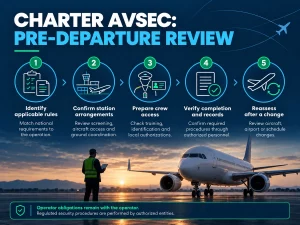
| Planning stage | Security consideration |
|---|---|
| Initial flight preparation | Identify the applicable national security requirements and operator security programme |
| Airport and handling coordination | Establish passenger screening, aircraft access and relevant ground security procedures |
| Crew preparation | Confirm applicable security training, identification and airport-access arrangements |
| Before aircraft departure | Verify completion of required aircraft security procedures and supporting records |
| Following an operational change | Review any affected station procedures, aircraft access arrangements or security requirements |
Changes to Aircraft, Airport or Operating Schedule
An aircraft substitution, new destination or revised departure airport can change the security arrangements relevant to a charter movement.
The operator needs to determine whether the revised operation falls within its existing security programme and whether supplementary procedures or additional airport arrangements are necessary. A change in flight timing can also affect passenger screening, crew access and the handling of the aircraft while it remains parked.
Security Documentation and Compliance Records
Records associated with aviation security need to follow the applicable national requirements and the operator’s approved procedures. Depending on the operation, relevant documentation can concern security programme approvals, personnel training, aircraft security procedures and other required compliance records.
Because parts of national aviation security programmes and operator procedures contain restricted information, the handling and distribution of these records need to follow the applicable access and confidentiality rules.
7. Aviation Security and Ground Operations Coordination for Charter Flights
Just Aviation provides 24/7 operational support for international charter flights through its trip planning services, coordinating airport and ground arrangements with local providers according to the operator’s requirements.
The Operations Control Center assists with:
- Coordinating ground handling services, including aircraft servicing and passenger handling arrangements.
- Confirming relevant airport access and ground-service requirements with local handling providers.
- Coordinating crew movement and reporting arrangements with applicable airport procedures.
- Arranging landing and overflight permits and supporting operational documentation.
- Updating ground arrangements when aircraft movements, schedules or destinations change.
The operator remains responsible for its aviation security programme and applicable regulatory obligations. Security screening, aircraft searches and other regulated security procedures remain under the responsibility of the authorized personnel and entities designated under the relevant requirements.
For international charter trip planning and ground coordination, contact Just Aviation’s Operations Control Center at [email protected]
Frequently Asked Questions About Aviation Security for International Charter Flights
1. What is AVSEC compliance in international charter aviation?
AVSEC compliance concerns the aviation security requirements applicable to aircraft operators, airports and related personnel. These requirements address protection against unlawful interference, including aircraft security, access control, passenger and baggage screening and relevant security programmes.
2. Does ICAO Annex 17 apply the same security procedures to every charter flight?
ICAO Annex 17 establishes international aviation security standards that States implement through national programmes and regulations. The procedures applicable to a particular charter operation depend on the relevant national rules, aircraft classification and operating circumstances.
3. Are private charter passengers exempt from airport security screening?
Private charter status does not independently establish an exemption from screening. Applicable requirements depend on national aviation security regulations, the flight classification and approved airport security arrangements.
4. What is the difference between an aircraft security check and a security search?
An aircraft security check and an aircraft security search involve different levels of examination under applicable aviation security procedures. The method and circumstances requiring each are established by the relevant regulatory framework and operator security programme.
5. Does using a ground handling provider transfer AVSEC responsibility away from the aircraft operator?
A handling provider performs the activities assigned under the applicable agreement and airport procedures. Regulatory obligations assigned to the aircraft operator remain with the operator, including oversight of relevant security arrangements carried out on its behalf.
6. When are supplementary station security procedures required?
Supplementary Station Procedures are relevant when an operator’s existing security programme does not fully address applicable requirements in another State where it conducts operations. The operator needs to establish the appropriate procedures under its national security programme and the requirements of that State.
7. What aviation security documents should charter operators prepare before departure?
Documentation depends on the applicable national regulations and the operator’s approved security programme. Relevant records can include security programme approvals, personnel training records, aircraft security documentation and applicable station procedures. Access to restricted security information must follow the relevant confidentiality requirements.
8. Can aviation security requirements change when a charter flight is rerouted?
A change in departure airport, destination or aircraft can affect the security procedures applicable to the operation. Operators need to review the revised movement against their security programme and confirm any additional requirements with the relevant airport or aviation security authority before departure.
Disclaimer
This article provides general operational guidance based on aviation security frameworks reviewed in October 2026. AVSEC requirements differ according to the State of the Operator, destination, airport, aircraft category and type of operation. Certain detailed security procedures are restricted and are governed by national programmes and approved operator documentation. Aircraft operators remain responsible for determining applicable requirements and maintaining compliance with the relevant aviation security authorities.
Conclusion
Aviation security compliance for international charter operations depends on understanding the relationship between the operator’s security programme, national aviation security requirements and the procedures applicable at each airport.
For charter operators, the main operational priorities are confirming the appropriate security programme, preparing aircraft and passenger handling arrangements, maintaining qualified personnel and addressing station-specific requirements before the flight. Keeping these elements aligned with the intended operation supports consistent security compliance across international destinations.


 +971 4 5855 689