
Aircraft Insurance Requirements for International Flights: Coverage, Documentation and Landing Permits

20 October 2026
| By Just Aviation TeamAircraft insurance requirements vary according to the aircraft, type of operation and countries involved in an international flight. For business aviation operators, the main considerations are meeting applicable liability limits, maintaining valid insurance documentation and confirming that the intended route falls within the policy’s coverage.
Insurance verification forms part of international trip planning, particularly when authorities require supporting documents for landing permits or operating approvals. This guide covers the regulatory requirements, certificate checks and operational changes relevant to international private and charter flights.
Key Takeaways
- What aircraft insurance coverage is required for international private and charter flights?
- How are minimum liability insurance limits determined in the European Union?
- What insurance documentation is needed for international landing and overflight permits?
- How do war-risk exclusions and territorial restrictions affect international flight operations?
- What insurance checks are necessary before departure or after an aircraft or route change?
1. Aircraft Insurance Coverage for International Operations
International aviation insurance requirements focus primarily on liability arising from aircraft operations. The applicable coverage depends on aircraft characteristics, passenger or cargo activity and the regulatory framework of the countries involved.
Third-Party Liability
Third-party liability insurance addresses insured liability for injury to people or damage to property outside the aircraft. Minimum coverage requirements are commonly linked to the aircraft’s maximum take-off mass (MTOM), with higher aircraft weight categories carrying higher regulatory minimums.
For international operations, the insurance review needs to establish whether the policy satisfies the third-party liability requirements applicable to the aircraft and intended jurisdictions.
Passenger, Baggage and Cargo Liability
Passenger liability covers the operator’s insured liability toward passengers, while baggage and cargo liability concern covered loss or damage involving transported property.
Regulatory requirements distinguish between commercial and non-commercial operations. Commercial charter activity involves passenger liability and, where applicable, baggage and cargo coverage. Private operators also need to meet the liability requirements relevant to their aircraft and flight classification.
Hull Insurance and Additional Coverage
Hull insurance concerns insured physical loss or damage to the aircraft. It is separate from the aviation liability coverage required under regulations such as the European Union’s aircraft insurance framework.
Additional coverage can arise from aircraft leasing arrangements, financing conditions or other contractual obligations. These matters are assessed by the operator and insurer according to the aircraft and intended activity.
2. Aircraft Insurance Requirements in the European Union and United Kingdom
The European Union establishes minimum aviation liability insurance requirements through Regulation (EC) No 785/2004, as amended. The regulation covers relevant aircraft operations within, into, out of and over EU territory, with specific exemptions and distinctions between operating categories.
The required coverage is expressed in Special Drawing Rights (SDR), an international unit of account maintained by the International Monetary Fund.
EU Minimum Liability Coverage
For operations within the regulation’s scope, the minimum insurance requirements include:
| Liability category | Minimum coverage |
|---|---|
| Passenger liability | 250,000 SDR per passenger |
| Baggage liability | 1,288 SDR per passenger in commercial operations |
| Cargo liability | 22 SDR per kilogram in commercial operations |
| Third-party liability | Determined by the aircraft’s MTOM category |
The baggage and cargo limits reflect the changes introduced by Commission Delegated Regulation (EU) 2020/1118. For qualifying non-commercial operations involving aircraft with an MTOM of 2,700 kg or less, Member States have discretion to establish a lower minimum passenger liability limit, provided it is not below 100,000 SDR per passenger.
Third-Party Liability Based on Aircraft MTOM
Article 7 of Regulation (EC) No 785/2004 establishes ten aircraft categories for minimum third-party liability insurance. The applicable category is determined by certified MTOM rather than the aircraft’s actual take-off weight for an individual flight.
| Aircraft MTOM | Minimum third-party liability |
|---|---|
| 2,700 kg to less than 6,000 kg | 7 million SDR |
| 6,000 kg to less than 12,000 kg | 18 million SDR |
| 12,000 kg to less than 25,000 kg | 80 million SDR |
| 25,000 kg to less than 50,000 kg | 150 million SDR |
These are selected categories from the regulation. Operators need to verify the complete schedule for aircraft falling outside these weight ranges.
United Kingdom Insurance Requirements
The United Kingdom applies the retained UK version of Regulation (EC) No 785/2004, as amended, to aircraft insurance requirements. The UK Civil Aviation Authority’s mandatory insurance requirements address passenger, baggage, cargo, third-party and war-risk coverage, together with the applicable exemptions.
The CAA also explains that operators using combined single-limit policies need sufficient coverage for the relevant liability categories. Evidence of insurance can be reviewed during registration processes, audits and aircraft inspections.
For flights involving both EU and UK destinations, the operator needs to assess compliance with the requirements applicable to each jurisdiction rather than relying solely on the acceptance of one insurance certificate.
3. Insurance Certificates and International Flight Permits
Insurance certificates serve as evidence of coverage and form part of the supporting documentation required by certain aviation authorities for landing permits, operating authorizations or regulatory inspections.
The required format and submission procedure depend on the jurisdiction and the type of flight. An insurance certificate accepted for one destination does not independently establish that the same document satisfies another authority’s requirements.
For international operations, insurance evidence needs to remain consistent with the aircraft details submitted through the flight permit application process.
Information Required on Insurance Certificates
The following details are relevant when checking insurance evidence for an international flight.
| Certificate information | Operational purpose |
|---|---|
| Aircraft registration and type | Identifies the aircraft covered by the insurance |
| Named insured | Connects the insured entity with the operator or registered owner |
| Policy reference | Identifies the insurance arrangement |
| Effective and expiration dates | Establishes coverage during the intended flight |
| Liability coverage and limits | Supports verification against applicable regulatory minimums |
| Territorial scope | Identifies covered geographical areas and relevant exclusions |
| Operation type | Helps establish compatibility with private, commercial or other insured activities |
Where an aviation authority requires prescribed wording, a signed declaration or additional insurance evidence, the documentation needs to follow that authority’s current instructions.
Aircraft Ownership and Operator Details
The aircraft’s registered owner, operator and named insured can be different legal entities. For example, an aircraft can be registered to a leasing company while being operated by a separate aviation business.
In these circumstances, the documentation needs to establish the relevant insured relationship. Where the certificate does not clearly identify the operating entity, supporting evidence or clarification from the insurer can be required during regulatory review.
Insurance Requirements for Different Flight Categories
The intended operation influences both the insurance coverage and the supporting documentation. Commercial charter flights require coverage consistent with the operator’s commercial activity and applicable passenger or cargo liability obligations. Non-commercial private flights remain subject to the liability requirements relevant to their aircraft and jurisdiction.
Ferry, delivery and positioning flights also require consideration of the actual insured activity. Where the aircraft is operating under special arrangements, the insurer needs to confirm that the policy covers the movement and intended route.
4. War-Risk Insurance and Territorial Restrictions
International aircraft insurance can include provisions addressing war, terrorism, hijacking and other specified aviation security risks. These provisions need particular attention when an itinerary involves countries or regions affected by conflict, political instability or airspace restrictions.
The EU insurance regulation and the UK regulatory framework include specified war-related risks within their applicable liability insurance requirements. However, regulatory insurance obligations and the territorial conditions of an individual policy are separate considerations.
Territorial Exclusions
An aircraft insurance policy can contain exclusions or special conditions affecting particular countries, regions or operating circumstances.
Before an international flight, the operator needs to establish whether the planned destination, route and intermediate stops remain within the policy’s accepted territorial coverage.
Where restrictions apply, the insurer determines whether an endorsement or additional arrangement is required for the intended operation.
Route Changes and Insurance Coverage
An amended route can introduce a jurisdiction that was not part of the original insurance review. This is relevant when operational circumstances require a different technical stop, diversion destination or routing through another region.
The revised route needs to be assessed against the policy’s territorial coverage and any applicable insurance conditions. Regulatory flight permissions and insurance acceptance also need separate verification because an approved route does not independently establish insurance coverage.
Just Aviation’s global business aviation compliance guide addresses the wider regulatory considerations affecting international aircraft and route planning.
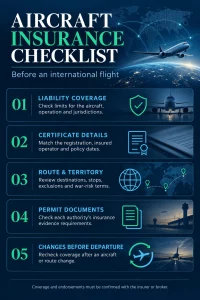
5. Insurance Checks Before International Departure
Insurance verification is most effective when completed during initial trip preparation and revisited when an operational change affects the aircraft, route or insured activity.
A practical review keeps the insurance evidence aligned with the documents used for permits, flight planning and regulatory inspections.
| Planning stage | Insurance verification |
|---|---|
| Initial trip preparation | Identify the jurisdictions, flight classification and applicable liability requirements |
| Before permit submission | Check the insurance certificate, aircraft details, policy validity and required supporting documentation |
| After aircraft substitution | Confirm that the replacement aircraft and its operating activity are covered |
| After route or destination changes | Review territorial restrictions and any affected insurance conditions |
| Before departure | Confirm that current insurance evidence is accessible and corresponds with the intended operation |
Common Documentation Problems
Insurance documentation can require correction when an aircraft registration has changed, the insured entity is unclear, the policy expires during the itinerary or the certificate does not contain the liability information requested by an authority. Where a permit application has already been submitted, revised insurance evidence needs to be coordinated with the relevant authority if the change affects the application.
For example, an aircraft substitution after permit preparation requires review of the new aircraft’s insurance and any permit tied to the original registration. The updated documents need to correspond with the aircraft ultimately operating the flight.
The UK CAA’s insurance guidance also recommends carrying evidence of valid insurance so it can be presented during an inspection. The operator needs to establish any additional carriage or presentation requirements applicable to the countries involved.
6. How Just Aviation Supports International Flight Permit Documentation
Just Aviation provides 24/7 operational support through its flight permit coordination services, assisting private, charter and business aviation operators with the documentation required for international flight permits and related approvals.
The Operations Control Center assists with:
- Identifying applicable landing and overflight permit requirements for the intended route.
- Coordinating aircraft and operator documents required for permit applications.
- Checking insurance certificates for consistency with aircraft registration, operator details, policy validity and authority-specific requirements.
- Coordinating updated supporting documents when aircraft details, routes or flight schedules change.
- Following up on documentation discrepancies and permit application status with the relevant authorities.
Where insurance clarification, a revised certificate or an additional endorsement is necessary, the operator works directly with its insurer or broker. Insurance underwriting, coverage decisions and confirmation of policy adequacy remain their responsibility.
For international flight permit and supporting-document coordination, contact Just Aviation’s Operations Control Center at [email protected]
Frequently Asked Questions About Aircraft Insurance Requirements for International Flights
1. Is worldwide aircraft insurance sufficient for international flights?
Worldwide territorial coverage does not independently establish that a policy meets the regulatory insurance requirements of every country involved in the flight. Operators need to verify applicable liability limits, insured activities and documentation requirements for the intended itinerary.
2. Is an insurance certificate required for an international landing permit?
Certain aviation authorities require evidence of aircraft insurance during landing or overflight permit processing. The specific document, format and submission procedure depend on the jurisdiction and type of operation.
3. What are the minimum aircraft insurance requirements in the European Union?
Regulation (EC) No 785/2004 establishes minimum liability insurance requirements for relevant aircraft operations. Passenger liability is generally subject to a minimum of 250,000 SDR per passenger, with defined exceptions, while third-party liability depends on aircraft MTOM. Commercial baggage and cargo liability have separate minimum limits.
4. Do private and charter flights require different insurance coverage?
Insurance requirements depend on the flight classification and applicable regulations. Commercial charter operations involve additional considerations relating to passenger carriage, baggage, cargo and operating authority, while private flights remain subject to relevant aircraft liability requirements.
5. What happens if an aircraft’s registration or planned route changes?
The operator needs to review the insurance evidence against the new aircraft or routing. Where the change affects policy coverage, certificate information or previously submitted permit documents, the relevant records need to be updated before they are relied upon for the operation.
Disclaimer
This article provides general operational guidance based on regulatory information reviewed in October 2026. Aircraft insurance requirements, liability limits, exemptions and documentation procedures depend on the applicable jurisdiction, aircraft and type of operation. Operators remain responsible for maintaining adequate insurance and meeting regulatory obligations, while insurers and brokers determine policy coverage, conditions and certification. Applicable legislation and current aviation authority requirements take precedence over this guide.
Conclusion
Aircraft insurance compliance is an important part of international flight preparation. The applicable liability requirements depend on the aircraft, flight classification and countries involved, while insurance certificates need to correspond with the aircraft and operation presented to aviation authorities.
For private and charter operators, the practical priorities are verifying regulatory coverage, maintaining accurate insurance documentation and reassessing affected requirements when an aircraft, route or policy changes. Integrating these checks into flight permit preparation helps maintain consistency between insurance evidence and the intended international operation.


 +971 4 5855 689