
UK Foreign Carrier Permit Applications: Common Rejection Reasons and Documentation Checks

23 November 2026
| By Just Aviation TeamA UK foreign carrier permit application brings together the operating carrier, aircraft, itinerary and commercial purpose of the flight. When those details are incomplete or inconsistent, the application may require clarification. Where an approval or traffic entitlement is missing, correcting the paperwork alone may not resolve the issue.
Effective preparation starts with identifying what the proposed operation requires and assembling supporting evidence that matches it. It also means distinguishing an application awaiting information from one that has been formally refused.
Plan the permit around the operation. Just Aviation’s flight permit services support operators with application preparation, document coordination and follow-up on outstanding requirements.
Key Takeaways
- Which flights require a UK Foreign Carrier Permit?
- How does UK Part TCO approval differ from the permit?
- Which application route matches the proposed service?
- What documentation issues can prevent a decision?
- How should operators interpret processing guidance?
- Which operational changes require further authorization?
Which Flights Require a UK Foreign Carrier Permit?
The UK Civil Aviation Authority states that non-UK air carriers undertaking commercial services to, from or within the United Kingdom require a Foreign Carrier Permit before the flight operates. This includes EU, EEA and EFTA carriers.
The CAA lists exemptions for certain private, positioning, ferry, delivery, maintenance and test flights, together with ICAO-compliant overflights. State and military flights follow separate clearance arrangements. The applicable conditions should be checked against the actual operation. A business jet may perform a commercial charter sector followed by an empty positioning sector. Assess each sector by its purpose rather than applying one classification to the entire itinerary.
Use the CAA’s permit applicability guidance when establishing the requirement. An exemption from this permit does not remove other applicable border, security, airport or airworthiness obligations.
How Do UK Part TCO Approval and the Permit Work Together?
UK Part TCO and the Foreign Carrier Permit address separate aspects of the operation. UK Part TCO concerns the foreign operator’s safety authorization. The Foreign Carrier Permit provides permission for the commercial services covered by its terms.
The CAA requires valid UK Part TCO approval before issuing a Foreign Carrier Permit. EASA TCO approval does not replace the UK approval. Verify the actual operating carrier’s status early, particularly where a broker, aircraft manager or leasing arrangement is involved. The company arranging the flight may be different from the carrier operating it.
Which Application Route Should Be Used?
Select the route that matches the proposed service.
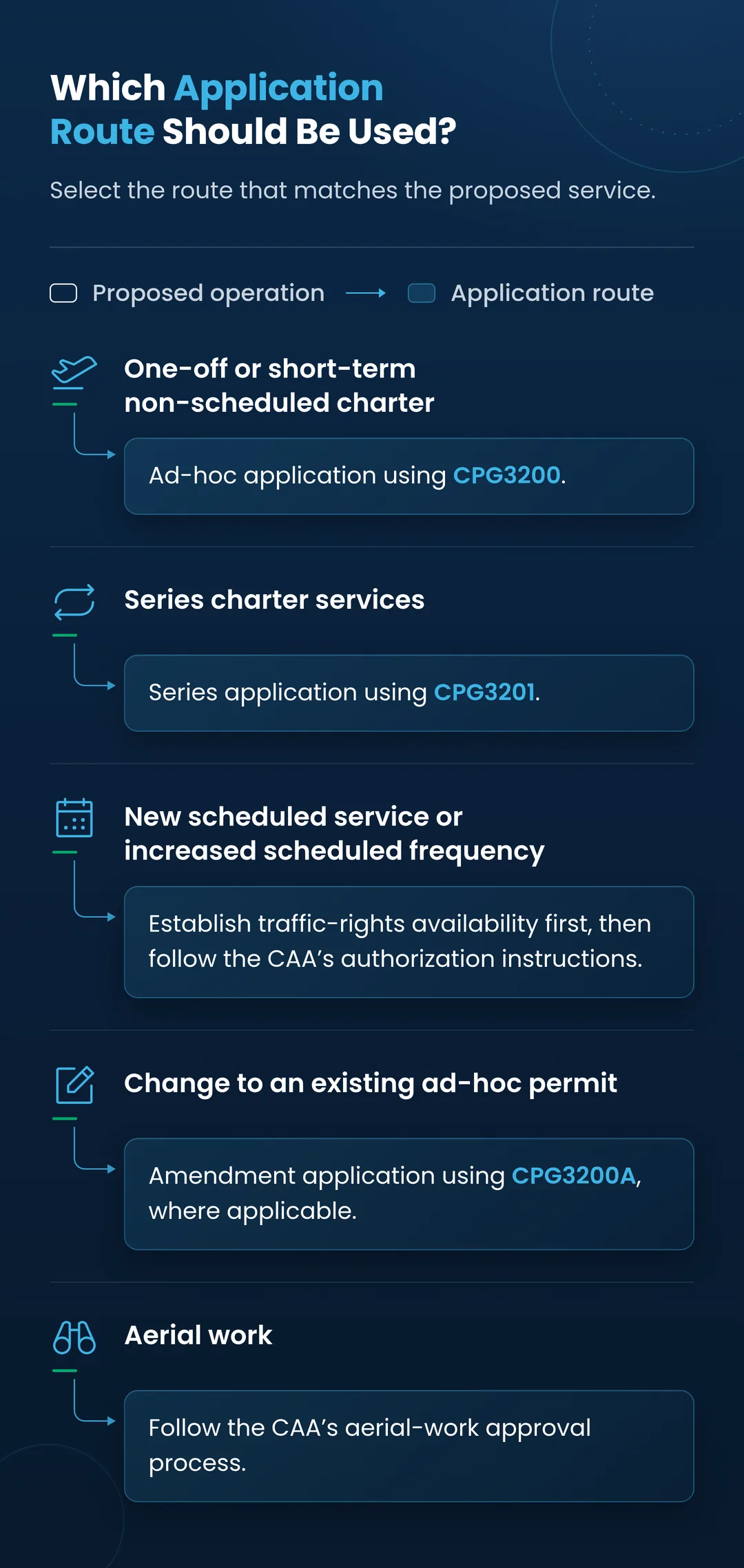
| Proposed operation | Application route |
|---|---|
| One-off or short-term non-scheduled charter | Ad-hoc application using CPG3200. |
| Series charter services | Series application using CPG3201. |
| New scheduled service or increased scheduled frequency | Establish traffic-rights availability first, then follow the CAA’s authorization instructions. |
| Change to an existing ad-hoc permit | Amendment application using CPG3200A, where applicable. |
| Aerial work | Follow the CAA’s aerial-work approval process. |
Use CPG3200 for an ad-hoc charter application and CPG3201 for a series-charter application. Complete the required online payment and submit the receipt with the application, following the CAA’s submission instructions.
Where the programme includes different flight purposes or changes to existing permissions, Just Aviation can help organize the itinerary, coordinate application requirements and identify outstanding information before submission.
What Can Cause Clarification, Delay or Refusal?
Administrative errors and unresolved operating requirements have different consequences. The following checks help operators identify which type of issue needs attention.
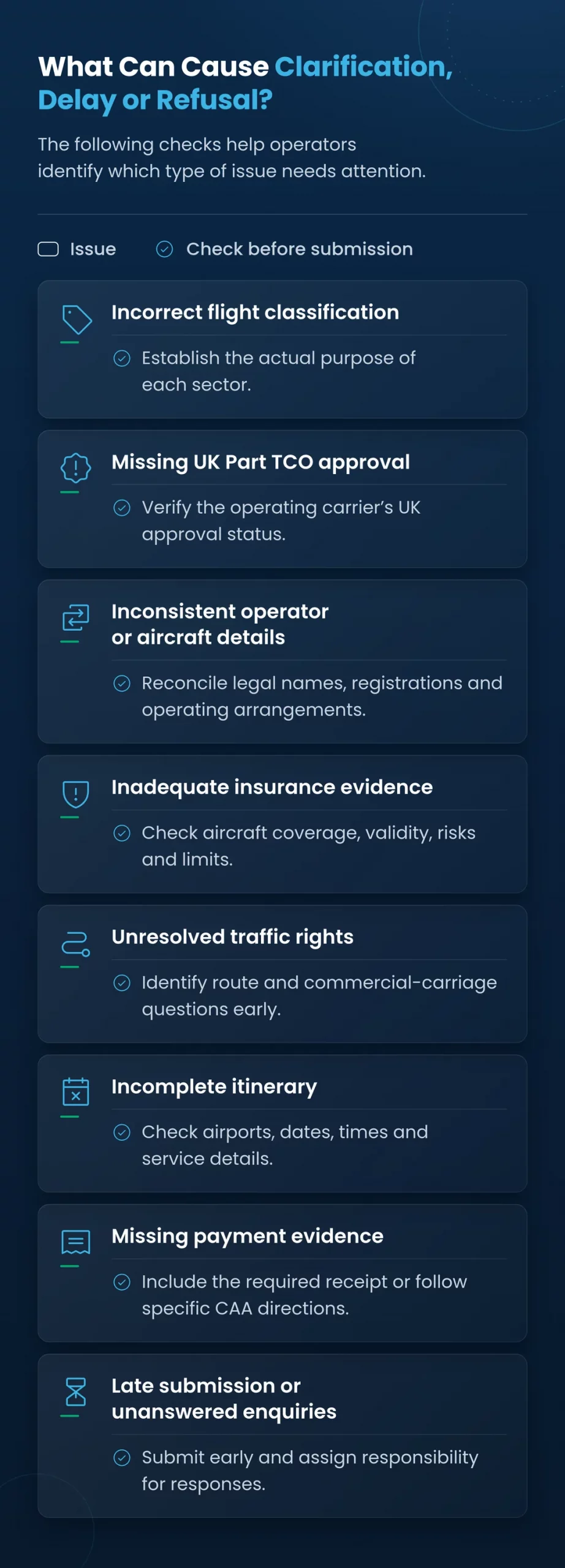
| Issue | Why it matters | Check before submission |
|---|---|---|
| Incorrect flight classification | The application may follow the wrong approval route. | Establish the actual purpose of each sector. |
| Missing UK Part TCO approval | A prerequisite for permit issuance remains unresolved. | Verify the operating carrier’s UK approval status. |
| Inconsistent operator or aircraft details | Documents may not clearly support the requested service. | Reconcile legal names, registrations and operating arrangements. |
| Inadequate insurance evidence | Applicable cover has not been demonstrated. | Check aircraft coverage, validity, risks and limits. |
| Unresolved traffic rights | Complete documents may still not establish entitlement to operate. | Identify route and commercial-carriage questions early. |
| Incomplete itinerary | The proposed service cannot be assessed clearly. | Check airports, dates, times and service details. |
| Missing payment evidence | The submission may not meet the stated instructions. | Include the required receipt or follow specific CAA directions. |
| Late submission or unanswered enquiries | Less time remains to resolve outstanding questions. | Submit early and assign responsibility for responses. |
These are application checks, rather than an official ranking of refusal reasons. A request for clarification should be addressed according to the information sought, while a refusal requires attention to the stated grounds.
Which Documents Should Be Checked Before Submission?
The CAA’s application requirements distinguish information required with the submission from supporting documents it may request during assessment.
Information Required With the Application
Published requirements include UK TCO confirmation, aircraft details, liability insurance evidence and identification of the Advance Passenger Information system to be used. Relevant information is also required for aircraft leased from another carrier, with or without crew.
| Application item | Practical check |
|---|---|
| Operating carrier | Legal identity is consistent across the form and supporting records. |
| UK Part TCO | Approval relates to the carrier operating the flight. |
| Aircraft | Type and registration match the proposed service. |
| Insurance | Evidence covers the relevant aircraft, period, risks and applicable limits. |
| Flight programme | Routes, dates, times and service details are complete and consistent. |
| Passenger-information reporting | The reporting system is identified as requested. |
| Leased aircraft | The operating arrangement is explained and supporting information is available. |
| Payment evidence | The required receipt accompanies the application. |
Supporting Documents Available on Request
Keep relevant records accessible, including:
- Air Operator Certificate and operating licence, as applicable.
- Certificate of incorporation or business registration.
- Aircraft registration and airworthiness certificates.
- Dangerous-goods or munitions-related declarations and supporting approvals where required.
Respond to the specific request and identify revised documents clearly. Sending additional files without explaining their relevance can make the current application package harder to follow.
How Should Insurance Evidence Be Reviewed?
Review the insurance evidence against the CAA’s insurance requirements. Check the cover for the proposed aircraft and operation, including its validity, territorial scope and applicable liability limits.
Confirm that:
- The operating carrier is correctly identified.
- The aircraft is included or clearly covered.
- Cover remains valid throughout the operating period.
- Territorial scope and exclusions are compatible with the flight.
- Relevant liability and war-risk requirements are addressed.
- Applicable limits have been checked for the aircraft and operation.
Where wording or coverage is unclear, obtain clarification from the operator’s insurer or broker. Resolve unexplained differences between the application, aircraft details and insurance evidence before relying on the package.
Use the requirements applicable to the current operation rather than copying limits or certificate wording from an earlier submission.
How Do Traffic Rights Affect the Decision?
Safety approval and complete documents do not automatically establish commercial traffic rights.
For scheduled services, the CAA assesses the proposed operation against the relevant air-service arrangements. For non-scheduled charter flights, its traffic-rights guidance identifies reciprocity as a consideration.
Describe where passengers or cargo will be taken on and discharged. Flag UK domestic sectors and commercial carriage involving countries outside the operator’s home state for assessment rather than assuming existing authority covers them.
A previous permit should not be treated as blanket permission for a different traffic pattern. Just Aviation’s guide to bilateral air service agreements and flight permits provides broader context.
How Long Should Operators Allow?
Application timing depends on the service, completeness of the submission and any consultation required.
For ad-hoc charter and series applications, the CAA aims to provide a decision, which may be a refusal, at least two working days before departure. Applications submitted less than two working days before departure are considered on a best-endeavours basis, depending on complexity and workload.
Scheduled applications are assessed individually, with timing affected by traffic rights and consultation requirements. These arrangements are explained in the CAA’s application-processing guidance.
The published decision aim should not be interpreted as approval within 48 hours of submission.
Allow time for clarification and separate approvals, accounting for weekends and public holidays. The CAA considers out-of-hours applications only for urgent emergency situations, such as air ambulance or humanitarian flights. Establish a realistic contingency if permission remains outstanding.
Which Requirements Must Be Tracked Separately?
Maintain a separate status for each authorization and airport arrangement.
| Requirement | What to establish |
|---|---|
| Foreign Carrier Permit | Issued and applicable to the proposed service. |
| UK Part TCO | Valid approval for the operating carrier. |
| Aviation security | Applicable requirements satisfied. |
| Airport slot, PPR and parking | Required airport arrangements confirmed. |
| Border reporting | Applicable passenger and crew reporting completed. |
| Special carriage | Additional approvals obtained where required. |
The CAA’s permit application guidance states that operators of aircraft with a maximum take-off weight of 10,000 kg or more also require a security direction. Establish the applicable arrangements alongside permit preparation.
Track airport acceptance and regulatory authorisation separately. A permit does not reserve an airport slot or parking position. The CAA’s territorial-scope guidance identifies separate approval arrangements for the Channel Islands and UK Overseas Territories. For services to and from the Isle of Man, the CAA administers Foreign Carrier Permits jointly with the Isle of Man Civil Aviation Administration.
What Happens When the Aircraft or Schedule Changes?
Changes to the aircraft, operating carrier, route or schedule should be checked against the issued permit. An aircraft substitution can affect insurance and aircraft coverage, while a different carrier or route may require reassessment of operator approvals or traffic rights.
Just Aviation can review the revised itinerary, coordinate supporting documents and assist with the required amendment or new application on the operator’s behalf. The CAA’s amendment instructions allow two amendments to a granted ad-hoc permit, after which a new application is required.
For an aircraft substitution, the review should cover:
- Permit coverage for the replacement aircraft.
- Valid insurance and applicable operator approvals.
- The required amendment or new application.
- Confirmation that the resulting authorisation covers the revised operation.
Just Aviation can follow up on outstanding requirements and communicate the outcome. Approval remains subject to the CAA’s assessment.
How Should Operators Respond to Clarification or Refusal?
Start with the reason given and assign responsibility for resolving it. For a clarification request, identify the missing information, who will supply it and whether the schedule remains achievable. Answer each question and explain which documents replace earlier versions.
For a refusal, distinguish a documentation issue from an unresolved approval, traffic-rights or operating restriction. A revised submission should address the stated grounds rather than repeat the original package.
Retain the application reference, correspondence, document versions and decision. Before operating, compare the issued permit’s validity, scope and conditions with the final itinerary.
How Just Aviation Supports UK Permit Preparation
Just Aviation brings permit preparation and related trip arrangements into one coordination process. Our Operations Control Center connects application requirements, airport services and follow-up with the operator’s schedule.
Support can include:
- Checking application details and document consistency.
- Coordinating submissions and responses to CAA enquiries.
- Following up on amendments and outstanding requirements.
- Coordinating slots, parking, handling, fuel and crew services where requested.
For UK permit coordination, contact the Just Aviation Operations Control Center at [email protected]
Our team can review the proposed operation, identify outstanding application information and coordinate the agreed support around the departure schedule. Permit approval remains subject to the CAA’s assessment.
Frequently Asked Questions About UK Foreign Carrier Permit Applications
1. What if the application uses a trading name but the certificates show a legal company name?
Make the relationship clear and identify the actual operating carrier consistently. Supporting evidence should allow the application and approvals to be matched without ambiguity.
2. What if the insurance certificate expires between the outbound and return flights?
Arrange evidence covering the full operating period and update the application records as necessary. Cover valid for the first sector should not be assumed to cover the return.
3. Can a broker’s details replace the operating carrier’s information?
The application must identify the carrier that will operate the service. Broker or representative details can support coordination but do not replace the operator’s approvals and evidence.
4. Should an empty positioning sector be classified the same way as the passenger charter?
Assess the sector according to its actual purpose. The CAA lists positioning flights among its exemptions, but other applicable operational and reporting requirements still need attention.
5. What if the operating carrier changes after submission?
Reassess the application against the replacement carrier’s approvals, aircraft and insurance. Establish the required application action before relying on the original submission.
6. Does a passenger-list change always require a permit amendment?
The effect depends on the permit and operation. Check whether the change affects authorized service details or traffic rights, and update applicable border reporting separately.
7. What should the crew receive once the permit is issued?
Provide the issued authorization, its conditions and any accepted amendments through the operator’s document-control process. The crew should have the version applicable to the final operation.
8. What if only part of the planned programme is authorized?
Compare the authorization with every proposed sector. Resolve any uncovered service separately rather than extending the approval beyond its stated scope.
9. What should operators retain after a refusal?
Keep the decision, stated grounds, application reference and supporting correspondence. Use those records to establish what must change before a revised request is made.
Disclaimer
This article provides general planning guidance. Requirements depend on the operator, aircraft, service and proposed traffic rights. Check current CAA instructions, applicable approvals and the conditions of the issued permit before operating.
Conclusion
A stronger UK permit application starts with correct flight classification, valid operator approvals and consistent supporting evidence. Identifying traffic-rights questions early, answering enquiries clearly and coordinating amendments helps reduce avoidable rework and keeps the permit aligned with the operation it is intended to authorize.


 +971 4 5855 689