
Fuel and Handling Coordination at Prince Said Ibrahim Airport, Comoros: Planning Non-Scheduled Business Flights

07 October 2026
| By Just Aviation TeamPrince Said Ibrahim International Airport (HAH/FMCH) is the principal international gateway to Grande Comore and Moroni. For Moroni private jet and business aviation support, fuel, handling, ATS and passenger-service arrangements need to be coordinated against the aircraft’s actual operating schedule. The services run on different published schedules, and some require advance activation. A flight arriving later than planned can therefore remain operational from an airport perspective while losing the fuel, ATS or ground-service arrangement built around the original ETA. The trip works best when each required service is matched to the aircraft’s actual operating window before departure.
Just Aviation coordinates fuel, handling, permits and wider flight-support requirements for non-scheduled operations at FMCH.
Key Takeaways
- Which FMCH service hours matter most for a non-scheduled business flight?
- Why is the airport’s H24 operations contact different from H24 flight support?
- How far in advance does an ATS extension need to be arranged?
- What makes the Jet A-1 window important for a late arrival or quick turn?
- Which fuel-payment issue needs resolving before departure?
- How do customs, immigration and health-service hours affect international arrivals?
- What does the absence of published repair and hangar facilities mean for AOG planning?
- Why must landing authorization and ground handling be managed separately?
The Important Planning Tool at Moroni Is the Service Clock
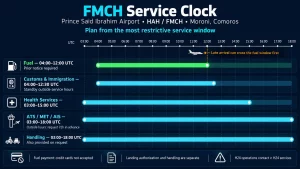
Prince Said Ibrahim does not operate every service on one common schedule. The current ASECNA eAIP publishes the following operating pattern:
| Service | Current published window |
|---|---|
| Airport administration | 0500–1300 UTC; airport operations control center staffed H24 |
| Customs and immigration | 0400–1230 UTC; standby outside service hours |
| Health services | 0300–1500 UTC |
| AIS / ARO / MET / ATS | 0300–1800 UTC; on request with 72 hours’ notice |
| Fuel | 0400–1200 UTC; prior notice required for non-scheduled flights |
| Handling | 0300–1800 UTC; handling also provided on request |
This creates a useful distinction for operators. An airport contact being available around the clock does not mean the aircraft can move its arrival several hours later with every originally planned service still available. For a non-scheduled movement, the real operating window is the intersection of the services the flight actually needs.
Build the Trip Backwards From the Most Restrictive Service
The best sequence depends on the mission. A business jet requiring a substantial uplift may be controlled by the fuel window. A late-night movement may be controlled by the ATS extension. An international passenger arrival may need customs, immigration and any applicable health arrangements aligned with the ETA.
Instead of beginning with: “What time does the passenger want to arrive?” build the schedule around: required services → confirmed service window → realistic aircraft ETA/ETD
This matters most when the schedule is tight. For example, an aircraft landing at 1130 UTC with a planned fuel uplift has very little margin before the end of the published 1200 UTC fuel period. A delay that moves arrival to 1230 UTC changes the fuel plan even if other airport services remain available.
Fuel Planning at FMCH Is Primarily a Timing Issue
The current eAIP publishes Jet A-1 at Prince Said Ibrahim, with storage capacity of 780 m³, a published delivery rate of 120 m³/h and a 20 m³ refueller. Those figures describe infrastructure, not the live fuel quantity reserved for a specific aircraft.
For non-scheduled business aviation, the more useful confirmation is: aircraft + requested quantity + fueling time + commercial arrangement
The published fuel service period is 0400–1200 UTC, and prior notice is required for non-scheduled flights. A mission depending on uplift after that window needs specific confirmation rather than an assumption that the airport’s wider operating capability automatically extends fuel service.
Fuel Payment Needs to Be Closed Before Arrival
Moroni has a practical fuel detail that can create an avoidable ground delay. The current AIP states that credit cards are not accepted for fueling. That makes the commercial arrangement part of the pre-flight fuel plan. Before departure for FMCH, establish the accepted settlement method for the specific uplift through the supplier or handling arrangement.
This is particularly relevant for an occasional business aircraft without an established local fuel account. A technically confirmed uplift is not operationally complete if payment remains unresolved when the bowser reaches the aircraft.
A Late Arrival Can Cross the Fuel Window Before It Crosses the ATS Window
This is a particularly useful distinction at FMCH. ATS is published until 1800 UTC, while routine fuel service ends at 1200 UTC.
Consider a flight originally planned: ETA 1030 UTC → passenger offload → Jet A-1 → ETD 1230 UTC
A four-hour inbound delay changes the mission significantly. At 1430 UTC:
- ATS remains within its normal published window.
- Handling may still fall within the published period.
- Routine fuel hours have already passed.
The operator therefore needs a fuel solution before simply accepting the later ETA. Depending on what can be confirmed, that may mean revising the uplift strategy, changing the departure plan or rebuilding the mission around another suitable fuel opportunity. The key point is that “airport still open” does not answer the fuel question.
Movements Beyond 1800 UTC Need Earlier Planning
AIS, ARO, MET and ATS are currently published from 0300 to 1800 UTC, with service outside that period available on request with 72 hours’ notice. This makes a late movement different from a routine ETA amendment. If the original business flight is already expected to operate outside the normal ATS period, the extension belongs in initial trip planning.
If a delay develops on the operating day and pushes the flight beyond 1800 UTC, the published 72-hour notice requirement means the operator cannot assume that an extension can be created at the last minute. That risk is worth considering before scheduling a late-evening non-scheduled movement with little time margin.
Handling and ATS Extensions Are Not the Same Request
Handling is published 0300–1800 UTC and is also provided on request; any extension or special arrangement should be confirmed separately for the actual non-scheduled flight.
For a non-scheduled movement outside the normal service period, confirm each required service separately against the actual ETA and ETD. Handling, ATS, MET, passenger processing, security and fuel arrangements need to support the same operating schedule. An after-hours confirmation for one service does not automatically extend the others. The operating plan therefore needs to identify exactly which services have been coordinated for the movement.
International Passenger Processing Has Its Own Clock
Prince Said Ibrahim is an international airport, but passenger-processing services do not follow exactly the same schedule as ATS. Customs and immigration are published 0400–1230 UTC, with standby outside those service hours. Health services are published 0300–1500 UTC. For an international business flight arriving outside the normal passenger-processing window, the required arrangements need to match the actual passenger mission. This becomes particularly relevant for:
- VIP arrivals
- Late schedule changes
- Medical or special passenger movements
- Large charter groups
- Departures moved substantially later than planned
The flight schedule and passenger-clearance plan therefore belong in the same operating file.
Landing Authorization Is Separate From Handling Confirmation
ANACM maintains the Comoros landing and overflight authorization process.
Its current published procedure asks applicants to provide operational details including the operator, aircraft type and registration, crew, route, planned date and purpose of flight, together with supporting aircraft and operator documentation.
Handling confirmation at FMCH does not replace this regulatory process. For a non-scheduled international business flight, two tracks therefore run in parallel:
- Regulatory: landing or overflight authorization.
- Airport: handling, fuel, passenger services and operating-time arrangements.
A trip is not fully prepared when only one side is confirmed.
Larger Jets Need the Published Ground-Movement Procedure in the Plan
The current FMCH eAIP prohibits runway U-turns for jet aircraft and aircraft above 20 tonnes. Those aircraft use the designated runway turn pads instead. This is not a reason to complicate normal trip planning with runway geometry. Its operational relevance appears when a larger business jet is being assessed for the station.
The local movement and parking arrangement needs to reflect the aircraft actually operating, particularly after a substitution from a smaller type. For the operator, aircraft performance and suitability remain separate technical decisions. The handling side needs the correct aircraft details so the local ground plan matches that decision.
Plan Technical Recovery Before an AOG Event
The current AIP lists no hangar space or repair facilities for visiting aircraft at FMCH. Oxygen, CO₂ and hydraulic fluid are available in the city, but aircraft-specific technical assistance requires separate confirmation.
For an AOG event, establish the recovery requirements around the actual defect, including:
- Maintenance-control support
- Authorized engineer positioning
- Spare-parts routing
- Specialist tooling
- Passenger and crew accommodation
- Recovery aircraft or revised passenger routing
The absence of standard visiting-aircraft repair facilities does not rule out arranging technical assistance for a specific event. Confirm the capability required for the aircraft type and maintenance task before building the recovery plan.
Schedule Fuel Before Passenger Flexibility
Passenger schedule changes need to remain aligned with the confirmed fuel and ATS arrangements. If the aircraft requires an uplift before departure, changes to the passenger itinerary need to preserve the confirmed fuel window or be coordinated against an alternative arrangement.
A revised departure that moves outside the normal ATS period creates a separate operational requirement. Passenger flexibility therefore works best within the confirmed airport-service plan. When a requested change moves the aircraft outside that plan, the affected services need to be reconfirmed before the revised departure is accepted.
| Practical Scenario: An Afternoon Delay Removes the Planned Fuel Window A business jet is planned into Prince Said Ibrahim in the morning with international passengers. The aircraft will offload the passengers, take Jet A-1 and reposition later the same day. Fuel and handling are arranged around the original arrival. The inbound flight is delayed and the revised ETA moves beyond the published 1200 UTC fuel-service period. ATS and handling still fit within their normal published windows, so the airport itself is not the immediate issue. Instead of treating the later ETA as a simple schedule amendment, the ground team checks whether the planned uplift can be supported outside the routine period. The operator simultaneously reviews the aircraft’s available fuel and onward mission. The revised departure is finalized only after the fuel strategy and service timing align. The operational lesson is specific to Moroni: different services close at different times. A flight can remain supportable in one part of the airport operation while another essential service has already moved outside its published window. |
|---|
Prince Said Ibrahim Airport Flight Support Services
Just Aviation coordinates the flight-support requirements for non-scheduled business and private aviation movements at FMCH, including:
- Landing permit coordination
- Flight planning and route support
- Ground handling coordination
- Jet A-1 fuel arrangements
- Crew transport and support
- Passenger ground arrangements
- Catering coordination
- Navigation-fee management
- Service-window and schedule-change coordination
After-hours or outside-window requirements are coordinated against the specific movement and require confirmation with the relevant airport or local service provider.
Aircraft performance, fuel calculations, maintenance, dispatch, flight release and command decisions remain with the relevant authority, operator and PIC as applicable.
For Comoros business aviation and flight support, contact the Just Aviation Operations Control Center at [email protected]
Frequently Asked Questions About Prince Said Ibrahim Airport Business Aviation
1. What are the fuel hours for private jets at Moroni Prince Said Ibrahim Airport?
The current AIP publishes fueling from 0400–1200 UTC, with prior notice required for non-scheduled flights.
2. Can Jet A-1 be arranged outside the published fuel hours at FMCH?
The AIP does not publish routine fuel service outside 0400–1200 UTC. Any off-hours requirement needs specific confirmation before the mission depends on it.
3. Does Prince Said Ibrahim Airport operate 24 hours for business aviation?
An H24 airport operations control center is published, but ATS, handling, fuel and passenger services each have their own operating periods.
4. How far in advance is an after-hours ATS request required at Moroni Airport?
AIS, ARO, MET and ATS are published outside their normal 0300–1800 UTC period on request with 72 hours’ notice.
5. Can private jet fuel be paid by credit card at Moroni Airport?
The current AIP states that credit cards are not accepted for fuel. The applicable settlement method needs to be arranged before arrival.
6. Does a non-scheduled business flight require advance handling at FMCH?
Handling operates from 0300 to 1800 UTC and is also provided on request. Confirm the handling arrangement against the aircraft type, ETA, ETD and required services before departure.
7. Are customs and immigration available for late international business jet arrivals?
Customs and immigration have published service hours with standby outside them. The required passenger-processing arrangement needs confirmation for the actual ETA.
8. Can a business jet obtain maintenance support at Prince Said Ibrahim Airport?
FMCH does not have standard hangar or repair facilities for visiting aircraft. Confirm aircraft-specific engineering and AOG support for the required maintenance task.
9. Does ground handling confirmation include the Comoros landing permit?
No. ANACM maintains a separate landing and overflight authorization process requiring aircraft, operator, crew, route and supporting documentation.
10. What matters most when a Moroni business flight is delayed?
Check which required service window the revised ETA or ETD crosses. Fuel, ATS, handling and passenger processing operate on different published schedules.
Disclaimer
Fuel hours, handling availability, ATS extensions, passenger-processing services, payment arrangements and airport procedures at Prince Said Ibrahim can change. Operators need current ASECNA, ANACM and local-service confirmation for the specific aircraft and operating date. Fuel planning, aircraft performance, maintenance, dispatch, flight release and command decisions remain with the operator and PIC as applicable.
Conclusion
Prince Said Ibrahim fuel and handling coordination is mainly a service-window problem. Jet A-1, handling, ATS and passenger processing are available on different published schedules, so a delayed business flight cannot be managed by changing the ETA alone. The reliable approach is to identify the service that controls the mission, arrange non-scheduled requirements before departure, close the fuel-payment method, and treat landing authorization separately from airport handling. That produces a realistic Moroni operation without assuming that H24 contactability means every service is available around the clock.


 +971 4 5855 689