
Managing Aviation Fuel Price Volatility: Uplift Planning for Business Jet Operators

20 October 2026
| By Just Aviation TeamFuel price is one part of an uplift decision. Operators also need to consider whether the required quantity is available, when it can be delivered, and what charges or payment terms apply. Market price data can provide context, but a current local quote is needed to understand the terms for a specific airport and uplift.
If a price, quantity or delivery time changes, the effects may extend beyond the fuel budget. An alternative supplier or uplift point can affect routing, aircraft loading, permits, handling, crew duty planning and the schedule. Reviewing these factors early gives the operations team time to assess the available options.
This article explains how to compare fuel quotes, confirm uplift arrangements and assess the wider effects of a change. It also covers tankering, alternative fuel stops and post-flight records that can inform future estimates.
Key Takeaways:
- What details should operators confirm to compare fuel quotes on the same basis?
- How can market price benchmarks inform planning without replacing local supplier quotes?
- What parts of the mission should be reassessed if fuel availability or delivery timing changes?
- How can tankering and alternative uplift points be compared against the full mission cost?
- Which uplift records should operators review after the flight to improve future estimates?
Start with the Mission Requirement
Before comparing prices, establish the planned uplift requirement using the aircraft’s approved performance data, the applicable fuel-planning policy and the requirements for the specific flight.
The required quantity can vary with aircraft type, route, weather, alternates, payload, operating conditions and the operator’s procedures. A price comparison based on a quantity that later changes may not be useful.
For operations within its scope, EASA’s Easy Access Rules for Air Operations address fuel planning and in-flight replanning. Operators should confirm the rules and approvals applicable to their operation with the relevant authority. Fuel procurement decisions do not replace required fuel planning or the pilot-in-command’s operational responsibilities.
Compare Quotes on the Same Basis
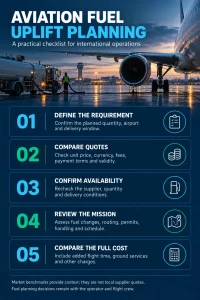
A headline unit price may not represent the full cost of an uplift. For a useful comparison, request quotes using the same quantity, unit of measure and delivery assumptions.
Check whether each quote specifies:
- Unit price and currency
- Requested quantity and any minimum uplift
- Taxes, delivery fees and other applicable charges
- Payment terms and accepted payment methods
- Quote validity period
- Delivery date, time window and uplift location
- Conditions that could affect availability or price
A simple estimate is: Estimated uplift cost = unit price × quantity + applicable charges
The estimate should be treated as a planning figure until the supplier confirms the applicable terms and availability. For broader market context, the IATA Jet Fuel Price Monitor provides average refinery prices. It is a benchmark, not a live quote for a particular airport, supplier, aircraft or delivery.
Confirm Availability and Set a Recheck Point
A quote and an available uplift are not necessarily the same thing. Before relying on a fuel arrangement, confirm the requested quantity, supplier, delivery window and any payment or ordering conditions.
For multi-sector missions, decide when the team will reconfirm each planned uplift. The interval will depend on the route, supplier terms, local conditions and time between planning and departure. If the quote expires, the schedule changes or the supplier reports a constraint, reassess the cost and operational plan.
A short decision record can help the team keep the plan current:
| Record | What to note |
|---|---|
| Planned uplift | Airport, supplier, quantity and delivery window |
| Price basis | Quote date, currency, charges and expiry |
| Availability status | Confirmed, pending or subject to conditions |
| Alternative | Other viable uplift point or supplier, if identified |
| Recheck trigger | A change in quote, schedule, availability or route |
| Decision | Person responsible and time of review |
Assess the Operational Effect of a Change
If an uplift becomes unavailable, more expensive or delayed, assess the alternatives against the complete mission plan. A change may affect:
- Aircraft loading and performance: Any change to planned fuel quantity needs to be assessed within approved aircraft limits and procedures.
- Routing and technical stops: An alternative airport may change the route, flight time or need for a stop.
- Permits and airport arrangements: A route or stop change may require revised permits, slots, parking, handling or other coordination.
- Crew and schedule: Additional time on the ground or a longer route may affect crew duty planning and passenger timing.
- Total mission cost: Compare the revised uplift with the cost of additional flight time, ground services and associated arrangements.
The operator should use its established procedures and current operational information to determine whether a revised plan is acceptable. A lower fuel price alone does not establish that an alternative is operationally suitable.
| Practical Scenario: A Delayed Uplift on a Multi-Sector Trip An operator plans a two-sector trip with a fuel stop at the intermediate airport. The supplier’s initial quote is lower than the available alternative, but the supplier later advises that the requested quantity may not be ready within the planned delivery window. The operations team should first confirm the status of the original uplift and the latest delivery time. It can then compare viable options: use another supplier at the same airport, uplift at a different suitable airport, or review whether the trip can be replanned under the operator’s procedures. For each option, the team checks the revised quote and delivery terms, then assesses any effects on routing, aircraft loading, permits, handling, crew duty and schedule. It records the selected option and the information supporting the decision. This scenario does not imply that one alternative is preferable in every case. It illustrates why confirming supply and assessing mission impacts belong in the same review. |
|---|
Assess Tankering Against the Full Cost
Tankering-carrying additional fuel from an earlier stop to reduce a later uplift-may be worth assessing when fuel prices or availability differ between airports. The calculation needs to include more than the price difference.
A practical comparison considers: Potential net saving = later uplift cost avoided − additional fuel and related costs
The additional costs may include the fuel consumed carrying extra weight, extra uplift charges, and any changes to the mission plan. The assessment must also remain within aircraft limitations and the operator’s approved fuel-planning procedures.
For more on fuel planning and tankering considerations, see Just Aviation’s guide to fuel efficiency techniques for business jet operations.
Use Market Data as Context, Not a Local Quote
Market indicators can help teams understand broader price movement, but they do not confirm the price or availability at a specific airport. Local quotes can reflect supplier terms, location, delivery arrangements, taxes and other charges.
A useful practice is to keep market monitoring separate from the airport-level uplift comparison:
- Use a market indicator to understand general price direction.
- Use current supplier quotes to estimate the planned uplift.
- Reconfirm local availability and terms before relying on the arrangement.
- Update the mission assessment if a material change affects the plan.
This helps prevent a general market movement from being mistaken for a confirmed change in the cost or availability of a specific uplift.
Sustainable Aviation Fuel (SAF) in Fuel Cost Planning
When considering sustainable aviation fuel (SAF), operators need to check its availability, commercial terms and supporting documentation alongside the planned fuel cost. Physical SAF uplift depends on the supply arrangement at the relevant location. A book-and-claim arrangement accounts for SAF’s environmental attributes separately from the fuel physically delivered to an aircraft, so it should not be described as a physical SAF uplift.
Operators should confirm which arrangement applies and review the documentation and reporting requirements relevant to their sustainability plans. Just Aviation’s articles on SAF pathways and sustainability considerations and SAF book-and-claim provide further background.
Review Actuals After the Flight
A post-flight review can improve future estimates. Where available, compare the quoted and invoiced uplift cost, planned and actual quantity, delivery timing, and any changes made during the operation.
Record reasons for material differences, such as a changed schedule, a revised quantity, supplier conditions or a new uplift location. Over time, this information can help the operations team identify where quote assumptions need closer checking and which parts of its planning process need refinement.
Just Aviation Support for International Business Jet Operations
Just Aviation supports business and charter operators with coordinated international flight support based on the aircraft, route, destination and operating schedule.
Support can include:
- Flight planning and route coordination
- Overflight and landing permit coordination
- Ground handling arrangements
- Fuel coordination and Crew support
- Navigation-fee coordination
- Coordination with local handlers, airport service providers and other operational contacts
Where a change to the fuel arrangement affects other parts of a planned movement, Just Aviation can support coordination and information gathering. Regulatory approvals, fuel-planning decisions, aircraft airworthiness and operator-specific compliance responsibilities remain with the operator and applicable authorities.
For international flight support and operational coordination, contact the Just Aviation Operations Control Center at [email protected]
Frequently Asked Questions About Aviation Fuel Costs
1. What should operators compare when reviewing fuel quotes?
Compare quotes for the same quantity and uplift location. Check the unit price, currency, applicable charges, payment terms, quote validity and delivery window.
2. Is the IATA Jet Fuel Price Monitor an airport fuel quote?
No. It provides an average refinery price for market context. It does not confirm the price or availability offered by a supplier at a specific airport. See the IATA Jet Fuel Price Monitor.
3. When should a planned uplift be reconfirmed?
Set a recheck point based on the quote’s expiry, supplier conditions and time until uplift. Reconfirm sooner if the schedule, route, requested quantity or local supply situation changes.
4. What should the operations team do if a supplier reports a delay or shortfall?
Confirm the latest quantity and delivery time, then assess viable alternatives against the mission plan. Review any effects on aircraft loading, route, permits, handling, crew duty and schedule before updating the arrangement.
5. Does a lower fuel price make an alternative airport the better option?
Not on price alone. Compare the full mission cost and operational effect, including any additional flight time, ground services, permits, handling and schedule changes.
6. When is tankering worth assessing?
When the expected saving on a later uplift may exceed the additional cost of carrying fuel, including the resulting fuel burn and related charges. The assessment must follow the operator’s procedures and aircraft limitations. Just Aviation’s guide to fuel efficiency techniques for business jet operations also discusses fuel planning and tankering.
7. What records should operators keep after an uplift?
Retain the quote or confirmation, uplift details, delivery or fuel ticket, invoice and any record of changes to the plan. Reconcile the delivered quantity and charges with the order and invoice, and document material differences according to the operator’s procedures.
8. Does Just Aviation determine the required fuel quantity or approve a revised flight plan?
No. Just Aviation can support coordination and information gathering. Fuel planning, aircraft performance assessment, regulatory approvals and the decision to operate remain with the responsible operator, flight crew and applicable authorities.
Disclaimer
Fuel prices, supplier terms and availability can change. This article provides general operational guidance and does not replace current supplier confirmation, aircraft documentation, approved fuel-planning procedures, aeronautical information, or requirements issued by the applicable authorities.
Operators are responsible for determining the fuel quantity and operational plan for each flight. Just Aviation provides flight-support and coordination services; regulatory approvals, aircraft airworthiness and operator-specific compliance decisions remain with the responsible operator and relevant authorities.
Conclusion
Managing aviation fuel costs requires a current view of both the quote and the mission it supports. Comparable pricing, supplier confirmation, a defined recheck point and a recorded alternative can help operators respond when terms or availability change.
The practical objective is to understand the cost and operational effects of each viable option before the uplift plan needs to change.


 +971 4 5855 689