
Jet A-1 Fuel Availability at São Tomé International Airport for Business Aviation

07 October 2026
| By Just Aviation TeamSão Tomé International Airport (TMS/FPST) supports scheduled, charter, and private aviation operations. For business aviation, Jet A-1 planning involves more than identifying whether aviation fuel is available in the country. The operator needs to confirm the aircraft-specific uplift, delivery arrangement, commercial release, turnaround timing, and onward fuel requirement. Fuel planning also changes when the aircraft, destination, routing, payload, or operating schedule changes. The objective is to establish a confirmed and workable fuel arrangement before the aircraft reaches the fueling window.
Key Takeaways
- What information confirms a usable Jet A-1 uplift at São Tomé?
- How does the onward sector determine the required fuel quantity?
- When is tankering a practical option for a São Tomé operation?
- How can a partial uplift be assessed against the flight plan?
- How are fuel delivery delays managed during the turnaround?
- Which Airports Can Be Considered for a Fuel Contingency Plan?
- How does OCC coordinate changes with the fuel supplier and handling team?
São Tomé Fuel Operating Environment
São Tomé and Príncipe has an established petroleum distribution system that includes Jet A-1. ENCO, a petroleum-products distributor in São Tomé and Príncipe , currently states that it imports and distributes petroleum products and lists JET-A1 among its products, with 4,500 m³ of JET-A1 distributed across three tanks. This confirms the presence of JET-A1 within the national fuel-distribution system, but it does not establish the availability of a specific quantity for a particular aircraft at São Tomé International Airport.
For flight planning,the relevant question is therefore not simply whether Jet A-1 exists in the market. The operator needs confirmation that the required quantity can be released and delivered to the aircraft within the planned operating window.
What Needs to Be Confirmed for a Jet A-1 Uplift?
A São Tomé fuel request needs to identify:
- Aircraft registration and type
- Required Jet A-1 quantity
- ETA and ETD
- Onward destination
- Required fueling time
- Fuel release or commercial arrangement
- Handling coordination
- Supplier confirmation
- Any applicable airport or operating requirements
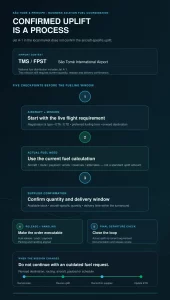
The distinction between fuel availability and confirmed uplift is important.
A practical confirmation sequence is:
- Jet A-1 listed as available → supplier contacted → stock confirmed → aircraft-specific quantity confirmed → commercial release confirmed → delivery timing confirmed → uplift completed
General product availability does not replace confirmation of the required quantity and delivery arrangement for the specific flight.
How Does the Onward Sector Determine the Fuel Requirement?
The required uplift relates to the planned onward flight. Aircraft type, routing, payload, winds, reserves, alternate requirements, and other flight-planning factors affect the fuel calculation.
A regional sector from São Tomé creates a different fuel requirement from a longer operation toward Europe, Southern Africa, or another distant destination. The fuel request therefore needs to use the current flight-planning requirement rather than a standard quantity. When the onward destination, routing, aircraft, or payload changes, the existing fuel request needs to be reviewed against the revised flight calculation before departure.
When Is Tankering a Practical Option?
Tankering involves carrying additional fuel from the previous station and reducing the quantity required at São Tomé. It can be considered when the previous airport has a suitable fuel supply and the additional fuel load fits the aircraft’s performance and operating limitations.
The assessment needs to consider:
- Maximum fuel capacity
- Maximum takeoff weight
- Payload
- Takeoff and landing performance
- Fuel burn associated with additional weight
- Runway characteristics
- Temperature and airport elevation
- Previous airport fuel availability
- Next airport fuel availability
- Turnaround-time requirements
Tankering is therefore not automatically preferable because it reduces the local uplift requirement. The operator’s flight-planning and aircraft-performance functions determine whether carrying additional fuel is operationally appropriate.
How Is a Partial Uplift Managed?
A partial uplift can be assessed against the aircraft’s actual fuel requirement rather than treated automatically as an operational failure.
The operator can establish:
- Preferred uplift: the quantity required for the planned operation.
- Minimum operational uplift: the quantity that supports an approved alternative plan.
- Available uplift: the quantity confirmed by the supplier for the aircraft and operating period.
If the preferred quantity is unavailable, OCC compares the confirmed uplift with the current flight plan, required reserves, aircraft performance, and any approved technical-stop option.
The aircraft then operates under the fuel strategy accepted by the operator’s responsible flight-planning and flight-release functions.
How Are Fuel Release and Delivery Arranged?
Fuel release forms part of the fuel coordination process. The applicable contract fuel arrangement, release, credit facility, payment method, or other supplier-approved commercial arrangement needs to be established before fueling.
The delivery arrangement also needs to align with the aircraft’s ETA, parking position, turnaround sequence, and ETD. The fuel provider, handling team, and OCC need consistent information on the aircraft, required quantity, delivery time, and any subsequent schedule changes.
How Is Fuel Integrated Into the Turnaround?
Fuel forms part of the aircraft turnaround rather than an isolated service. The exact sequence depends on the aircraft, airport procedures, safety requirements, and other requested services.
For a business aviation stop, the turnaround can include aircraft parking, passenger and crew activities, baggage handling, fueling, catering or cabin servicing, and departure preparation. Fuel therefore needs a defined delivery window within the turnaround. If delivery moves behind the planned sequence, OCC can reassess the effect on the remaining ground time and departure schedule.
What Happens When the Fuel Requirement Changes?
A destination, routing, aircraft, payload, or schedule change can produce a different fuel requirement.
OCC first obtains the revised fuel calculation from the operator’s responsible flight-planning function and communicates the updated quantity to the fuel supplier.
The supplier then confirms whether the revised quantity can be provided within the available operating window.
A typical sequence is:
Revised destination or aircraft → updated fuel calculation → revised uplift request → supplier confirmation → aircraft-performance review → updated ETD
This keeps the fuel request aligned with the actual flight plan instead of continuing with an outdated quantity.
What Happens When Fuel Delivery Is Delayed?
When fuel delivery is delayed, OCC obtains the latest supplier status and revised delivery estimate.
The assessment can then consider:
- Current onboard fuel
- Confirmed fuel quantity
- Revised delivery time
- Remaining turnaround
- Crew duty
- Passenger schedule
- Destination requirements
- Alternate requirements
- Available technical-stop options
If the delay affects the planned departure, the operator’s responsible operational functions determine whether to wait for the uplift, reduce or revise the fuel requirement where operationally permitted, use an alternative fuel stop, or delay the flight. The fuel supplier, handling team, and OCC then work from the same revised operating timeline.
When Does a Fuel Decision Point Become Necessary?
A defined decision point gives OCC a specific time to reassess the original fuel plan when delivery timing changes.
For example, an aircraft has a 1500 ETD and requires 8 tonnes of fuel for the planned operation. The supplier confirms delivery within the original turnaround window. If the delivery time moves beyond the planned fueling window, OCC establishes a decision point based on the remaining ground time and operational requirements.
At that point, OCC reviews the supplier’s latest ETA, onboard fuel, remaining turnaround, crew duty, destination requirements, alternate requirements, and any available technical-stop option.
The purpose of the decision point is to avoid waiting indefinitely for an uncertain fuel delivery without reassessing the flight plan.
Which Airports Form Part of a Fuel Contingency Plan?
When the confirmed São Tomé uplift does not support the planned onward operation, a mainland fuel stop can form part of the revised routing.
Libreville
Libreville Léon-Mba International Airport (LBV/FOOL) can be assessed as a mainland fuel option when the aircraft’s route and available fuel support the additional stop. Before inclusion in the operating plan, the operator needs confirmation of current Jet A-1 availability, uplift quantity, delivery timing, airport status, landing and overflight requirements, handling, parking, and operating hours.
Accra
Kotoka International Airport (ACC/DGAA) can also be assessed as a mainland fuel option. Its suitability depends on the aircraft’s routing, available fuel, onward destination, and current airport arrangements. Jet A-1 availability, delivery timing, permissions, handling, parking, operating hours, and other applicable requirements need confirmation before relying on the stop.
A contingency fuel airport therefore needs to be assessed as a complete operational solution rather than selected only because it is geographically reachable.
How Does the Onward Destination Affect Fuel Protection?
The required São Tomé uplift changes according to the onward destination and planned route. For a regional operation to Libreville or Accra, the uplift is based on the aircraft’s calculated trip fuel, reserves, alternate requirements, and planned arrival fuel.
A longer operation toward Europe, Southern Africa, or the Middle East introduces different routing, range, payload, wind, and reserve considerations. The fuel request therefore needs to remain linked to the actual onward destination and current flight plan.
How Is Fuel Quality and Documentation Managed?
Fuel quantity is only one part of the fueling process. The operator and handling team also need the applicable fuel documentation and records associated with the uplift.
The operational review can include:
- Applicable Jet A-1 specification
- Fuel quality documentation
- Delivery records
- Uplift quantity
- Fuel supplier documentation
- Reconciliation between requested and actual uplift
Any fuel-quality concern needs to be addressed through the applicable airport, supplier, handling, and operator procedures before the aircraft is released for the intended operation.
How Is an Aircraft Substitution Reflected in the Fuel Plan?
An aircraft substitution changes the fuel-planning basis. The replacement aircraft can have different fuel burn, capacity, performance, payload, and arrival-fuel requirements. When the aircraft changes, OCC provides the replacement registration and aircraft details to the fuel and handling teams.
The operator’s flight-planning function establishes the applicable fuel requirement, after which the supplier confirms the revised quantity and delivery arrangement.
How Is the Final Uplift Verified Before Departure?
After fueling, the actual uplift is checked against the current fuel requirement. The final fuel quantity, aircraft fuel status, and applicable fuel documentation form part of the departure review. If the actual uplift differs from the planned quantity, the difference is assessed against the current flight plan, reserves, aircraft performance, and destination requirements.
Any resulting change to the routing or departure plan is coordinated through the operator’s responsible flight-planning and flight-release functions.
| Practical Scenario: Revised Fuel Requirement at São Tomé A business jet arrives at São Tomé with an onwards flight planned to Accra. The aircraft registration, fuel requirement, delivery timing, and handling arrangements are confirmed for the planned operation. After arrival, the operator changes the onwards destination to a longer sector. The flight-planning function establishes a revised fuel requirement and provides the updated quantity to the coordination team. The local fuel supplier confirms the revised quantity and delivery timing. The available delivery window does not support the full preferred uplift within the original departure schedule. OCC compares the confirmed uplift with the minimum operational fuel requirement and the approved contingency routing. The operator selects the applicable fuel plan, and the affected fuel, handling, and destination teams receive the revised operating information. The departure schedule is then adjusted according to the confirmed fuel arrangement and the operator’s operational requirements. Operational Lesson: A change in destination requires the fuel quantity, supplier arrangement, turnaround timing, and flight plan to reflect the revised mission. |
|---|
How Just Aviation Coordinates Jet A-1 at São Tomé
Just Aviation coordinates Jet A-1 requirements with the relevant fuel and handling providers, including the aircraft details, uplift quantity, delivery timing, fuel release, and schedule changes.
When the confirmed uplift does not support the planned operation, the Operations Control Center coordinates the applicable contingency arrangements with the selected airport and local providers. Fuel calculations, aircraft performance, routing, tankering, reserves, and flight-release decisions remain with the operator’s responsible functions.
Planning a business aviation fuel stop at São Tomé?
Contact the Just Aviation Operations Control Center at [email protected] for 24/7 coordination of fuel, handling, ground services, and operational changes.
Frequently Asked Questions About Jet A-1 at São Tomé
1. Is Jet A-1 available at São Tomé International Airport?
Jet A-1 is part of São Tomé and Príncipe’s fuel-distribution market, and ENCO currently lists JET-A1 among its distributed products. However, national product availability does not confirm a specific aircraft’s uplift at TMS. Operators need current confirmation of the required quantity and delivery arrangement for each flight.
2. What information belongs in a São Tomé fuel request?
The request includes the aircraft registration and type, required quantity, ETA, ETD, onward routing, preferred fueling time, and applicable commercial or fuel-release arrangement.
3. Is general fuel availability the same as a confirmed uplift?
No. General availability indicates that the product is offered within the relevant supply system. A confirmed uplift establishes the aircraft-specific quantity and delivery arrangement for the planned operating period.
4. Can the fuel requirement change after arrival?
Yes. A revised destination, aircraft, routing, payload, or operating requirement can produce a different fuel calculation. The revised quantity needs to be confirmed with the supplier before the new fuel plan is used.
5. What happens when the requested quantity is not available?
OCC compares the confirmed quantity with the current operational fuel requirement and any approved alternative routing or technical-stop option.
6. When does tankering become relevant?
Tankering becomes relevant when carrying additional fuel from the previous station fits the aircraft’s fuel capacity, performance, payload, routing, and operating requirements. It is an aircraft- and mission-specific decision.
7. What happens when fuel delivery is delayed?
OCC obtains the latest supplier status and reassesses the effect on the turnaround, onboard fuel, crew duty, destination requirements, and available contingency options.
8. Who makes the final fuel and flight-release decision?
The operator’s appropriately authorized flight-planning, performance, dispatch, and flight-release functions retain responsibility for fuel calculations, reserves, aircraft performance, routing, and flight release.
Disclaimer
Jet A-1 stocks, uplift quantities, delivery timing, commercial arrangements, handling capability, airport conditions, and local fuel logistics can change according to the operating date and local conditions.
Operators need current confirmation for the specific aircraft and mission before relying on a São Tomé fuel arrangement. Fuel calculations, reserves, aircraft performance, tankering, routing, and flight-release decisions remain with the operator’s appropriately authorized personnel.
Conclusion
Jet A-1 planning at São Tomé International Airport requires more than confirming that aviation fuel exists within the local supply system. The operator needs confirmation of the aircraft-specific uplift, delivery timing, commercial release, and onward fuel requirement.
Tankering, partial uplift, and mainland technical-stop options provide additional planning paths when the preferred uplift does not fit the revised operation. Their suitability depends on aircraft performance, payload, routing, airport conditions, and the current fuel arrangements at the relevant stations.
The key distinction is between fuel availability and confirmed uplift. A workable fuel plan connects supplier confirmation, aircraft requirements, delivery timing, turnaround constraints, contingency routing, and OCC coordination into one current operational assessment.


 +971 4 5855 689