
Ground Support Coordination at Nosy Be Fascene Airport, Madagascar: Managing Peak Island Charter Operations

21 October 2026
| By Just Aviation TeamNosy Be Fascene Airport (NOS/FMNN) is an international gateway to one of Madagascar’s main island tourism destinations. Seasonal charter activity can place scheduled flights, private aircraft, international passengers and local ground services into the same operating periods. For operators, the practical issue is not whether Fascene handles charter traffic. It is whether the stand, handler, ground equipment, fuel, border services and passenger transport all remain aligned with the aircraft’s actual arrival and departure window.
Key Takeaways
- What needs to be confirmed before a non-scheduled charter departs for Nosy Be?
- Why can the assigned stand affect taxi access at Fascene?
- Which published GSE limitations matter for business aircraft?
- How much lead time applies to international passenger services?
- How should fuelling fit into a short charter turnaround?
- What changes when the ETA moves into a later operating period?
- How does an aircraft substitution change the ground plan?
- What technical recovery needs consideration at an island airport?
Peak Handling Pressure Comes From Overlapping Requirements
Nosy Be Fascene Airport receives scheduled, charter and private aviation serving an island tourism market.
A peak operating period does not necessarily mean the airport is congested. The pressure develops when several aircraft need the same type of resource at similar times.
Typical overlaps can involve:
- Parking positions
- Ground handling service teams
- Fuel delivery
- Ground power
- International passenger processing
- Baggage handling
- Resort vehicles
- Departure preparation
For a charter arriving during a concentrated traffic period, the useful question is:
- Which resources are confirmed for this aircraft during its actual ground window?
That is more practical than treating “peak season” as a general airport restriction.
Lock the Handling Package Before Departure
The current ASECNA eAIP for Nosy Be requires a prior handling agreement for non-scheduled operations. Operators should therefore confirm the required local arrangements before departure and ensure that the handling request reflects the actual aircraft, schedule and passenger mission.
Useful information includes:
- Aircraft type and registration
- ETA and ETD
- Passenger numbers
- International or domestic movement
- Planned ground duration
- Required parking
- Fuel uplift
- Ground-power requirement
- Baggage-handling requirements
- Passenger transportation
- Any special assistance
Providing these details in advance gives the local handling team a single operating picture and reduces the need for additional coordination after arrival.
Planning a charter to Nosy Be?
Contact Just Aviation to coordinate ground handling, parking, requested fuel uplift and passenger-support arrangements with the relevant local providers.
Treat the Stand and Taxi Route as One Ground Plan
Parking at Fascene is not only about finding an open stand. Current local procedures connect some parking positions directly to Taxiway E availability. When stand 03 is occupied, Taxiway E is closed. An additional Taxiway E restriction can apply when larger aircraft are positioned at stand 03A.
The diagram below illustrates how stand occupancy can affect Taxiway E access and why parking and ground movement should be coordinated together.
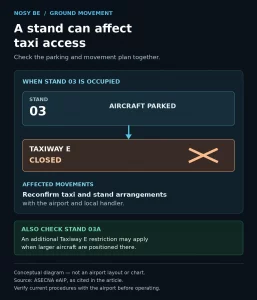
For operators, the operational consequence matters more than the stand numbers themselves: A parking assignment can change how another aircraft enters, leaves or moves across the apron. This becomes more relevant when:
- A larger aircraft replaces the planned type
- Arrival times begin to overlap
- Ground time extends
- An aircraft remains parked while another needs to depart
- A stand change occurs close to arrival
For larger charter or business aircraft, parking confirmation needs to reflect both where the aircraft will stay and how it will move to and from that position.
Check Ground-Equipment Dependencies Before Dispatch
Fascene has established handling capability, but its published GSE profile is more limited than a large hub. The current eAIP lists:
- One GPU available
- No ASU published
- No pushback equipment published
- No visiting-aircraft hangar
- No published repair facility for visiting aircraft
These details become operational when the aircraft depends on a particular service.
- Ground power
An aircraft requiring external power needs the GPU included in the handling request. Because only one unit is published, simultaneous access during overlapping movements cannot simply be assumed.
- Air start
An aircraft dependent on an external air-start unit needs another workable start solution established before operating to NOS.
- Pushback or towing
Where aircraft geometry or the assigned stand requires a towing or pushback solution, availability needs confirmation rather than an assumption based on larger-airport practice.
The aircraft’s ground-support dependency is therefore part of pre-flight planning, not an after-arrival handling detail.
International Passenger Processing Needs Advance Activation
Nosy Be is an international airport, but border services for a non-scheduled movement operate on request. The current eAIP publishes 24 hours’ advance notice for:
- Customs and immigration
- Health and sanitation services
For an international charter, the handler needs the applicable flight and passenger information early enough for those services to be activated for the planned arrival or departure.
A significant ETA change can also affect the original arrangement. For operators carrying VIP groups, resort passengers or larger charter parties, border-service confirmation belongs in the ground plan alongside parking and handling rather than being left as a terminal-only matter.
Fuel Availability and Fuel Timing Are Separate Questions
Nosy Be publishes Jet A-1 and AVGAS 100LL, with TotalEnergies Marketing Madagasikara identified in the current eAIP. For non-scheduled flights, fueling is request-based and needs advance coordination.
The fuel plan needs three separate confirmations:
- Quantity: Can the requested uplift be provided for the aircraft?
- Timing: Can delivery fit the planned ground window?
- Commercial arrangement: Is the applicable fuel authorization, credit or payment method aligned with the live flight?
A short island turnaround can become fuel-critical even when Jet A-1 is present at the airport if the delivery time no longer fits ETD.
Build the Turnaround Around the Critical Service
A charter turnaround often combines several activities:
Passenger offload → baggage → fuel → servicing → new passenger boarding → departure
Not every task controls the departure time. For one aircraft, fuel may be the critical path. For another, international processing may take longer. For a business jet requiring the airport’s published GPU, ground power availability may influence the sequence.
The useful ground plan identifies:
- Which services are required?
- Which can proceed in parallel under applicable procedures?
- Which service controls the earliest realistic departure?
This produces a workable ETD instead of several independent service estimates.
Passenger Transport Needs the Same Live ETA as the Handler
At Nosy Be, many charter passengers continue directly from Fascene to resorts, villas or hotels. The ASECNA eAIP for Nosy Be Fascene Airport (FMNN) lists taxis, hotel vehicles and rental transport, but private and charter passengers benefit from a transport plan tied directly to the flight.
Before arrival, confirm:
- Passenger number
- Vehicle type and capacity
- Resort or hotel destination
- Driver or transport contact
- Baggage volume
- Current ETA
- VIP or assistance requirements where applicable
A 20-passenger charter and a four-passenger business jet create very different vehicle and baggage needs. For a delayed aircraft, the transport provider needs the same revised ETA used by handling and passenger processing.
A Late ETA Can Change More Than the Ground-Handling Time
The published AIP lists ATS as available during HJ–HN, with service outside those hours subject to request procedures, including flight-plan filing before 1200 UTC; security and other services may also require advance arrangements or extensions for non-scheduled flights. Operators should confirm the airport’s applicable operating arrangements and each required service for the revised ETA.
The revised plan may affect:
- ATS availability
- Handling
- Fuel timing
- Security
- Border services
- Passenger transport
- Crew ground arrangements
The key is not to keep moving the ETA while assuming the original airport arrangements remain intact. Once the new schedule is credible, the time-dependent services need to be aligned with that operating window.
Aircraft Substitution Changes Several Ground Requirements at Once
Replacing one aircraft with another is rarely only a registration amendment.
The substitute type can change:
- Stand assignment
- Taxiway access
- Wingspan clearance
- GPU requirement
- Fuel quantity
- Baggage capacity
- Passenger handling
- Expected ground time
At Fascene, where stand occupancy can affect taxiway availability, a larger substitute deserves particular attention. The replacement aircraft needs to reach the local handling team before the flight is treated as ready under the previous arrangement.
Build Technical Recovery Into the Island Plan
The current eAIP does not publish a visiting-aircraft hangar or repair facility at Nosy Be. That does not mean technical support can never be arranged. It means a business or charter operator cannot plan around a published on-site repair capability in the same way it might at a major maintenance base.
For an aircraft with limited local engineering support, consider in advance:
- Operator maintenance contact
- Engineer positioning options
- Critical spare-part routing
- Ground equipment needed for troubleshooting
- Passenger accommodation if the aircraft becomes unavailable
- Recovery aircraft or revised passenger routing where appropriate
At an island destination, an AOG event can quickly become a passenger and crew logistics problem as well as a technical one.
Do Not Let a Schedule Extension Become an Unconfirmed Parking Stay
A passenger may decide to remain on the island longer than planned. If the aircraft was originally arranged for a short stay, the revised itinerary changes the ground requirement.
Before treating the extension as settled, confirm:
- Revised departure time
- Continued stand availability
- Any movement impact from the assigned position
- Crew arrangements
- Fuel timing
- Required international services for departure
- Passenger transport back to the airport
A parking arrangement built around a short charter turnaround does not automatically describe the same situation several hours or days later.
| Practical Scenario: A Delayed Business Jet Arrives Into a Busier Window
A business jet is planned into Nosy Be with international passengers, a short ground stay and an onward departure later the same day. Handling, border services, parking, fuel and resort transport are arranged around the original arrival time. The inbound sector is delayed. The new ETA now overlaps with other airport activity, and the original stand plan is no longer the most practical arrangement. The revised parking position affects the aircraft’s ground-movement sequence. The jet also requires external ground power, so the published GPU requirement is checked against the updated operating window. Fuel delivery moves later to fit the new turnaround, while passenger vehicles and international-arrival services are aligned with the same revised ETA. The aircraft arrives into a ground plan built for the new traffic picture rather than the original schedule. The operational lesson is that a delay at Nosy Be is not only a timing change. Parking, movement, GSE, fuel and passenger services may all need to be rebuilt around the revised window. |
|---|
How Just Aviation Supports Nosy Be Charter Operations
Just Aviation provides a single coordination point for the local elements of a non-scheduled Nosy Be operation, including handling, parking, requested fuel uplift, required ground equipment, passenger transport and applicable international-arrival services. When the aircraft type, ETA, ground duration or passenger plan changes, the affected local arrangements can be realigned against the current mission.
Aircraft performance, fuel planning, loading, maintenance release, dispatch, flight release and command decisions remain with the operator and PIC as applicable.
For Nosy Be charter and business aviation support, contact the Just Aviation Operations Control Center at [email protected].
Frequently Asked Questions About Nosy Be Ground Handling and Business Aviation
1. What ground handling services are available for private jets at Nosy Be Airport?
Non-scheduled aircraft require advance handling coordination. Operators can arrange parking, passenger handling, baggage support, fuel, ground power and transport according to the aircraft and schedule.
2. How far in advance should ground handling be arranged at Nosy Be Fascene Airport?
Arrange handling before departure and allow additional lead time where the flight requires customs, immigration, health services, fuel, special equipment or a non-standard operating time.
3. Can Nosy Be Airport handle a quick-turn business jet operation?
A short turnaround can be planned, but the achievable ground time depends on parking, passenger processing, fuel delivery, baggage, GSE and the traffic picture during the operating window.
4. Is overnight parking available for business jets at Nosy Be Airport?
Overnight parking is subject to the aircraft type, stand availability and the airport’s live parking plan. Longer stays are best confirmed for the complete requested ground period.
5. Can international private jet passengers clear customs and immigration at Nosy Be?
Yes. Customs and immigration are published on request, with 24 hours’ advance notice currently specified for activation of the required services.
6. Is Jet A-1 available for private and charter aircraft at Nosy Be?
Jet A-1 is published at Fascene. Non-scheduled operators need to arrange the aircraft-specific quantity, delivery timing and applicable commercial fuel authorization in advance.
7. What ground equipment limitations should business jet operators know at Nosy Be?
Current published information lists one GPU, while no ASU or pushback equipment is published. Aircraft requiring specific GSE need an aircraft-specific solution confirmed before operation.
8. Can a delayed private jet still operate into Nosy Be at night?
Night operations depend on the current ATS and airport-service arrangements for the revised schedule. A flight moving substantially later needs the new operating window reconfirmed.
9. Can larger business jets use the same parking plan as smaller charter aircraft?
Not automatically. Aircraft size, wingspan and stand assignment can affect apron movement and taxi access, so a larger substitute aircraft requires a revised ground-positioning check.
10. What happens if a private jet goes AOG at Nosy Be Airport?
The current eAIP does not publish a visiting-aircraft repair facility or hangar. Operators may need to plan engineer positioning, spare-parts logistics, passenger accommodation or another recovery solution.
Disclaimer
Handling arrangements, parking, GSE, fuel service, border processing, ATS availability, security and local airport procedures can change. Operators need current confirmation for the aircraft, schedule and passenger mission being operated. Aircraft performance, loading, fuel planning, maintenance, dispatch, flight release and command decisions remain with the operator and PIC as applicable.
Conclusion
Ground support at Nosy Be works best when the stand, aircraft movement, handling resources and passenger plan are built around the same operating window. Seasonal charter traffic does not make Fascene permanently congested, but overlapping movements can change which parking positions, equipment and services are available at a given time. Advance handling, early activation of international services, aircraft-specific GSE planning and a realistic recovery plan give operators more control when the ETA, aircraft or passenger schedule changes.


 +971 4 5855 689