
Fuel Logistics at Mtwara Airport, Tanzania: Planning Uplift for Offshore and Business Aviation

07 October 2026
| By Just Aviation TeamMtwara Airport (MYW/HTMT) is an H24 Code 4C airport serving southern Tanzania and is published for domestic, entry and exit operations. Public petroleum-sector reporting confirms that Jet A-1 has been distributed at Mtwara, but historical distribution does not confirm the fuel position for a future flight. Business aviation and energy-support operators should therefore plan around four separate questions: whether Jet A-1 is currently available, whether the required quantity can be supplied, whether delivery fits the ground window, and whether the applicable commercial arrangement is in place.
Key Takeaways
- What does published Jet A-1 distribution at Mtwara actually confirm?
- Which fuel details should OCC obtain for the individual aircraft?
- Does Mtwara’s H24 airport status mean fuel is available H24?
- How should multi-sector energy-support operations plan their uplift?
- When can carrying additional fuel from Dar es Salaam reduce local dependency?
- What should happen if the full requested quantity cannot be confirmed?
- How should a destination change be reflected in the fuel order?
- When should Dar es Salaam be evaluated as part of the contingency plan?
Published Fuel Presence Is Not a Live Uplift Confirmation
EWURA’s publicly available airport-level reporting records Jet A-1 distribution at Mtwara Airport. This confirms that aviation turbine fuel has been supplied at the airport. It does not establish the current operating-day position.
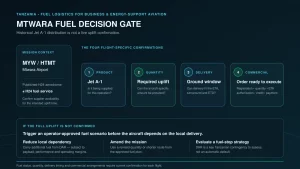
Before the aircraft becomes dependent on a Mtwara uplift, OCC should distinguish four separate confirmations:
- Product: Is Jet A-1 currently being supplied for the planned operation?
- Quantity: Can the required aircraft-specific uplift be provided?
- Delivery: Can the fuel be delivered within the required ground window?
- Commercial arrangement: Is the applicable contract-fuel authorization, credit arrangement, fuel release or direct-payment method accepted?
A general statement that fuel has historically been supplied at Mtwara does not answer these four questions for a specific flight.
H24 Airport Operations Do Not Mean H24 Fuel Service
Tanzania Airports Authority currently publishes Mtwara Airport as operating 24 hours. That describes the aerodrome’s operating status. It should not be interpreted as confirmation that the fuel provider delivers Jet A-1 continuously throughout the same period.
For an evening, night or early-morning uplift, the fuel-service window should therefore be checked separately. OCC should confirm:
- Planned fueling time
- Required notice for the requested uplift
- Delivery availability at the intended hour
- Any local arrangement required outside normal supplier staffing periods
The same caution applies to entry and exit operations. Mtwara’s published entry/exit status does not by itself establish continuous availability of every border or ground service required for an international movement.
Give the Fuel Provider the Actual Mission Requirement
A useful fuel request needs more than an aircraft registration and a request for Jet A-1. The local fuel arrangement should normally reflect:
- Aircraft registration and type
- ETA and ETD
- Requested quantity and unit
- Expected ground time
- Onward destination or planned flying sequence
- Applicable commercial fuel arrangement
- Any departure time that materially affects the mission
The onward plan matters because two identical aircraft can create very different uplift requirements. A short return to Dar es Salaam may need only a top-up. A longer business aviation sector or several project-support movements may make the local uplift a critical part of the operating plan.
Multi-Sector Energy-Support Operations Need Rotation-Level Fuel Planning
Mtwara can form part of aviation logistics supporting southern Tanzania’s energy and offshore-related activity. The actual aviation pattern can vary. It may involve a fixed-wing aircraft transporting personnel into Mtwara, project-related regional sectors, helicopter support arranged separately, or another combination of aviation and surface or marine logistics.
The fuel plan should therefore follow the aircraft’s actual sequence, rather than assuming every energy-support mission operates directly offshore. For an aircraft flying several sectors, OCC should identify:
- Fuel required for the initial planned departure
- Expected fuel position after each sector
- Whether another uplift is required before a subsequent movement
- Which part of the program depends on that later uplift
- What approved revised plan applies if the expected quantity or timing changes
This prevents a later sector from depending on a local fuel delivery that has not yet been incorporated into the operational plan.
Prepare an Original and a Revised Fuel Scenario
Where the full uplift is operationally important, the operator can prepare more than one valid fuel scenario before arrival.
For example:
- Original mission: fuel calculated for the complete planned routing.
- Revised mission: fuel calculated for a shorter or amended operating sequence.
- Fuel-stop strategy: fuel calculated for a routing that includes another suitable airport before the onward mission continues.
These are not generic minimum quantities. Each scenario must come from the operator’s approved fuel-planning process, including the applicable reserves, aircraft performance and operating requirements.
For OCC, the benefit is that a lower-than-requested local quantity can trigger an already understood operational choice rather than an improvised decision on the ground.
When Should Additional Fuel Be Carried From Dar es Salaam?
Where the aircraft is already operating through Julius Nyerere International Airport (DAR/HTDA) before Mtwara, the operator may assess whether carrying additional fuel into Mtwara reduces dependence on a large local uplift. This may be worth evaluating when:
- The full Mtwara quantity has not been confirmed
- The planned ground time is short
- Several subsequent sectors depend on the uplift
- A delay would disrupt a time-sensitive passenger or project schedule
The operator should decide this from aircraft-specific calculations. Additional fuel affects:
- Takeoff weight
- Payload
- Runway performance
- Fuel burn
- Landing weight
- Mission economics
Tankering is therefore an option to assess, not a default recommendation.
Keep the Commercial Fuel Arrangement Aligned With the Flight
An aircraft can encounter a fueling delay even when the physical product is present. The problem may instead be that the commercial instruction and the live flight no longer match. Common mismatches include:
- Incorrect aircraft registration
- Revised quantity not reflected in the order
- ETA moved without updating the supplier
- Contract-fuel authorization issued for different details
- Credit or direct-payment arrangement still unresolved
- Operating company details differing between the request and authorization
Before the planned delivery window, OCC should ensure that the current aircraft, quantity, schedule and applicable commercial arrangement agree. After that alignment is established, repeated discussion of “fuel availability” becomes less useful than knowing whether the specific order is ready for execution.
Fit Fueling Into a Short Turnaround
For a short Mtwara stop, the relevant question is whether the confirmed fuel delivery supports the required ETD.
Fueling may sit alongside passenger handling, baggage, servicing or other ground activities, but operators should not assume that every task can occur simultaneously. The ground sequence should establish:
- Expected start of fueling
- Required uplift
- Services that may proceed in parallel under applicable procedures
- Any activity that must wait
- Expected fueling completion relative to ETD
If fueling becomes the critical path, the departure plan should reflect the actual completion estimate rather than the original schedule.
A Destination Change Requires a Fresh Quantity Check
Passenger or mission changes after arrival can materially alter the departure uplift. Consider a business aircraft initially planned: Mtwara → Dar es Salaam
The passengers later request a longer onward sector.
The appropriate sequence is:
- The operator recalculates the fuel requirement.
- Weight and performance are reassessed.
- The revised quantity is passed to the local fuel arrangement.
- Quantity and delivery timing are reconfirmed.
- ETD is adjusted if the additional uplift changes the turnaround.
Acceptance of the original fuel request should not be treated as confirmation that a substantially larger quantity can be supplied at the same time.
Set a Decision Time for a Time-Critical Uplift
Where the flight supports a fixed business, crew or project schedule, an unresolved fuel status should not remain open indefinitely. OCC should identify the point at which continued waiting requires a revised plan. At that stage, the operator can evaluate:
- Fuel already onboard
- Quantity actually confirmed
- Revised delivery estimate
- Crew duty
- Passenger or project timing
- An approved alternative routing or fuel stop
The decision point should come from the mission’s real constraints rather than an arbitrary standard lead time.
Dar es Salaam Is an Important Fuel Contingency to Evaluate
EWURA’s published national fuel data shows that Julius Nyerere International Airport handles substantially more Jet A-1 activity than Tanzania’s regional airports. That makes DAR an important airport to evaluate in Mtwara fuel planning, particularly when the aircraft is already routing through mainland Tanzania.
A revised routing might involve:
- Mtwara → DAR → fuel uplift → onward flight
Alternatively, additional fuel may be carried from DAR before the aircraft initially positions to Mtwara. DAR should not automatically be treated as the best contingency for every mission. The operator should compare it with other suitable airports based on:
- Aircraft fuel remaining
- Routing
- Destination
- Aircraft performance
- Crew duty
- Passenger consequences
- Handling and airport requirements
- International permissions or formalities where applicable
The objective is an operationally suitable recovery plan, not simply the nearest airport known to have a larger fuel market.
| Practical Scenario: A Mtwara Uplift Is Not Fully Confirmed Before Departure A business aircraft is planned from Dar es Salaam to Mtwara for a project-support visit followed by additional regional flying. The planned operating sequence requires a significant Mtwara uplift. Before departure from DAR, the local status confirms that the full requested quantity cannot yet be committed within the intended ground window. The operator reviews an alternative fuel scenario. Aircraft performance calculations show that additional departure fuel can be carried from Dar es Salaam while preserving the required payload and operating margins. The planned Mtwara uplift is therefore reduced to the quantity needed under the revised fuel strategy. That quantity and its delivery timing are confirmed against the aircraft and schedule. The revised plan reduces dependence on one large, time-critical local delivery. Final fuel calculations, aircraft performance and operational acceptance remain with the operator. The planning lesson is not that fuel is unavailable at Mtwara. It is that an aircraft should not become dependent on a quantity or delivery time that has not been confirmed for the specific mission. |
|---|
How Just Aviation Supports Mtwara Fuel Operations
Just Aviation can obtain the current aircraft-specific fuel status from the relevant local parties and align the requested uplift, schedule and applicable commercial authorization.
If the aircraft schedule, requested quantity or operator-selected fuel strategy changes, the revised local arrangement or selected contingency can be updated through the same operational channel. Fuel calculations, reserves, tankering decisions, aircraft performance, flight planning and flight release remain with the operator and PIC as applicable.
For Mtwara fuel and business aviation support, contact the Just Aviation Operations Control Center at [email protected].
Frequently Asked Questions About Fuel at Mtwara Airport
1. Has Jet A-1 been supplied at Mtwara Airport?
Yes. Public EWURA reporting records Jet A-1 distribution at Mtwara Airport. Current quantity and delivery conditions still require flight-specific confirmation.
2. Does Mtwara’s H24 airport status mean Jet A-1 is available H24?
Not necessarily. Airport operating hours and fuel-provider service hours are separate and should be confirmed independently.
3. What should OCC confirm beyond general fuel availability?
Confirm the product, aircraft-specific quantity, planned delivery window and applicable commercial fuel arrangement.
4. What information should accompany the fuel request?
Provide aircraft type and registration, ETA/ETD, requested quantity, onward mission and the applicable credit, contract-fuel or payment arrangement.
5. Can additional fuel be carried from Dar es Salaam instead?
The operator may assess this when aircraft performance, payload and the planned routing make additional fuel carriage appropriate.
6. What if the full requested quantity is not confirmed?
The operator should evaluate an approved revised fuel scenario, amended mission or suitable fuel-stop strategy rather than assume the original plan remains viable.
7. Should fuel be reconfirmed after the destination changes?
Yes, where the revised route changes the required uplift or fueling time.
8. Is Dar es Salaam a useful contingency for Mtwara fuel planning?
Yes. DAR has a much larger aviation-fuel market and is an important Tanzanian option to evaluate, subject to the aircraft’s route and operational requirements.
9. Can fuel be physically available while the uplift is still delayed?
Yes. Commercial authorization, aircraft details, quantity or schedule may still need alignment before delivery can proceed.
Disclaimer
Historical fuel-distribution data does not represent live Jet A-1 stock. Supplier arrangements, quantities, service hours, delivery timing, commercial terms, airport conditions and local procedures at Mtwara can change. Operators should obtain current aircraft-specific fuel confirmation and review applicable aeronautical information before each operation. Fuel calculations, reserves, tankering, aircraft performance, flight planning and flight-release decisions remain with the operator and PIC as applicable.
Conclusion
Fuel planning at Mtwara should be based on current aircraft-specific confirmation rather than historical availability alone. Operators should establish the required quantity, delivery window and commercial arrangement before the mission becomes dependent on the local uplift. For multi-sector or time-sensitive operations, an operator-approved revised fuel scenario provides a clearer response if the requested quantity changes. Where routing makes it suitable, Dar es Salaam can also be incorporated into the fuel strategy without assuming that it is the correct contingency for every Mtwara operation.


 +971 4 5855 689