
Daytona 500 2027: Business Aviation Airport Options, Parking and Ground Handling Guide

26 November 2026
| By Just Aviation TeamBy Just Aviation Team | November 2026
The Daytona 500 is scheduled for Sunday, 21 February 2027, at Daytona International Speedway. Speedweeks runs from 13 to 21 February, so operators should build the flight itinerary around the events their passengers plan to attend. See the official NASCAR 2027 schedule.
For business aviation, airport selection needs to address the complete movement: arrival, parking, passenger transport and departure after the race. International arrivals require a separate assessment of border-processing availability. An aircraft that can land at the preferred airport still needs confirmed handling, parking and any applicable arrival permissions.
Just Aviation’s ground handling services help operators coordinate local providers and requested services around the aircraft, schedule and passenger itinerary.
Key Takeaways
- Which airports should operators assess for a Daytona itinerary?
- What should be confirmed separately for arrival, parking and departure?
- How does Sunday race-day timing affect international arrival planning?
- Which FAA notices and event procedures need checking?
- How should passenger transfers and post-race schedule changes be managed?
What Should Be Established Before Choosing an Airport?
Start with the passenger’s planned attendance dates and required arrival time at the venue. Include qualifying, hospitality commitments or other events where relevant.
The operational brief should identify:
| Planning input | Why it matters |
|---|---|
| Aircraft type and registration | Supports performance, airport acceptance, stand and equipment checks. |
| Arrival and departure windows | Allows providers to assess availability across the full itinerary. |
| Origin and onward destination | Establishes whether US arrival or departure formalities apply. |
| Ground duration | Determines the parking requirement and whether repositioning needs assessment. |
| Passenger destination | Provides the actual hotel, hospitality entrance or meeting point for transfer planning. |
| Crew arrangements | Identifies accommodation, transport and any replacement-crew requirement. |
| Required aircraft services | Establishes fuel, ground power, towing, catering and other dependencies. |
| Schedule flexibility | Provides alternatives if the requested airport or service window cannot be confirmed. |
For a Sunday departure, obtain the passenger’s expected post-race commitments. A flight planned immediately after the race needs enough flexibility to accommodate the actual event finish and the journey back to the aircraft.
Which Airports Should Operators Assess?
Daytona Beach International is the direct local airport to assess. Orlando Sanford International provides another regional option, while Flagler Executive may suit aircraft and itineraries that meet its operating limitations.
Each option requires an aircraft-specific performance and service assessment.
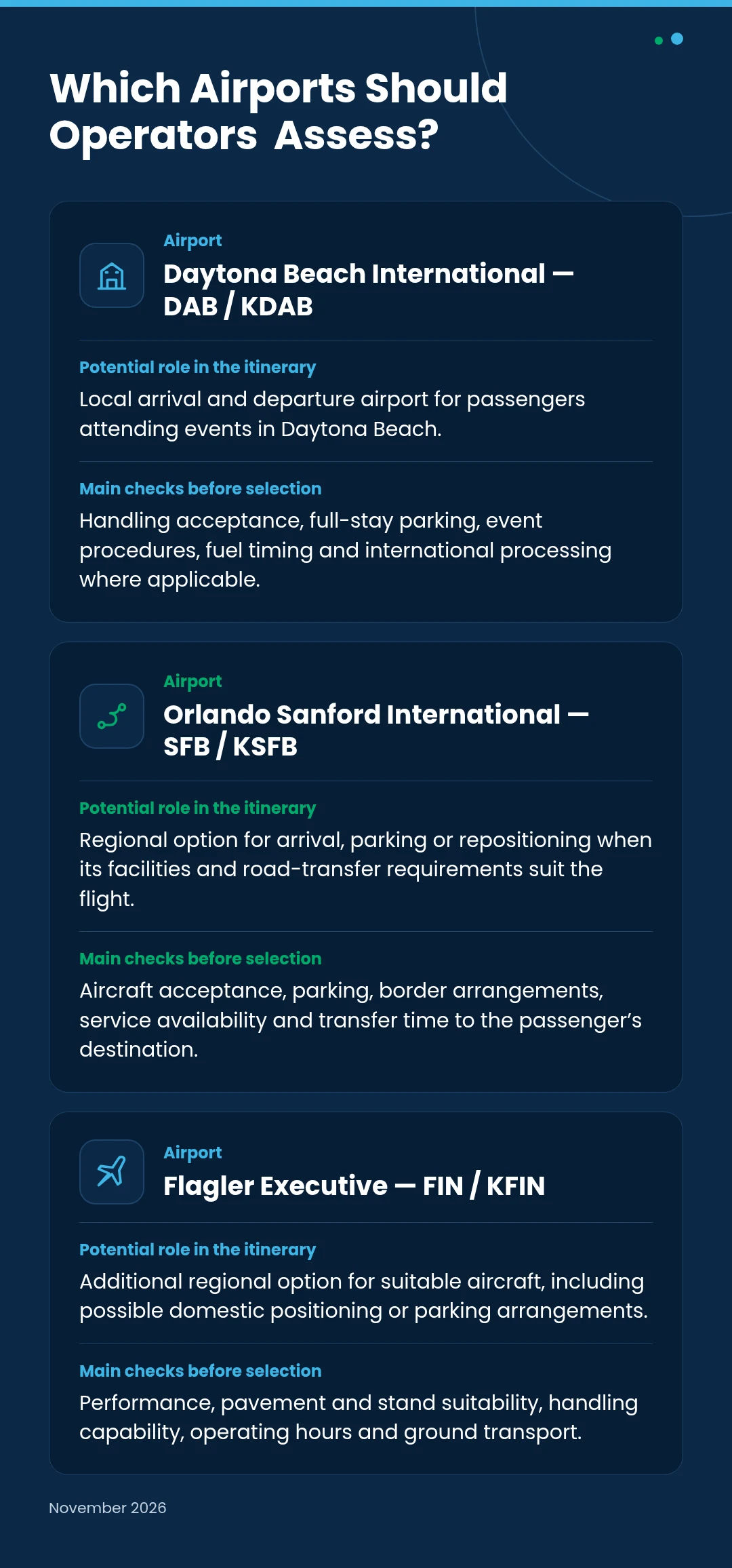
DAB publishes information for general and corporate aviation. SFB’s official airfield page identifies its aviation services and facilities. Flagler County describes FIN as a towered general aviation airport with paved runways of approximately 5,500 and 5,000 feet. Use current aeronautical information and aircraft performance calculations for the intended movement.
What Should Operators Confirm at Daytona Beach International?
Obtain a handling confirmation that covers both ends of the visit. An arrival booking should be supported by the parking period and the planned departure arrangements.
Ask the provider to confirm:
- Acceptance of the aircraft and proposed movement times.
- Parking from arrival through departure.
- Any towing, stand change or aircraft-access restrictions.
- Equipment required for servicing and departure preparation.
- Passenger meeting and vehicle-access arrangements.
- Fuel availability and the intended uplift window.
- Applicable event procedures and booking conditions.
Identify which items are confirmed and which remain subject to allocation. If the provider expects to assign the parking position closer to arrival, establish how dispatch will receive the update and whether that affects services or passenger collection.
Just Aviation’s Daytona Beach ground handling support can coordinate these enquiries with local providers.
How Should Overnight Parking and Repositioning Be Planned?
Request parking for the complete stay, including any time needed after the passenger’s expected return. Clarify whether the arrangement permits access for servicing or requires the aircraft to move before departure.
| Parking arrangement | What to assess |
|---|---|
| Remain at the arrival airport | Confirm the full parking period, aircraft access, servicing and departure availability. |
| Drop off passengers and reposition | Assess the additional sectors, parking at the second airport, crew duty and return-flight arrangements. |
| Use a different passenger departure airport | Reconcile aircraft positioning, passenger transport, handling and any international departure requirements. |
| Extend the stay | Confirm revised parking, crew accommodation, service availability and additional charges. |
A repositioning plan needs its own confirmed sequence. Establish where the aircraft will park, where the crew will stay, when the aircraft can return and how a delayed passenger pickup will be handled.
Compare the complete cost of the options. Extra sectors, handling, fuel, crew transfers and parking can materially change the result. Just Aviation’s business jet ground handling cost guide explains the charging items to include in that comparison.
What Should International Arrivals Check Before Selecting DAB?
Confirm CBP processing for the actual arrival date and time before committing to a direct international arrival.
U.S. Customs and Border Protection (CBP) generally provides general aviation arrival inspections at Daytona Beach International Airport (DAB/KDAB) from 9:00 a.m. to 5:00 p.m. Eastern Time, Monday through Friday, excluding federal holidays. The published procedures list a separate 9:00 a.m. to 4:30 p.m. Eastern Time block-in window. Weekend, holiday and after-hours service is subject to case-by-case approval and availability. Confirm the requested inspection window directly with CBP before committing to a Sunday race-day arrival. See the CBP general aviation fact sheet for KDAB.
Pilots must obtain CBP permission to land before departing the foreign airport and by 4:00 p.m. Eastern Time on the preceding business day. If the revised ETA falls more than 30 minutes before or after the approved arrival time, the original permission becomes invalid and the crew must contact CBP to obtain permission again. See the KDAB permission-to-land procedures.
If the requested DAB processing cannot be confirmed, the operator can assess another suitable arrival airport or an earlier arrival. Reconcile the resulting passenger transfer or onward domestic sector with the itinerary.
Which US Entry and Reporting Arrangements Need Separate Review?
Establish the operation type and applicable US requirements before departure from the foreign location. The review should cover passenger and crew reporting, travel documents, CBP permission to land, airport-specific inspection arrangements and any additional operating authorisation relevant to the flight.
CBP distinguishes the APIS filing from permission to land. Its general aviation processing guidance directs arriving operators to file the manifest and secure permission at the intended airport. Commercial departures also have applicable clearance procedures.
Coordinate these requirements alongside handling and parking. Just Aviation’s global business aviation compliance guide provides related context for tracking the separate permissions and operational arrangements.
Which FAA Event Procedures Should Be Checked?
Review the FAA notices effective for the planned arrival and departure dates. Assess any published event procedures, temporary restrictions, airport limitations and traffic-management instructions.
The FAA explains that Special Traffic Management Programs may be introduced for events and that a domestic notice provides the applicable reservation information. Prior Permission Required arrangements can also apply where local activity affects operations.
For the 2027 movement, establish:
| Check | Required action |
|---|---|
| Event notice | Review the notice covering the intended airport and operating period. |
| Reservation requirement | Obtain and record a reservation if the published procedure requires one. |
| Airport or provider PPR | Confirm any separate local acceptance process. |
| Temporary flight restrictions | Review the effective NOTAM and its conditions. |
| Changed timing | Check whether a reservation, approval or service booking needs amendment. |
Use the published instructions for the event year and movement date. FAA security-related procedures direct pilots to review relevant NOTAMs for their route.
Which Ground Services Need Advance Confirmation?
Prioritise the services that determine whether the aircraft can arrive, remain and depart as planned.
| Service | What to confirm |
|---|---|
| Fuel | Grade, requested quantity, release or payment acceptance and delivery window. |
| Ground power and cabin conditioning | Compatible equipment, connection arrangements and availability before boarding. |
| Towing | Aircraft compatibility, personnel, timing and access to the departure position. |
| Aircraft servicing | Lavatory, water, cleaning and other requested services within the available window. |
| Catering | Delivery time, access arrangements and the deadline for changes. |
| Technical support | Relevant local capability and the process for obtaining assistance. |
Where the aircraft will remain parked through the event, ask whether servicing can be completed before passengers leave the venue. Confirm that arrangement with the crew and handler.
How Should Passenger Transfers Be Arranged?
Use the passenger’s confirmed venue entrance, hospitality location or hotel address when booking transport. Include passenger numbers, luggage and any access requirements.
The Speedway publishes event-dependent parking and directions. Check the arrangements relevant to the passenger’s ticket or hospitality package and brief the driver accordingly.
For the return journey, establish:
- The passenger meeting point after the event.
- How the driver receives updates.
- Where the vehicle can wait.
- The airport and handling facility to which passengers will return.
- Waiting-time and amendment charges.
- Who advises the crew of the passenger’s departure from the venue.
Estimate the complete journey from the passenger’s location to the aircraft. Include venue exit, vehicle access, road travel and airport processing.
How Should Departure After the Race Be Managed?
Build flexibility around the passenger’s expected return. The final race finish, hospitality commitments and road journey can alter when the passenger reaches the handling facility.
The operator should establish a departure window that works with crew availability, airport procedures and onward arrangements. The handler then confirms the services needed to prepare the aircraft within that window.
If the passenger is delayed, review the consequences before issuing a new departure time. Recheck applicable movement reservations, international departure procedures, fuel and crew arrangements.
For example, an aircraft may be ready at DAB while the passenger remains at a post-race event. Dispatch should establish the updated passenger estimate, ask the handler which services can remain available and have the operator assess the revised flight. If an overnight stay becomes necessary, parking and accommodation need fresh confirmation.
Just Aviation’s crew support services can coordinate hotel and transfer changes alongside the operator’s revised reporting instructions.
What Should Be Included in the Final Trip Confirmation?
Consolidate the arrangements into a current brief before departure for Daytona.
| Item | Confirmation to retain |
|---|---|
| Airport | Correct airport codes and acceptance for the aircraft. |
| Movement arrangements | Applicable reservation, PPR or event-procedure requirements. |
| Parking | Full-stay confirmation and any towing or repositioning plan. |
| International processing | APIS status, CBP permission and agreed inspection arrangements where applicable. |
| Ground services | Accepted service order, fuel arrangement and preparation window. |
| Passenger transport | Driver instructions, meeting points and correct return airport. |
| Crew logistics | Accommodation, transfers and operator-approved reporting arrangements. |
| Commercial terms | Quotation, deposit, cancellation and amendment conditions. |
Identify unresolved items explicitly and assign follow-up. Revalidate the brief when the aircraft, occupants, airport or timing changes.
How Just Aviation Supports Daytona 500 Flights
Just Aviation coordinates airport enquiries and local services around the operator’s aircraft and passenger itinerary.
Support can include:
- Comparing airport and parking options.
- Coordinating handling and event-procedure enquiries.
- Following up on international arrival arrangements.
- Arranging fuel and aircraft-specific ground services.
- Coordinating passenger transport and crew logistics.
- Communicating schedule changes and revised confirmations.
Airport acceptance, border permissions and service availability remain subject to confirmation. Aircraft suitability, performance, dispatch and crew decisions remain with the operator and its authorised personnel.
For a coordinated Daytona 500 trip assessment, contact the Just Aviation Operations Control Center at [email protected].
Frequently Asked Questions About Daytona 500 Business Jet Operations
1. When is the 2027 Daytona 500?
The Daytona 500 is scheduled for Sunday, 21 February 2027, at Daytona International Speedway. Speedweeks runs from 13 to 21 February. See the official NASCAR 2027 schedule.
2. Which airport should be assessed first?
Start with DAB and compare its confirmed arrangements with suitable regional options. Consider aircraft requirements, parking and the complete passenger transfer.
3. Can an international flight arrive at DAB on race-day Sunday?
A direct Sunday international arrival at DAB depends on CBP inspection availability and advance permission to land. Contact CBP to confirm your requested arrival time before committing to DAB. See the CBP general aviation fact sheet for KDAB.
4. Does a handling booking include overnight parking?
Check the accepted scope and parking period. Obtain separate confirmation where the handling order leaves parking subject to allocation.
5. Is an FAA reservation required for every Daytona 500 flight?
Follow any procedure published for the relevant airport, date and operation. The requirement should be established from the applicable FAA notice.
6. Can Flagler Executive accommodate the proposed business jet?
The operator needs to assess performance, pavement, stand and service suitability using current information. Its approximately 5,500-foot longest runway is one part of that assessment.
7. Should departure be scheduled immediately after the race?
Assess the passenger’s event commitments, transfer and airport processing alongside the flight’s operational requirements. Allow for the confirmed services and applicable procedures.
8. What if the aircraft must reposition for parking?
Confirm the additional sectors, parking airport, crew arrangements and return movement before accepting the plan.
9. Which changes need a final review?
Review aircraft substitutions, passenger or crew amendments, airport changes and revised movement times against the affected reporting, permissions and service bookings.
Disclaimer
This article provides general event-flight planning guidance. Apply current FAA notices, aeronautical information, CBP instructions, airport requirements and provider confirmations for the intended operation.
Conclusion
A workable Daytona 500 itinerary connects the airport choice with confirmed parking, ground services and passenger transport. For international flights, establish border-processing availability early, then keep the departure plan aligned with the passenger’s actual return and the aircraft’s operational readiness.


 +971 4 5855 689