
Aircraft Disinsection Requirements: What Operators Need to Check Before International Flights

25 October 2026
| By Just Aviation TeamAircraft disinsection is a public-health and biosecurity procedure used to control insects that can carry diseases across international borders. Requirements differ by destination, aircraft origin and the treatment procedures accepted by the relevant national authority.
For business and charter operators, disinsection needs to be considered during international trip planning, particularly when the flight requires treatment before departure, specific documentation or biosecurity verification on arrival. This guide covers the recognized treatment methods, destination requirements and operational preparations involved.
Key Takeaways
- When is aircraft disinsection required for international flights?
- Which aircraft disinsection methods are used for international flights?
- What documentation is needed to demonstrate aircraft disinsection compliance?
- How do Australia and New Zealand apply disinsection requirements?
- How do cabin and cargo hold treatment affect aircraft turnaround planning?
- What happens when disinsection has not been completed or cannot be verified on arrival?
1. Understanding Aircraft Disinsection Requirements
Disinsection requirements may depend on the aircraft’s country of departure, previous movements and destination-specific biosecurity rules. For multi-sector flights, operators need to review the relevant aircraft history when determining the applicable treatment requirements.
Disinsection Versus Aircraft Disinfection
Disinsection and disinfection address different operational purposes. Disinsection focuses on controlling insects and other arthropod vectors, while disinfection addresses infectious agents on surfaces or in the environment.
An aircraft cleaning or disinfection service does not independently satisfy a disinsection requirement. Operators need to establish the correct procedure for the intended destination rather than treating these services as interchangeable.
When Disinsection Requirements Apply
National requirements can consider the country of departure, previous aircraft movements, destination, potential vector exposure and applicable biosecurity regulations.
For a multi-sector itinerary, the aircraft’s operating history can become relevant where the receiving authority applies origin-based or previous-travel criteria. The applicable requirement needs to be confirmed before selecting the treatment method.
2. Aircraft Disinsection Methods and Procedures
WHO guidance addresses insecticide application methods intended to control vectors within aircraft cabins and cargo holds. The appropriate procedure depends on the destination’s requirements, the aircraft’s operating conditions and any applicable authorization for the treatment method.
The following methods are particularly relevant to international flight operations.
| Treatment method | How it is conducted | Operational consideration |
|---|---|---|
| Residual treatment | Approved insecticide is applied to specified aircraft interior surfaces without passengers onboard. | Treatment validity, approved applicator arrangements and records need to be maintained. |
| Pre-embarkation treatment | The cabin is treated before passengers board. | Cabin preparation, catering and aircraft access need to be coordinated before treatment. |
| Pre-departure treatment | The cabin is treated after passenger boarding and before departure, following the approved procedure. | Crew responsibilities, cabin configuration and passenger briefing need to be addressed. |
| On-arrival treatment | Treatment is conducted after landing under the destination authority’s applicable procedures. | Passenger disembarkation and baggage unloading can be affected until treatment is completed. |
WHO’s technical guidance describes residual, pre-embarkation and pre-departure disinsection methods. Australia and New Zealand also provide for on-arrival treatment under their joint disinsection framework. Treatment acceptance and documentation requirements depend on the destination.
Residual Treatment
Residual disinsection involves treatment of designated interior aircraft surfaces using an approved insecticide. The treatment provides protection over a specified period rather than being limited to one flight.
For operators using this arrangement, the important checks concern treatment validity, aircraft areas covered, approved application procedures and supporting records. Cleaning, maintenance or changes affecting treated surfaces can also require review of the treatment status.
Australia and New Zealand recognize residual treatment under their approved disinsection arrangements, with protection lasting approximately eight weeks under the prescribed conditions.
Pre-Embarkation Treatment
Pre-embarkation disinsection takes place before passengers board the aircraft, using the procedure and insecticide accepted by the receiving authority.
For this method, treatment needs to be integrated with cabin preparation and the closure of relevant aircraft service doors. Cargo hold requirements are addressed separately within the applicable procedure.
The Australian Department of Agriculture’s disinsection guidance explains the specific arrangements accepted for flights into Australia and New Zealand.
Pre-Departure and On-Arrival Treatment
Pre-departure treatment takes place after passenger boarding, in accordance with the approved cabin procedure. Operators need to establish crew responsibilities and the relevant treatment instructions before departure.
On-arrival treatment follows the receiving authority’s procedures and can involve supervision by biosecurity personnel. Where required, the aircraft’s passenger and baggage movements are coordinated around completion of the treatment.
For Australia, on-arrival disinsection is used when an earlier treatment has not been completed or its compliance cannot be verified.
3. Australia and New Zealand Aircraft Disinsection Requirements
Australia and New Zealand maintain a joint framework for aircraft disinsection, providing a useful example of how treatment procedures affect international operations.
Australia and New Zealand establish their aircraft disinsection requirements through the joint Schedule of Aircraft Disinsection Procedures.
Australia: Treatment and Arrival Verification
Australia requires aircraft arriving internationally to comply with its applicable disinsection measures. The approved methods include residual, pre-embarkation, pre-departure and on-arrival treatment.
For visiting operators, preparation involves establishing the treatment method, ensuring the required insecticide and procedures are used, and maintaining the prescribed evidence of treatment.
The Australian aircraft disinsection requirements also distinguish methods requiring formal operator arrangements from those conducted under other approved procedures.
Where treatment has not been carried out or cannot be verified, the aircraft can undergo on-arrival disinsection under biosecurity supervision, affecting the planned arrival sequence.
New Zealand: Disinsection and Biosecurity Entry Requirements
New Zealand’s Ministry for Primary Industries (MPI) requires arriving aircraft to meet the applicable Craft Risk Management Standard, including disinsection and biosecurity requirements.
The rules apply to different aircraft categories, including business jets, private aircraft and charter operations.
The New Zealand government’s aircraft arrival guidance addresses aircraft disinsection, entry notification, designated places of first arrival and related biosecurity responsibilities.
For an operator, the disinsection arrangement needs to be prepared alongside the intended arrival location, relevant notifications and handling requirements.
Formal Arrangements for Certain Treatment Methods
Residual and pre-embarkation disinsection require the applicable formal arrangement: an Approved Arrangement with Australia’s Department of Agriculture or a Compliance Agreement with New Zealand’s Ministry for Primary Industries (MPI). The joint framework provides for mutual recognition of these arrangements, subject to the applicable conditions.
These arrangements establish the operator’s treatment procedures, recordkeeping and verification requirements. An operator without the relevant approval needs to use another method accepted for the intended arrival rather than treating residual or pre-embarkation disinsection as an unrestricted alternative.
4. Aircraft Disinsection Certificates and Supporting Documentation
Disinsection documentation allows the receiving authority to verify whether the aircraft has undergone the applicable treatment.
The required certificate, declaration or electronic record depends on the destination and the treatment method. A general cleaning record or unsupported statement that spraying has occurred does not replace the prescribed evidence.
Information Relevant to Treatment Records
Depending on the procedure, disinsection documentation can include the aircraft identification, date and location of treatment, method used, insecticide details and confirmation by the responsible applicator. The record needs to correspond with the treatment performed and the aircraft arriving at the destination.
For Australia and New Zealand, the current prescribed certificate templates apply to residual, pre-embarkation and pre-departure treatments. These certificates must follow the joint disinsection schedule. On-arrival treatment follows the applicable supervised procedure rather than the pre-departure certificate process.
Updated Certificate Requirements for Australia
The Australian Department of Agriculture issued a 2025 reminder concerning aircraft disinsection certificates.
For treatments performed after 30 June 2025, the relevant certificates need to follow the current templates in the Australia and New Zealand disinsection schedule. Older or externally produced certificate formats are not accepted as substitutes under these requirements.
Incorrect certification can prevent the authority from verifying treatment, resulting in additional biosecurity controls and on-arrival procedures.
Aircraft Disinsection Information Reporting
Operators conducting residual or pre-embarkation treatment under the relevant formal arrangements use the Aircraft Disinsection Information (ADI) system according to the applicable reporting requirements. The Australian ADI guidance explains the treatment reporting and authorization arrangements.
The operator needs to establish whether the chosen method requires an electronic submission in addition to maintaining the relevant certificate.
5. Cabin and Cargo Hold Treatment During Aircraft Turnaround
Aircraft disinsection can affect the ground sequence because different treatment methods require access to specific aircraft areas at defined stages of preparation. The treatment plan needs to reflect cabin readiness, baggage and cargo handling, passenger boarding and the applicable departure or arrival procedures.
Cabin Treatment and Passenger Boarding
When pre-embarkation treatment is selected, cabin servicing and relevant aircraft access need to be completed according to the approved sequence before treatment begins. For pre-departure spraying, cabin configuration and crew responsibilities need to follow the prescribed method after passenger boarding.
These procedures differ from routine cabin cleaning and require the correct products and application instructions.
Cargo Hold Disinsection
For flights into Australia and New Zealand, cargo holds must be treated in accordance with the joint aircraft disinsection schedule, which specifies the accepted treatment options for cargo areas. Operators must confirm that the selected method and supporting documentation meet the current requirements.
This is particularly relevant when cargo holds require treatment after loading or when special items, including live animals, affect the permitted application sequence. The applicable treatment instructions determine how these circumstances are handled.
Passenger and Crew Considerations
Where treatment takes place with passengers onboard, the operator needs to follow the applicable safety instructions and passenger notification procedures.
For certain on-arrival treatments, biosecurity authorities establish the conditions for passenger disembarkation and aircraft access. Any special circumstances involving passengers or crew need to be handled under the relevant authority’s procedures rather than through an independently selected treatment approach.
6. Destination-Specific Disinsection Checks Before International Flights
Before arranging disinsection, operators need to verify the requirements of each destination, including relevant aircraft movements, accepted treatment products and supporting documentation. Procedures applicable to Australia and New Zealand should not be assumed to apply elsewhere.
Aircraft Origin and Previous Movements
Some national vector-control requirements consider the aircraft’s origin or recent operating history. Where this applies, the aircraft’s previous destinations and any relevant treatment records need to be assessed against the receiving authority’s criteria.
For multi-sector operations, an intermediate technical stop does not independently determine whether earlier aircraft movements remain relevant to the destination’s requirements.
Approved Treatment Products and Procedures
WHO guidance provides a technical reference for disinsection methods, but national authorities determine which products and procedures are accepted under their own requirements.
An operator needs to establish the approved treatment method, relevant aircraft areas, responsible personnel and documentation before arranging the work. This is particularly important when the treatment is conducted by a third-party service provider rather than under the operator’s own approved procedures.
Health Screening and Disinsection Are Separate Requirements
Aircraft disinsection concerns insect-vector control. Passenger and crew health screening concerns the identification or management of health risks affecting people travelling internationally.
Where a country applies additional health entry measures, the requirements can involve passenger or crew documentation, recent travel history or designated arrival procedures. These checks are addressed separately from aircraft disinsection within the wider international aviation compliance process.
7. Planning Disinsection Before Departure
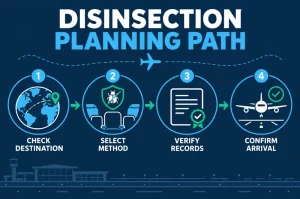
The following checklist identifies the main disinsection requirements to confirm during international flight preparation.
| Planning stage | Operational check |
|---|---|
| Initial itinerary review | Determine whether disinsection is required for the destination and aircraft operating history |
| Before arranging treatment | Confirm the accepted method, approved product and responsible applicator |
| Before departure | Check that the prescribed treatment and certificate requirements have been completed |
| Before arrival | Confirm any required reporting, treatment evidence and biosecurity arrangements |
| After a route or schedule change | Review whether the revised operation affects treatment validity or destination requirements |
For flights involving several countries, the operator needs to establish whether the treatment performed remains acceptable for each subsequent arrival. A change in aircraft registration, destination or planned treatment method can require corresponding updates to documentation and ground-service arrangements.
Consequences of Missing or Incorrect Treatment
Australia’s on-arrival aircraft requirements explain that an aircraft without verifiable treatment can be subject to supervised on-arrival spraying and associated charges. Passenger disembarkation, baggage handling and aircraft turnaround may be affected until the required biosecurity procedures are completed.
8. Aircraft Disinsection and Ground Handling Coordination
Just Aviation provides 24/7 operational support for international flights, assisting operators with destination-specific disinsection arrangements through its trip planning and ground handling services.
The Operations Control Center assists with:
- Confirming local disinsection requirements with relevant service providers.
- Coordinating treatment arrangements with authorized personnel.
- Aligning cabin and cargo hold treatment with aircraft servicing, boarding and turnaround schedules.
- Coordinating required certificates, treatment records and advance notifications.
- Updating ground arrangements when flight schedules or destinations change.
These services support aircraft preparation and operational coordination. Treatment must be performed by appropriately authorized personnel, while regulatory compliance remains the operator’s responsibility.
For international aircraft disinsection and ground handling coordination, contact Just Aviation’s Operations Control Center at [email protected]
Frequently Asked Questions About Aircraft Disinsection Requirements
1. Is aircraft disinsection required for every international flight?
Disinsection requirements depend on the receiving country’s regulations, aircraft origin and other applicable conditions. Australia and New Zealand require arriving international aircraft to comply with their disinsection framework, while requirements elsewhere need to be verified for the intended operation.
2. What is the difference between aircraft disinsection and disinfection?
Disinsection controls insects and other arthropod vectors, while disinfection addresses infectious agents. The procedures serve different purposes, and routine aircraft cleaning or disinfection does not independently satisfy a disinsection requirement.
3. Which aircraft disinsection methods are accepted?
WHO provides technical guidance on residual, pre-embarkation and pre-departure disinsection. Under their joint framework, Australia and New Zealand accept residual, pre-embarkation, pre-departure and on-arrival treatment, subject to the applicable conditions. Other destinations may have different requirements.
4. Is an aircraft disinsection certificate required?
Certificate requirements depend on the destination and treatment method. For Australia and New Zealand, the applicable disinsection schedule establishes prescribed certificate formats and reporting arrangements for relevant treatments.
5. What happens if disinsection has not been completed before arrival?
The receiving authority determines the applicable response. Under Australia’s procedures, an aircraft without completed or verifiable disinsection can undergo supervised on-arrival treatment, affecting passenger movement and involving additional charges.
6. Can ground handling providers coordinate aircraft disinsection?
Ground handling coordination can include arranging the relevant treatment through personnel or providers operating under the applicable requirements. Treatment approval, application procedures and regulatory compliance remain subject to the receiving authority’s rules and the operator’s responsibilities.
Disclaimer
This article provides general operational guidance on aircraft disinsection requirements. Treatment methods, approved products, documentation and biosecurity procedures may change over time following updates by the relevant authorities. Operators should verify current destination-specific requirements and comply with applicable regulations and official guidance before conducting international flights.
Conclusion
Aircraft disinsection is an important part of international flight preparation where destination biosecurity rules require treatment or supporting evidence. The applicable method, aircraft areas requiring treatment and documentation procedures need to be established before the ground operation is finalized.
For private and charter operators, the practical priority is aligning disinsection with the aircraft’s itinerary, cabin and cargo handling sequence, and arrival requirements. Accurate treatment records and early verification of destination procedures help reduce avoidable complications during international aircraft arrivals.


 +971 4 5855 689