
Top 10 Crew-Friendly Stopover Destinations for International Flight Operations

20 October 2026
| By Just Aviation TeamAn international crew stopover needs to provide sufficient time for rest, practical airport access and appropriate accommodation before the next flight. Crew entry requirements, transportation and the length of the planned stay also influence the choice of destination.
For business aviation operators, crew support planning involves coordinating these arrangements with the aircraft schedule and applicable duty limitations. This guide examines ten international destinations, focusing on their airport facilities, crew travel requirements and suitability for different layover arrangements.
Key Takeaways
- Which international destinations offer practical options for crew stopovers?
- What crew entry, airport access and transportation requirements need consideration?
- How do short overnight stops, extended layovers and crew changes affect planning?
- What EASA requirements apply to suitable accommodation and crew rest?
- How can operators coordinate crew arrangements when schedules change?
Ten Crew-Friendly International Stopover Destinations
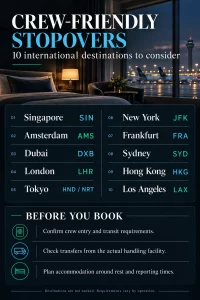
The following destinations offer airport facilities, accommodation options and ground arrangements relevant to international crew layovers. They are presented as operational options rather than a performance ranking. The appropriate destination depends on the aircraft’s operating schedule, crew entry requirements and availability of the necessary ground services.
1. Singapore: Changi Airport (SIN/WSSS)
Singapore Changi Airport offers transit hotel facilities and landside accommodation. For crew members entering Singapore, Crowne Plaza Changi Airport, connected to Terminal 3, is one accommodation option.
Operators need to distinguish between transit and landside accommodation when arranging crew stays. Entry eligibility depends on nationality and applicable immigration conditions, while transfers need to be arranged from the aircraft’s actual handling location. For flights using a separate business aviation facility, terminal-connected accommodation does not necessarily provide direct access from the aircraft.
2. Amsterdam: Schiphol Airport (AMS/EHAM)
Amsterdam Airport Schiphol provides landside accommodation and hotels within its secure passenger areas. The airport’s transit accommodation information includes Mercure Hotel in Lounge 3 and YOTELAIR in Lounge 2, with access subject to their respective booking and travel conditions.
For crews leaving the airport, Schengen entry requirements need to be assessed according to nationality and travel status. Transit accommodation is not automatically accessible to crews arriving through a general aviation handling facility. Operators should therefore establish whether the crew will remain in transit or enter the Netherlands before confirming the hotel and transportation arrangements.
3. Dubai: Dubai International Airport (DXB/OMDB)
Dubai International Airport has accommodation facilities within its terminal environment, including DXB Hotel in Terminal 3. Access to airside accommodation depends on the traveller’s itinerary and relevant airport procedures.
For charter and business aviation crews, the operating airport and handling facility need to be established before selecting accommodation. Crew members entering the UAE require the appropriate immigration status, while those using transit facilities must meet the applicable access conditions. Hotel bookings should also account for the actual arrival time, particularly when rooms are needed outside standard check-in hours.
4. London: Heathrow Airport (LHR/EGLL)
London Heathrow Airport offers terminal-associated accommodation, including the Sofitel at Terminal 5 and Hilton at Terminal 4, covered by the airport’s official hotel guide.
For charter operations, Heathrow’s aircraft acceptance and handling arrangements need to be confirmed before planning crew accommodation. London has several airports serving business aviation, and hotel selection needs to correspond with the airport used for the flight.
Crew entry requirements also differ according to whether personnel are operating the aircraft or arriving to join a subsequent flight. The UK government’s aircrew guidance explains the relevant immigration provisions for operational, positioning and other aircrew categories.
5. Tokyo: Haneda (HND/RJTT) and Narita (NRT/RJAA)
Tokyo’s two major international airports require separate accommodation and transportation arrangements.
Haneda Airport has terminal-associated accommodation, including The Royal Park Hotel Tokyo Haneda at Terminal 3. Narita International Airport provides information on hotel shuttle services connecting the airport with nearby properties.
Operators need to establish the aircraft’s actual arrival and departure airport before arranging crew logistics. Japanese immigration requirements depend on nationality, crew status and the purpose of entry. Where crew positioning involves both airports, the transfer between Haneda and Narita needs to be planned separately from the hotel transfer.
6. New York: John F. Kennedy Airport (JFK/KJFK)
John F. Kennedy International Airport offers accommodation in its airport area, including the TWA Hotel beside Terminal 5.
For business aviation crews, accommodation planning needs to use the confirmed aircraft handling location rather than the passenger terminal alone. Operators also need to distinguish JFK from other New York-area airports, including Newark Liberty, when coordinating arrival transfers and crew positioning.
US immigration requirements vary according to nationality and the crew member’s intended activity. Operating crew and personnel travelling commercially to join an aircraft can require different entry arrangements, making travel status an important part of pre-arrival preparation.
7. Frankfurt: Frankfurt Airport (FRA/EDDF)
Frankfurt Airport offers accommodation within its airport environment, including the Sheraton Frankfurt Airport Hotel and Frankfurt Airport Marriott Hotel near Terminal 1.
These properties provide options for crews operating through Frankfurt, although transfers still need to be planned according to the aircraft’s handling position and airport access arrangements.
Crew members entering Germany for accommodation need to meet the applicable Schengen entry requirements. The German Federal Foreign Office’s visa information provides relevant guidance on nationality-based entry conditions. For crew changes, the arrival status and travel documentation of incoming personnel also need consideration.
8. Sydney: Sydney Kingsford Smith Airport (SYD/YSSY)
Sydney Airport requires particular attention to operating times when planning international crew arrangements.
Under the Australian Government’s Sydney Airport curfew framework, restrictions apply between 23:00 and 06:00 local time, with defined exceptions and conditions for qualifying aircraft movements.
The aircraft’s permitted arrival and departure schedule affects crew reporting and accommodation arrangements. Crew entry into Australia also requires appropriate immigration authorization for the individual’s nationality and operating status. For flights affected by a schedule change, the operator needs to review applicable curfew conditions before finalizing revised crew transportation or reporting times.
9. Hong Kong: Hong Kong International Airport (HKG/VHHH)
Hong Kong International Airport offers terminal-connected accommodation at the Regal Airport Hotel, accessible from Terminal 1 by a pedestrian walkway.
For business aviation operations, the terminal connection does not establish the transfer required from the aircraft’s assigned handling facility. Operators need to confirm the crew pickup point and transport arrangements before selecting accommodation.
Crew entry requirements depend on nationality, operating status and the purpose of the visit. Where crew members are arriving or departing on separate flights, their immigration processing and positioning arrangements need to be coordinated individually.
10. Los Angeles: Los Angeles International Airport (LAX/KLAX)
Los Angeles International Airport provides hotel shuttle pickup arrangements within its passenger terminal complex, including designated pickup areas on the Upper/Departures Level.
These facilities are relevant to passenger-terminal transportation and do not establish direct pickup arrangements from a business aviation handling facility. Crew transfers should therefore be coordinated using the assigned aircraft handling location and hotel address.
US entry requirements depend on the crew member’s nationality and travel classification, particularly for personnel arriving commercially to join an aircraft. Operators can also refer to Just Aviation’s ground handling services at Los Angeles International Airport for related aircraft ground coordination.
How Long Should Crews Plan for Stopovers at Each Destination?
International crew stopover duration varies according to the preceding duty period, required rest, next flight assignment and local operating conditions. Overnight stays, extended layovers and crew changes involve different scheduling requirements, including immigration processing, airport restrictions and time-zone considerations.
The following considerations help operators plan an appropriate stopover duration for each destination.
| Destination | Stopover duration and operational considerations |
|---|---|
| Singapore (SIN) | For overnight stops, the duration needs to accommodate crew entry processing, hotel transfers and the required rest period. After long-haul sectors, additional time may be needed to manage fatigue and time-zone adjustments under the operator’s procedures. |
| Amsterdam (AMS) | Short overnight stays depend on Schengen entry arrangements, accommodation access and the next reporting time. Longer stays may be needed when the crew is positioning or awaiting a subsequent international assignment. |
| Dubai (DXB) | For overnight arrivals, the planned stay needs to account for hotel check-in and the required rest period before the next duty. Extended layovers or crew replacements require separate accommodation and transport arrangements. |
| London (LHR) | The duration depends on the crew’s immigration status, actual operating airport and next departure. For crew changes or longer assignments, entry conditions and positioning schedules also affect the permitted and practical length of stay. |
| Tokyo (HND/NRT) | Following long-haul flights, the schedule needs to account for applicable rest requirements and time-zone differences. Longer layovers or crew changes also require airport-specific transport arrangements, particularly when flights involve both Haneda and Narita. |
| New York (JFK) | Overnight rest planning needs to include US immigration processing, airport transfers and the next duty period. Crew positioning and replacements can require longer stays depending on onward flight availability and entry arrangements. |
| Frankfurt (FRA) | For overnight stopovers, the duration depends on Schengen entry requirements, hotel access and applicable crew rest. Extended stays may be necessary when crew members are positioning between international sectors. |
| Sydney (SYD) | The stopover schedule needs to account for long-haul rest requirements and the airport’s 23:00–06:00 curfew, where applicable. Extended layovers may be needed when permitted departure times or crew duty limitations affect the next flight. |
| Hong Kong (HKG) | Short overnight stays require coordination of immigration processing, accommodation and airport transfers. Crew changes or subsequent long-haul sectors can require additional time based on duty and rest arrangements. |
| Los Angeles (LAX) | The duration depends on airport transfers, US entry procedures and the next flight assignment. Following long-haul arrivals, the operator needs to allow for applicable rest requirements, while crew positioning can require a longer ground stay. |
The final stopover schedule should be established using the operator’s applicable flight-time limitations and fatigue-management procedures, with accommodation and ground transportation arranged around the resulting rest and reporting times.
What Crew Rest and Accommodation Requirements Apply?
Crew accommodation needs to support the required rest opportunity under the rules applicable to the aircraft operator.
The ICAO fatigue-management resources address sleep, duty scheduling and fatigue considerations for flight operations, including general aviation.
Suitable Accommodation Under EASA Rules
Under EASA ORO.FTL.105(4), suitable accommodation for operations within its scope means a separate room for each crew member in a quiet environment, with a bed, sufficient ventilation, facilities for controlling light and temperature, and access to food and drink.
These conditions provide a regulatory basis for assessing crew accommodation rather than relying on hotel proximity or general amenities.
Transportation Time and Rest Calculations
Under EASA ORO.FTL.235(b), the standard minimum rest period away from home base for covered operations is the preceding duty period or 10 hours, whichever is greater.
Under AMC1 ORO.FTL.235(b), when travel to suitable accommodation exceeds 30 minutes, the operator should increase rest by twice the excess travel time. For example, a 45-minute journey results in a 30-minute increase.
Other applicable provisions, including requirements associated with time-zone differences, need separate consideration. These rules do not apply identically to every private or charter operation.
Crew Visa, Transportation and Airport Access Requirements
International crew stopovers require coordination beyond accommodation. The arrangements need to reflect how crew members arrive, whether they enter the country and how they will return to the aircraft.
Crew Visas and Entry Documentation
Immigration requirements depend on nationality, travel documents, operating status and intended length of stay.
A crew member operating the aircraft can be treated differently from one arriving commercially to join a subsequent flight. Transit permission also needs to be distinguished from permission to leave the airport for hotel accommodation. These requirements are addressed as part of the wider international crew arrangements process.
Airport Transfers and Crew Reporting
Transportation arrangements need to identify the actual handling facility, authorized pickup location, hotel and return reporting point.
A hotel adjoining a passenger terminal can still require a separate vehicle transfer when the aircraft uses a general aviation handling facility. Crew reporting time also needs to reflect applicable airport access and security procedures.
Crew Changes and Schedule Adjustments
Where incoming and outgoing crews use different flights, their immigration and transportation arrangements need to be coordinated individually.
An aircraft delay can affect hotel bookings and the planned rest period. The operator reassesses crew duty and rest requirements before establishing the revised reporting schedule, after which the affected ground arrangements are updated.
How Just Aviation Supports International Crew Stopovers
Just Aviation provides 24/7 operational support through its crew support services, coordinating accommodation, transportation and crew travel arrangements with local providers according to the aircraft schedule and operator requirements.
The Operations Control Center assists with:
- Coordinating hotel bookings based on crew numbers, required rest arrangements, arrival times and reporting schedules.
- Assisting with crew visa requirements and relevant travel documentation coordination.
- Arranging airport transfers between handling facilities, hotels and crew reporting locations.
- Coordinating travel and ground logistics for crew changes and repositioning.
- Updating accommodation and transportation arrangements when flight delays or extended stays affect existing bookings.
These services support the operator’s crew logistics planning. Duty calculations, fatigue assessments and fitness-for-duty decisions remain with the operator and crew under the applicable regulatory framework.
For international crew accommodation, transfers and layover coordination, contact Just Aviation at [email protected]
Frequently Asked Questions About International Crew Stopovers and Layover Planning
1. Are these the ten best destinations for crew stopovers?
The destinations are not ranked against comparative hotel or crew-rest performance data. They are selected for identifiable airport facilities, transport arrangements and operating considerations relevant to international layovers.
2. What determines the duration of an international crew stopover?
The duration depends on the preceding duty period, applicable rest requirements, next flight assignment and destination-specific operating conditions. Extended stays can be necessary for crew changes, long-haul rest or aircraft scheduling restrictions.
3. Do flight crews need visas for overnight stopovers?
Entry requirements depend on nationality, crew status and destination rules. Operating crew and positioning crew can be subject to different immigration procedures, particularly when entering a country for accommodation.
4. Does an airport hotel guarantee suitable accommodation for crew rest?
A hotel’s airport location does not independently establish that it meets the operator’s accommodation requirements. Room conditions, access and the crew’s rest opportunity need to be assessed.
5. How does airport transportation affect crew rest?
Under the applicable EASA acceptable means of compliance, travel exceeding 30 minutes to suitable accommodation calls for an increase in rest equal to twice the excess travel time. Other operators need to apply their relevant regulatory requirements.
6. How should crew accommodation be managed during flight delays?
The operator reassesses the crew’s duty and rest schedule. Hotel bookings, transportation and reporting arrangements are then updated to reflect the revised operating plan.
Disclaimer
This article provides general operational guidance based on official airport and aviation authority information reviewed in October 2026. Hotel availability, crew entry conditions, airport access and transportation arrangements depend on the intended operation. Duty and rest requirements are governed by the operator’s applicable regulations and approved procedures. Current authority requirements and aeronautical information take precedence over this guide.
Conclusion
International crew stopover planning involves matching the crew’s required rest with the aircraft’s operating schedule and the practical arrangements available at each destination. The ten locations discussed provide different options for overnight accommodation, extended layovers and crew positioning.
Selecting the appropriate arrangement requires consideration of the actual airport, applicable crew requirements and confirmed local services. This helps operators prepare crew stopovers that support subsequent international flight operations.


 +971 4 5855 689