
Runway Surface Conditions at Toliara Airport, Madagascar: Planning Charter Operations

21 October 2026
| By Just Aviation TeamAccording to the ASECNA Madagascar eAIP, Toliara Airport (TLE/FMST) is available for the aerodrome operations and services specified in its current aeronautical information, including non-scheduled operations subject to the applicable requirements. Its main paved runway is approximately 2,000 metres by 30 metres. For charter operators, runway length alone is not enough to confirm suitability. Current surface condition, aircraft weight, weather, pavement capability and the ground area available after landing can all affect whether the planned operation remains practical.
Key Takeaways
- What should operators confirm before dispatching a charter to Toliara?
- How can rain or changed runway conditions affect the planned operation?
- Why should heavier aircraft be checked against more than runway length?
- What changes when a different aircraft is assigned?
- How can a larger fuel uplift affect departure planning?
- What local support should be arranged for a non-scheduled flight?
- When may another aircraft, operating time or airport be more practical?
Start With the Runway the Aircraft Will Actually Use
Toliara’s primary paved runway is approximately 2,000 metres long and 30 metres wide and is the main surface relevant to most regional charter operations. The airport also has a much shorter secondary runway, but operators should not treat it as an equivalent backup for normal regional or business aviation movements.
For trip planning, the important questions are:
- Is the main runway fully available?
- Are the published distances unchanged?
- Are there any current restrictions affecting takeoff, landing or ground movement?
- Does the planned aircraft meet performance requirements at the actual weight and conditions?
This gives operators a useful operating picture instead of relying only on the published runway length.
Check Today’s Runway Condition, Not Only the Published Surface
The main runway is paved, but a permanent pavement description does not establish the condition that will exist when the aircraft arrives. Before operating, operators should review current:
- NOTAMs
- Weather
- Recent rainfall
- Runway availability
- Reported surface condition
- Any temporary restrictions
- Available landing and takeoff distances
This is particularly relevant during or after rain. A runway may remain open while the changed surface condition still affects landing or takeoff performance.
The operational question is therefore not simply: Is Toliara open?
It is: Does the aircraft still meet the required performance under the conditions expected at Toliara?
Rain Can Change the Plan Without Closing the Airport
Wet conditions can alter the performance margin even when the runway remains available. For an aircraft approaching Toliara after rainfall, the operator may need to review:
- Landing distance
- Takeoff distance for the next sector
- Aircraft weight
- Wind
- Temperature
- Current runway condition
- Available performance margin
If the updated calculation no longer supports the original plan, the response may involve a lower operating weight, revised fuel load, different departure time or another aircraft. This is more useful than treating “wet runway” as a general warning. The effect depends on the specific aircraft and conditions.
Heavier Aircraft Need a Full Pavement Check
According to the current ASECNA Madagascar eAIP, Toliara’s main RWY 04/22 is published at PCN 66/F/A/X/T, while the apron is published at PCN 35/F/A/X/T.
For heavier business aircraft, this difference means runway suitability should not be considered in isolation. The planned aircraft and operating weight may also need to be checked against the pavement capability of the area where it will taxi and park.
The graphic below compares the published pavement classifications for Toliara’s main runway and apron, showing why both surfaces need to be considered when assessing an aircraft’s suitability.
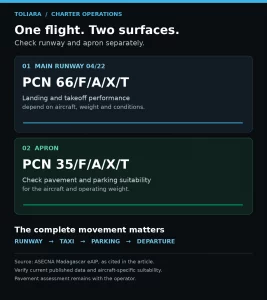
The operational assessment should therefore consider the complete movement from landing to parking and subsequent departure, with pavement suitability remaining an operator responsibility.
Ground Manoeuvring Should Be Confirmed for Larger Aircraft
Movement restrictions at a regional airport can matter even when the runway itself is suitable. For larger aircraft, operators should confirm whether the current taxiing, turning and parking arrangement supports the planned aircraft without creating unnecessary ground limitations.
This is particularly relevant when:
- The aircraft has a larger wingspan
- The planned parking position changes
- A temporary movement-area restriction is active
- The aircraft requires more turning space than smaller regional types
Current aerodrome information and local confirmation should therefore be reviewed together with the runway-performance assessment. The objective is to avoid confirming an aircraft for landing before establishing that it can also be positioned practically after arrival.
An available runway does not by itself confirm that the complete arrival, turnaround and departure operation can be supported; operators should also verify current aerodrome information, aircraft performance, ground movement and available services.
An Aircraft Substitution Changes the Toliara Assessment
A change of aircraft requires the Toliara assessment to be reviewed against the replacement aircraft’s performance, weight and ground-handling requirements. A different type can change:
- Landing performance
- Takeoff performance
- Operating weight
- Pavement loading
- Wingspan
- Turning requirements
- Parking needs
- Fuel demand
If a regional turboprop is replaced by a heavier aircraft, the operator should review Toliara again against the actual replacement. This should happen before the revised aircraft is committed to the sector, not after it arrives.
A Larger Fuel Uplift Can Change Departure Performance
Fueling at Toliara is available on request, with prior notice required for non-scheduled flights, as specified in the current ASECNA Madagascar eAIP. The operational connection is weight.
Suppose a charter originally plans a short onwards sector, but the passenger later requests a longer destination.
The aircraft may now require substantially more fuel.
The operator should then:
- Recalculate the required fuel.
- Establish the new departure weight.
- Recheck takeoff performance.
- Confirm that the pavement and ground operation remain suitable.
- Finalize the revised uplift and departure schedule.
A fuel change should therefore not be treated as a standalone handling request. It can change the entire departure plan.
Non-Scheduled Flights Need Ground Support Confirmed in Advance
According to the current ASECNA Madagascar eAIP, fueling at Toliara is available on request, with prior notice required for non-scheduled flights; the same aeronautical information sets out the applicable handling, parking, customs and immigration arrangements.
Customs and immigration are available on request upon receipt of the flight plan. ATS normally operates from 0300 to 1500 UTC, with additional service available through the applicable advance flight-plan procedure.
Operators should therefore confirm the services required for the planned arrival and departure window before the flight. This helps ensure that fuel, parking, aircraft guidance and other required local support are aligned with the actual operating schedule.
Do Not Let a Schedule Change Outrun the Airport Plan
Regional charter schedules can change quickly. A passenger delay, aircraft substitution or revised destination may affect more than the ETA. For example, moving the flight several hours later may introduce:
- Different weather
- A wet runway after rainfall
- A higher or lower operating weight
- Different local service availability
- A changed fuel requirement
- Another parking situation
When the schedule changes materially, the Toliara operating picture should be refreshed rather than assuming the original airport assessment still applies.
When Should the Mission Be Revised?
A different plan may be more practical when:
- Current runway conditions no longer support the original aircraft plan
- The replacement aircraft is heavier or requires different ground space
- Additional fuel materially changes takeoff weight
- The apron or intended parking position does not suit the aircraft
- Required local services cannot support the planned timing
Depending on the mission, the operator may evaluate:
- Another departure or arrival time
- Lower operating weight
- Revised fuel strategy
- Different aircraft
- Another suitable Madagascar airport
Tôlanaro (FMSD) or Antananarivo/Ivato (FMMI) may be relevant for some routings, but neither should be treated as an automatic alternative. The choice depends on the aircraft, route, weather, fuel, airport availability and passenger itinerary.
| Practical Scenario: A Heavier Aircraft Replaces the Planned Charter A regional charter is planned to operate into Toliara, but the originally assigned aircraft becomes unavailable before departure and is replaced by a heavier aircraft. The operator reassesses the replacement aircraft against the current runway condition, apron capability, parking arrangement and revised operating weight. A change in the onwards itinerary also requires additional fuel, increasing the planned departure weight and requiring the takeoff-performance calculation to be reviewed before the final uplift is confirmed. The flight proceeds only after the replacement aircraft, runway conditions, pavement requirements, parking arrangements and operating weight are confirmed for the revised mission. The key point is that Toliara suitability must be assessed against the aircraft actually operating the flight and the conditions applicable to that movement |
|---|
How Just Aviation Supports Toliara Charter Operations
Just Aviation supports operators by aligning the local non-scheduled requirements with the confirmed aircraft and schedule, including parking, aircraft guidance, handling, fuel and passenger transport where required.
If the aircraft, ETA or ground requirement changes, the relevant local arrangements can be updated against the revised operating plan. Runway performance, pavement suitability, aircraft weight, fuel planning, weather acceptance, dispatch and command decisions remain with the operator and PIC as applicable.
For Toliara regional charter and business aviation support, contact the Just Aviation Operations Control Center at [email protected]
Frequently Asked Questions About Toliara Airport Runway Conditions
1. What runway is normally relevant for regional charters at Toliara?
The airport’s main paved runway is approximately 2,000 metres long and 30 metres wide and is the primary surface for most charter planning.
2. Is checking the published runway length enough?
No. Operators should also consider current surface condition, weather, aircraft weight, available distances and pavement suitability.
3. Can rain affect the operation even when Toliara remains open?
Yes. Wet conditions can change aircraft takeoff or landing performance without requiring the airport to close.
4. Why does aircraft weight matter at Toliara?
Higher weight can affect runway performance and pavement loading, particularly for heavier business aircraft or flights requiring substantial fuel.
5. Should the apron be checked separately from the runway?
Yes. The apron has a lower published pavement capability than the main runway and can become relevant for heavier aircraft.
6. Does changing aircraft require another Toliara review?
Yes. The Toliara assessment should be reviewed against the replacement aircraft’s requirements.
7. Can additional fuel change the departure plan?
Yes. A larger uplift increases takeoff weight and may require another performance and pavement review.
8. Should non-scheduled handling and fuel be arranged in advance?
Yes. Operators should confirm the specific services needed for the planned arrival and departure window.
9. When should another airport be considered?
When current runway conditions, aircraft suitability, ground support or the revised mission no longer fit Toliara reliably.
Disclaimer
Runway condition, available distances, pavement information, weather, NOTAMs and airport services can change. Operators should use current aeronautical information and approved aircraft-specific performance data for each flight. Aircraft performance, pavement assessment, fuel planning, dispatch and command decisions remain with the operator and PIC as applicable.
Conclusion
Toliara charter planning should focus on whether the actual aircraft and operating weight fit the current runway and ground conditions. Operators should verify surface information before departure, review the apron and parking requirement for heavier aircraft, and reassess the plan after any meaningful change in weather, aircraft type or fuel load. This keeps the decision operational: not simply whether Toliara is open, but whether the complete arrival, turnaround and departure remain practical for the specific flight.


 +971 4 5855 689