
Mining Charter Coordination at Saurimo Airport, Angola: Planning Aircraft Support for Remote Operations

11 October 2026
| By Just Aviation TeamSaurimo’s Deolinda Rodrigues Airport (VHC/FNSA) provides an important air connection into Angola’s Lunda Sul mining region. Mining operations in Lunda Sul can generate movements of personnel, contractors, executives and project equipment through the province. For charter operators, the trip does not end when the aircraft reaches Saurimo. Reliable mining charter coordination also depends on the correct destination airfield, mine-site access, passenger transfer, baggage and equipment, airport support and the timing of the wider crew or project movement.
Key Takeaways
- Is Saurimo Airport or a mine-operated airfield the correct destination for the mission?
- What passenger information needs to be finalized before a mining crew charter departs?
- How should airport arrival and mine-site access be connected?
- Which ground services need flight-specific confirmation at Saurimo?
- What changes when the charter carries tools or project equipment with the passengers?
- How should a delayed flight be aligned with mine transport and site access?
- What needs to be checked before an international charter operates directly to Saurimo?
- How can operators prepare for an aircraft technical problem away from Angola’s main aviation hubs?
Saurimo Airport or Catoca Aerodrome: Which Airfield Should the Charter Use?
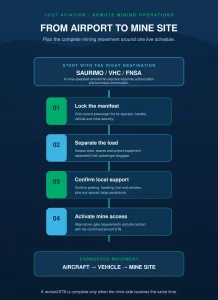
“Saurimo” and “Catoca” are not interchangeable aviation destinations. ANAC currently lists Deolinda Rodrigues Airport (FNSA) as an SGA-operated airport in Saurimo. ANAC’s current civil-aerodrome classification lists Catoca as an aerodrome operator in Saurimo, Lunda Sul, separately from SGA-operated Deolinda Rodrigues Airport. That creates two different planning questions.
| Location | Operational role |
|---|---|
| Saurimo / Deolinda Rodrigues (VHC/FNSA) | SGA-operated airport serving Saurimo and the surrounding Lunda Sul region |
| Catoca aerodrome | Mine-operated facility with access and operating conditions that require specific confirmation |
The presence of a mine airfield does not mean a charter can automatically use it. For a Catoca-related mission, establish at the beginning whether passengers will:
- Land at Saurimo → transfer by road to the mine or
- Operate to the mine aerodrome under confirmed authorization and technical conditions
This decision affects the flight plan, ground transport, passenger timing and airport support from the start.
Build the Flight Around the Mining-Site Appointment
Catoca’s operating center is located roughly 35 km from Saurimo city. Other mining and industrial sites in Lunda Sul have different transfer requirements. The aircraft ETA therefore should not be treated as the passenger’s final arrival time. For mining personnel, the useful sequence is:
Aircraft arrival → baggage release → vehicle departure → site gate → mine check-in or shift handover
Before departure, align:
- Mine or project destination
- Site contact
- Passenger names
- Vehicle assignment
- Driver contact
- Required site-arrival time
- Gate or visitor-access arrangement
- Baggage and equipment volume
A charter that lands on schedule can still miss the real mission if the mining-site transfer has been planned separately from the aircraft.
Crew Rotations Need a Passenger-Ready Cutoff
Mining movements often involve personnel arriving and departing in groups. Where one aircraft brings an incoming team and returns with personnel completing a rotation, both groups need to be built into the same schedule. For the departing group, work backwards:
Aircraft ETD → airport reporting → road transfer → mine departure
The mining company or contractor then receives a usable site-departure time, rather than only an aviation ETD. This becomes more important when:
- The mine is outside Saurimo
- Access roads carry heavy industrial traffic
- Site security requires passenger processing
- Shift handover has a fixed time
- The aircraft has another sector after Saurimo
Lock the Passenger Manifest Before the Site Transfer Starts
Mining charters can involve last-minute personnel changes as contractors, engineers or project staff are added or removed from a movement. The live passenger list needs to remain consistent across:
- Aircraft operator
- Ground handling
- Mining company
- Vehicle provider
- Site security
- Accommodation provider where applicable
A person added to the flight at the last minute may also need mine-site access approval. Likewise, removing a passenger from the charter without updating the mine transfer can leave vehicles or security teams waiting for someone who is no longer travelling. Use one current manifest for the complete movement rather than separate aviation and mine lists.
Separate Personal Baggage From Project Equipment
A mining charter may carry more than passenger bags. Engineers and contractors can travel with:
- Tools
- Test equipment
- Protective equipment
- Electronic devices
- Replacement components
- Survey or technical equipment
These items should be declared to the aircraft operator early enough for loading, carriage and any applicable dangerous-goods requirements to be assessed.
Some equipment may involve:
- High individual weight
- Oversize dimensions
- Batteries
- Chemicals
- Pressurized items
- Other dangerous-goods considerations
The aircraft operator determines what can be carried and under which conditions.
A useful load plan therefore separates:
- Passengers and normal baggage from Tools, spares and project cargo before the aircraft is loaded.
Confirm Saurimo Ground Support for the Actual Charter
SGA manages Deolinda Rodrigues Airport. The services required for a specific Saurimo charter should be confirmed with the relevant airport and handling providers based on the aircraft, schedule and mission requirements. Station-specific capability still needs confirmation for the aircraft and operating time. For a Saurimo charter, establish the required:
- Parking
- Ramp handling
- Passenger processing
- Baggage handling
- Fuel
- Ground equipment
- Crew transport
- Passenger vehicles
- Any special cargo assistance
Do not build the trip around a generic assumption that every service offered across the SGA network is continuously positioned at Saurimo.
Fuel deserves separate confirmation
Public aviation sources currently give inconsistent information about routine fuel availability at Saurimo. That makes a flight-specific confirmation more useful than a general statement that fuel is either available or unavailable.
For a charter depending on a Saurimo uplift, confirm “product + quantity + delivery time + commercial arrangement”, before the planned operation becomes dependent on that fuel.
International Mining Charters Need a Separate Entry Plan
A mining company may want to fly executives, technical specialists or contractors directly into Saurimo from another country. Do not assume that Saurimo can be used for direct international passenger processing for every charter. Before committing to a direct international sector, establish:
- Current airport-of-entry status
- Landing authorization
- Customs and immigration arrangements
- Visa requirements
- Passenger documentation
- Ground handling
- Operating hours for the required services
Where direct processing at Saurimo cannot be confirmed for the mission, the itinerary may need an approved Angola entry point first, followed by a domestic sector to Saurimo. That distinction needs to be resolved before permits, crew duty and passenger timing are built around the direct flight.
Mining-Site Security and Airport Security Are Different Processes
Clearing the airport does not automatically clear the passenger into the mine.
Mining operations may apply their own access procedures for visitors, contractors, vehicles and equipment. Before the flight, confirm with the project or mine contact whether the travelling party requires:
- Visitor authorization
- Identification details
- Vehicle registration
- Site escort
- Equipment declaration
- Other project-specific access formalities
These are mine requirements, not airport requirements. Keeping the two processes separate prevents a passenger from arriving successfully at Saurimo and then waiting at the mine gate because site access was never activated.
A Schedule Change Needs to Reach the Mine, Not Only the Airport
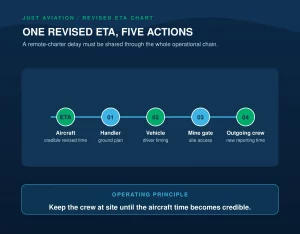
A mining charter delay affects more parties than the handler. If the aircraft ETA moves significantly, update the operational chain that depends on it:
Aircraft → handler → passenger vehicle → mine contact → site access → outgoing crew
For example, a two-hour delay may mean:
- The driver reports later
- The incoming crew reaches the mine after the planned shift change
- The outgoing group needs a new mine-departure time
- Aircraft ground time changes
- Crew duty or the next charter sector needs review
One credible revised schedule is more useful than repeated speculative updates. The mine and airport sides should be working from the same current flight time.
Do Not Send the Outgoing Crew to the Airport Too Early
A common remote-charter problem is protecting the aircraft schedule by sending personnel to the airport long before the aircraft is ready.
That can simply transfer the delay from the mine to the terminal. Where a flight is significantly delayed, hold the departing passenger group against a revised reporting plan until the aircraft schedule becomes sufficiently stable.
This is particularly useful when:
- The mine is some distance from the airport
- The passenger group is large
- Ground transport is dedicated
- The aircraft is arriving from another remote station
- The incoming flight remains operationally uncertain
The aim is to keep the workforce productive at the site without creating a risk that passengers cannot reach the airport once the revised flight becomes firm.
A Mine-Owned Airfield Is Not Automatically the Better Option
ANAC’s current classification confirms a Catoca-operated aerodrome in Lunda Sul. For a Catoca mission, that may appear operationally attractive because it can reduce the surface connection from Saurimo. But the choice cannot be made from geography alone. Before considering the mine aerodrome, establish:
- Operator permission
- Current airfield status
- Aircraft suitability
- Runway and pavement information
- Operating window
- Fuel strategy
- Fire and rescue provision
- Ground support
- Regulatory approval
- Passenger-access arrangement
If those elements are not confirmed, Deolinda Rodrigues remains the established public-airport option for building the wider Saurimo trip.
Protect the Aircraft’s Next Sector
A mining charter may be only one leg in a longer aircraft program. Examples include:
- Luanda → Saurimo → Luanda or:
- Luanda → Saurimo → another provincial airport
If the mining passenger movement starts running late, assess the effect on:
- Aircraft ground time
- Fuel
- Crew duty
- Next passenger group
- Next airport operating conditions
- Overnight requirement
The mining client’s preferred departure time needs to fit the aircraft’s wider operation. Extending a Saurimo stay to accommodate a late site meeting can create a larger disruption elsewhere in the charter program.
Build a Technical-Recovery Plan Before the Mission
Public sources reviewed for this guide do not establish broad business-aviation maintenance capability at Saurimo Airport. For aircraft operating repeatedly into the mining region, operators should establish in advance:
- Maintenance-control contact
- Aircraft-specific technical support availability
- Engineer-positioning requirements
- Availability and delivery arrangements for required parts and tooling
- Crew accommodation
- A contingency plan for aircraft recovery where required
This becomes more important when the aircraft is needed for a fixed crew rotation. An AOG event does not only ground the aircraft. It can also interrupt workforce movement between Luanda and the mining operation.
| Practical Scenario: A Mining Crew Rotation Arrives Late A charter is planned from Luanda to Saurimo carrying an incoming technical team for a Lunda Sul mining operation. The aircraft is due to return with personnel finishing their rotation. The inbound sector is delayed. Instead of sending the outgoing crew toward Saurimo Airport against the original schedule, the mine transport remains on hold until a credible revised ETA is available. The new aircraft time is then worked backwards into an updated mine-departure time for the outgoing group. The airport vehicle for the arriving team is also moved to the same revised schedule. The incoming passengers reach Saurimo, transfer directly to the pre-cleared mine vehicle and continue toward the site. The outgoing personnel arrive at the airport closer to the revised aircraft turnaround rather than waiting there for several hours. The aircraft completes the passenger exchange without turning one aviation delay into separate airport, vehicle and mine-site delays. The operational lesson is that a mining charter to Saurimo is one connected movement from aircraft to mine and back again. |
|---|
How Just Aviation Supports Saurimo Mining Charters
Just Aviation can provide one coordination channel between the charter operation and the local support required in Saurimo, including airport handling, parking, requested fuel, coordination with local ground-transport providers and schedule updates.
For mining movements, Just Aviation can coordinate with the relevant local transport provider and project contact so that the airport ETA and mine-side movement follow the same operational schedule. Aircraft performance, flight planning, loading, fuel calculations, maintenance, dispatch and command decisions remain with the operator and PIC as applicable.
For Saurimo mining charter and business aviation support, contact the Just Aviation Operations Control Center at [email protected]
Frequently Asked Questions About Saurimo Mining Charter Operations
1. Which airport serves mining charter flights to Saurimo, Angola?
Deolinda Rodrigues Airport (VHC/FNSA) is Saurimo’s main public airport and is managed by Angola’s Sociedade Gestora de Aeroportos.
2. Is there an airstrip at the Catoca diamond mine?
ANAC lists a Catoca-operated aerodrome in Saurimo, Lunda Sul. Access and use for a specific charter require confirmation of the applicable operating, regulatory and technical requirements.
3. How far is the Catoca mine from Saurimo?
Catoca states that its mining operation is approximately 35 km from Saurimo. Actual airport-to-site transfer time depends on route and current road conditions.
4. Can international mining charters fly directly to Saurimo Airport?
Direct international use depends on current entry, border-processing and flight-authorization arrangements. These need confirmation for the specific charter before routing is finalized.
5. Is Jet A-1 reliably available at Saurimo Airport?
Public sources reviewed are inconsistent. Operators relying on local fuel need current confirmation of product, quantity, delivery timing and commercial arrangements.
6. What information is important for a mining crew rotation through Saurimo?
Keep the passenger manifest, mine destination, site contact, vehicle assignment, baggage or equipment details and passenger-ready times aligned with the live flight schedule.
7. Can tools and mining equipment travel on the passenger charter?
Potentially, subject to aircraft loading, size, weight and dangerous-goods requirements. Provide equipment details to the operator before loading is finalized.
8. What happens when a Saurimo mining charter is delayed?
The revised aircraft time needs to flow through ground handling, mine transport, site access and any outgoing crew rotation rather than being treated only as an airport delay.
9. Is business-aircraft maintenance readily available at Saurimo?
Public sources reviewed do not establish broad business-aviation maintenance capability at Saurimo. Operators should establish aircraft-specific technical-support and AOG contingency arrangements before the mission.
10. Can mining passengers transfer directly from the airport to the work site?
Yes, where the mining company has arranged the required transport and confirmed the applicable site-access requirements. Airport arrival and mine-site authorization remain separate parts of the movement.
Disclaimer
Airport services, fuel arrangements, mine-airfield access, road conditions, site-security requirements and operating procedures can change. Operators need current confirmation for the specific aircraft, schedule and mining mission. Aircraft performance, loading, fuel planning, permits, maintenance, dispatch, flight release and command decisions remain with the operator and PIC as applicable.
Conclusion
Effective Saurimo mining charter coordination connects the flight schedule with the mining operation rather than treating airport arrival as the end of the trip. Operators need the correct airfield, current ground support, a live passenger manifest, realistic mine transfers and a recovery plan for schedule or technical changes. The most important distinction is between the public airport at Saurimo and any mine-operated airfield, whose access cannot be assumed. Once the aircraft, passenger and site movements are coordinated through one operational schedule, remote mining charters become easier to manage.


 +971 4 5855 689