
Late Safari Charter Arrivals at Arusha Airport: Operational Planning for Northern Tanzania

11 October 2026
| By Just Aviation TeamArusha Airport (ARK/HTAR) began 24-hour operations in August 2026 following the installation and commissioning of an airfield ground lighting system. This gives operators greater flexibility for late safari arrivals, but 24-hour airport operation does not confirm the availability of every handling, parking, fuel or passenger service for every movement. ARK primarily serves domestic safari and regional operations; for any international business-aviation movement, operators should confirm in advance whether the airport is approved and equipped to handle the specific international arrival or departure, including applicable customs, immigration and other border-processing requirements.
Key Takeaways
- What should operators verify before relying on a late arrival at Arusha Airport?
- How does ARK’s current operating status affect international business aviation itineraries?
- How should OCC determine the latest workable departure from a safari airstrip?
- How can lodge-transfer time be converted into a practical passenger cutoff?
- What ground and parking constraints should be checked for an evening arrival?
- When should Kilimanjaro International Airport be used instead of Arusha?
- How should OCC decide between a late return and an overnight at the safari location?
- How can a late ARK arrival affect the next morning’s charter rotation?
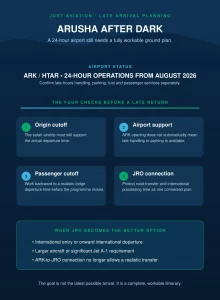
Confirm the Current ARK Operating Window Before Building the Itinerary
Tanzania Airports Authority announced that Arusha Airport would begin day-and-night operations from August 2026 following the installation and commissioning of airfield ground lighting. Because some published airport information may still reflect the previous operating schedule, OCC should confirm the current aerodrome status and applicable NOTAMs before relying on a late movement.
This is especially important when the planned arrival is well after the airport’s previous daytime window. The verification should establish not only whether the aerodrome can accept the movement, but whether the required airport and ground services are available at the planned time. The introduction of 24-hour operations does not by itself confirm availability of every airport, handling, parking, fuel or passenger service for every late movement, so these requirements should be confirmed separately.
ARK’s Published Domestic Role Matters for International Business Aviation
A major planning distinction is that Arusha’s current airport profile identifies it as serving domestic flights. This makes ARK particularly relevant for internal safari sectors such as:
Safari airstrip → Arusha or Arusha → safari airstrip
It should not automatically be treated as the northern Tanzania entry point for an international business jet.
For an international business-aviation arrival into northern Tanzania, Kilimanjaro International Airport (JRO/HTKJ) should be evaluated as the principal international gateway, subject to the applicable airport, immigration, customs and flight requirements.
A typical itinerary may therefore involve: International business jet → JRO → passenger transfer → domestic safari operation
or on return: Safari flight → ARK → surface transfer → JRO → international departure
OCC should protect sufficient time between these separate airport movements rather than treating ARK and JRO as one interchangeable station.
The Safari Airstrip Can Determine Whether the Late Flight Happens
Once ARK availability is established, OCC should work backwards to the origin. Lake Manyara Airport (LKY/HTLM), for example, is currently published by Tanzania Airports Authority as operating 12 hours per day, seven days a week.
Other safari locations may have their own operating restrictions and infrastructure. The useful planning question is:
What is the latest departure supported by the origin airstrip and the operator’s assessment for this flight?
That check should include:
- Published operating period
- Current airstrip condition
- Aircraft suitability
- Weather
- Local restrictions
- Passenger reporting requirement
A later ARK arrival cannot compensate for an origin that can no longer support departure.
Convert the Airstrip Cutoff Into a Lodge Departure Time
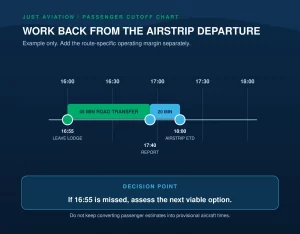
For safari passengers, the critical time is often not the aircraft ETD but the time they must leave the lodge or camp.
Suppose:
- Latest planned airstrip departure: 1800
- Passenger reporting and baggage: 20 minutes
- Road transfer from lodge: 45 minutes
- Additional operating margin: according to the specific trip
The passenger team needs a lodge-departure cutoff based on those inputs.
This should be established before passengers begin a late-afternoon game drive, meeting or lodge activity.
For remote safari properties, road conditions and transfer distances can vary considerably. OCC should therefore use the actual lodge-to-airstrip movement rather than a generic transfer allowance.
A Later Arrival Does Not Guarantee Parking
Operating-hour availability and parking capacity are separate issues. Arusha’s published airport profile identifies two apron areas. Tanzania Airports Authority lists two aprons at ARK: a 15,000 m² main apron capable of accommodating three ATR 72 or Bombardier Q400 aircraft together with up to 15 C208 aircraft, and an 8,925 m² remote apron capable of accommodating up to 15 C208 aircraft below 12 tonnes.
This matters during concentrated safari movements. Several aircraft may return toward Arusha during similar afternoon or evening windows. An aircraft arriving later than planned may therefore enter a different parking environment from the one anticipated earlier in the day.
For an evening arrival, OCC should confirm:
- Aircraft type and registration
- Revised ETA
- Required parking duration
- Whether the aircraft is staying overnight or turning
- Any servicing needed before the next flight
A confirmed late movement should not be interpreted as an open-ended parking confirmation.
Aircraft Substitution Can Change the Ground Plan
Safari charter programs frequently substitute aircraft for maintenance, payload or scheduling reasons. Replacing one Caravan with another registration may require only limited ground-plan changes. Replacing a smaller aircraft with an ATR, Q400 or another larger type can affect:
- Apron allocation
- Aircraft acceptance
- Ground handling
- Passenger capacity
- Baggage handling
- Required servicing
- Performance assessment
If the aircraft type changes while the itinerary is already moving later, both the airport suitability and the ground arrangement should be rechecked against the replacement aircraft. The original schedule confirmation should not simply be carried forward to a materially different aircraft.
What Changes When a Daytime Sector Moves Into the Evening?
A material move from an afternoon schedule into evening conditions should trigger a focused operational review. The operator should reassess, as applicable:
- Aircraft capability for the revised operation
- Crew qualification and duty
- Weather at origin, destination and alternate
- Fuel planning
- Aircraft performance
- Current NOTAMs
- Applicable company procedures
Separately, OCC should establish whether the revised ARK arrival still has the required:
- Parking
- Ground support
- Passenger vehicle
- Crew transport
- Overnight accommodation
- Requested aircraft servicing
This distinction is important. One review determines whether the flight remains operationally acceptable. The other determines whether the arrival can be supported on the ground.
Late Passenger Transport Should Be Planned Before Takeoff
A flight arriving after sunset may still fail the passenger itinerary if the ground vehicle remains booked against the original afternoon ETA.
ARK is located close to Arusha city, which can make it attractive for domestic safari arrivals, but the passenger movement should still be synchronised with the aircraft. Before departure from the safari location, OCC should know:
- Who is collecting the passengers
- Where they are going
- Driver contact and reporting time
- Baggage requirements
- Whether the vehicle remains available after a further delay
For VIP and executive passengers, this is particularly important when the arrival connects with a hotel check-in, meeting, onward road journey or international departure from JRO.
Control Safari Schedule Changes With One Decision Point
Passenger plans often move gradually:
- “Another 30 minutes.”
- “Maybe one more game drive.”
- “We may leave after sunset.”
OCC should avoid turning every passenger estimate into a new aircraft schedule. Instead, establish a decision point from the latest feasible airstrip departure.
For example:
- Latest planned airstrip departure: 1800
- Passenger reporting: 1740
- Road transfer: 45 minutes
- Required lodge departure: before 1655 plus the applicable trip margin
Once the passengers can no longer support that timeline, the team should stop producing provisional later ETAs and assess the next viable option. This creates a clear operational boundary for the safari coordinator.
When Is Kilimanjaro International the Better Choice?
Kilimanjaro International Airport (JRO/HTKJ) provides international airport infrastructure, Jet A-1 availability and a runway of approximately 3,600 metres; operators should confirm current operating status and required services for the specific movement.
It should be evaluated when the mission requires capabilities beyond those available at ARK.
| Mission | ARK | JRO |
|---|---|---|
| Domestic safari turboprop return | Often practical, subject to aircraft and service requirements | Evaluate when operational requirements support JRO |
| International business jet arrival | Confirm international-entry approval, customs, immigration and required services for the specific flight | Principal international gateway to evaluate |
| Larger aircraft | Aircraft-specific assessment required | Broader airport infrastructure; confirm aircraft-specific requirements |
| Significant Jet A-1 requirement | Confirm product, quantity and uplift arrangements | Jet A-1 available; confirm required uplift and service arrangements |
| Passenger destination in Arusha city | Generally closer to Arusha city | Longer surface transfer to Arusha |
| International onward flight | Confirm international departure and border-processing capability for the specific movement | Principal international gateway for onward international operations |
| Late-night movement | 24-hour operations introduced in August 2026; confirm handling, parking, fuel and passenger services separately | Confirm current operating status and required services for the specific movement |
The choice should reflect the aircraft, regulatory requirements, ground support and passenger itinerary together.
ARK and JRO Connections Need Realistic Transfer Time
A late safari flight arriving at ARK may connect with an international business jet waiting at JRO. That connection should not be planned using only aircraft arrival times.
OCC needs to account for:
- Passenger disembarkation
- Baggage delivery
- Road transfer between the airports
- International departure processing
- Passenger boarding
- Business jet departure requirements
A delay on the safari sector can therefore affect the international flight even when both airports remain operationally available. Where the connection becomes too tight, the operator may need to revise the JRO departure rather than trying to recover the entire delay through ground transport.
Check the Next Morning Before Accepting Tonight’s Delay
A late return should also be measured against the aircraft’s next planned movement. If the same aircraft is scheduled for an early safari departure the following morning, OCC should consider:
- Crew rest
- Refueling
- Aircraft servicing
- Maintenance requirements
- Morning positioning
- Passenger reporting time
- The next destination airstrip’s operating window
The late flight may remain possible but still create a poor overall rotation.
The decision may therefore be between:
- Operate tonight: complete the current passenger movement and revise tomorrow’s program.
- Overnight passengers: protect crew rest and the following aircraft rotation.
Neither option should be selected solely because ARK can accept the aircraft later.
| Practical Scenario: A Late Safari Return Threatens an International Connection A safari charter is scheduled to return passengers to Arusha in the late afternoon. The guests are then due to transfer by road to Kilimanjaro International Airport for an evening international business jet departure. The lodge program runs late, but the passengers can still reach the safari airstrip before its latest planned departure. The operator confirms that the later domestic sector remains acceptable. The revised ARK arrival is also supportable. However, the delay reduces the road-transfer and international processing time at JRO to a level that no longer supports the original business jet schedule. OCC therefore stops trying to recover the complete delay within the safari flight. The JRO departure is revised instead. The ARK arrival, passenger vehicle and JRO ground arrangements are aligned with the new schedule, allowing the passengers to complete the airport transfer without building the international departure around an unrealistic connection. The operational issue was not whether Arusha could receive the late safari aircraft. It was whether the complete ARK-to-JRO passenger connection still worked. |
|---|
How Just Aviation Supports Late Safari Operations at Arusha
Just Aviation provides one operational contact for the local services affected by a schedule change. For an ARK movement, this can include coordinating confirmation of current airport and service status with the relevant parties, parking, ground handling, operator-requested fuel uplift where applicable, and passenger or crew ground transportation
Where the itinerary connects through Kilimanjaro International, Just Aviation can coordinate the ARK and JRO ground arrangements against the same passenger schedule. If the operator selects JRO instead of ARK for the revised mission, the handling, parking, fuel and passenger-transfer requirements can be moved accordingly.
Aircraft performance, fuel planning, weather acceptance, crew legality, flight release and command decisions remain with the operator and PIC as applicable.
For northern Tanzania safari charter support, contact the Just Aviation Operations Control Center at [email protected].
Frequently Asked Questions About Late Safari Arrivals at Arusha
1. Should operators verify ARK night availability before each late flight?
Yes. The operating-hours change is recent, and current aeronautical information and airport status should be checked for the specific movement.
2. Can an international business jet plan ARK as its normal entry airport?
Not automatically. ARK’s 24-hour operation does not by itself confirm international entry capability for every business-aviation movement. Operators should confirm current customs, immigration, airport and service requirements for the specific flight.
3. Does a late ARK arrival extend the operating hours of safari airstrips?
No. Each origin airstrip retains its own published operating period and local conditions.
4. How should OCC establish the latest passenger departure from a lodge?
Work backwards from the planned airstrip departure using passenger reporting, baggage, road-transfer time and the required operating margin.
5. Can parking become an issue during late safari arrival waves?
Yes. ARK has finite apron capacity, so parking should be reconfirmed against the aircraft type, revised ETA and intended ground duration.
6. Should an aircraft substitution be reconfirmed with ARK?
A material change in aircraft type or operating requirement should be reviewed against airport suitability, parking and ground support.
7. When should JRO be considered instead of ARK?
JRO is relevant for international arrivals, larger aircraft, significant fuel requirements or missions needing broader airport infrastructure.
8. What if the late ARK arrival threatens an international departure from JRO?
OCC should reassess the entire ground connection and revise the onward schedule if the remaining transfer and processing time is no longer realistic.
9. When can an overnight at the safari location be operationally stronger?
An overnight may be preferable when the origin cutoff, crew rest, next-day aircraft rotation or onward passenger connection no longer supports the evening flight.
Disclaimer
Arusha operating status, safari-airstrip schedules, parking, airport services, NOTAMs, weather and local procedures can change. Operators should verify current aeronautical information and service availability for the specific operation. Aircraft suitability, fuel planning, flight planning, weather acceptance, crew legality, flight release and command decisions remain with the operator and PIC as applicable.
Conclusion
Late safari arrivals at Arusha require more than confirmation that the destination can accept an evening movement. OCC should verify the current ARK status, establish the origin-airstrip cutoff, translate it into a passenger-ready time, confirm parking and ground support, and protect any onward JRO connection or next-day aircraft rotation. Where the mission requires international processing or broader aircraft capability, Kilimanjaro International should be evaluated directly. The objective is a workable end-to-end itinerary rather than simply the latest possible ARK arrival.


 +971 4 5855 689