
Flying to the U.S. with Pets: A Guide for Private Aircraft Operators

25 October 2026
| By Just Aviation TeamInternational pet travel involves more than confirming that an animal can travel in the cabin or aircraft hold. For private aircraft operators, the entry plan also needs to account for the animal’s species, its recent travel history, required documents, the U.S. arrival airport and the arrangements needed for inspection.
Dogs have specific U.S. import requirements administered by the Centers for Disease Control and Prevention (CDC). These requirements depend in part on where the dog has been during the six months before arrival and where it received its rabies vaccination. Cats and other pets follow different rules, which may involve the U.S. Department of Agriculture’s Animal and Plant Health Inspection Service (APHIS), other federal agencies and the destination state.
This guide focuses on the operator’s planning role. It does not replace the importer’s responsibility to meet applicable entry requirements or the authorities’ decisions at the U.S. port of entry.
Key Takeaways
- What should operators establish about a dog’s travel and rabies vaccination history?
- Which CDC documents and air waybill arrangements need to be checked before boarding?
- How can a foreign-vaccinated dog’s recent travel to a high-risk country affect the U.S. arrival airport?
- What additional requirements may apply to cats and other pet species?
- How can operators coordinate the pet’s entry plan with the flight itinerary and U.S. arrival arrangements?
Start with the Animal and Its Travel History
Before confirming the itinerary, identify the animal’s species and the purpose of its movement, such as personal pet travel or commercial transport. Some dogs entering the United States for commercial purposes may be subject to additional USDA requirements, as outlined in the USDA guidance on importing pets into the United States.
For dogs, the departure country alone may not determine the applicable entry pathway. The CDC considers whether the dog has been in a country or political unit classified as high risk for dog rabies during the previous six months. Earlier trips and layovers where the dog clears customs may affect this assessment. The CDC’s high-risk country list and Dog Importation Navigator outline the relevant pathway.
Check the Baseline CDC Requirements for Dogs
CDC requirements apply to dogs entering or returning to the United States. At a baseline, dogs must:
- Appear healthy on arrival
- Be at least six months old when they arrive
- Have a microchip that can be detected by a universal scanner
- Have a completed CDC Dog Import Form receipt
The CDC Dog Import Form is required for each dog. For air travel, the receipt must be available to show before boarding and upon arrival to U.S. Customs and Border Protection (CBP). Dogs that have been only in dog rabies-free or low-risk countries during the previous six months generally follow a different documentation pathway from dogs that have been in a high-risk country.
The CDC form does not replace other requirements that may apply through USDA, CBP or the destination state. The APHIS guidance on importing pets into the United States advises travelers to check the applicable federal and state requirements.
Identify the Requirements for High-Risk Country Travel
If a dog has been in a high-risk country during the six months before U.S. arrival, additional CDC requirements apply. The required documents and arrival arrangements depend partly on whether the dog was vaccinated against rabies in the United States or in another country.
Under the CDC requirements for U.S.-vaccinated dogs from high-risk countries, a dog that has been in a high-risk country during the previous six months needs a CDC Dog Import Form receipt and a Certification of U.S.-Issued Rabies Vaccination. The vaccination certification must be completed and USDA-endorsed before the dog leaves the United States. The importer should confirm that both documents are current and available for the return journey.
The high-risk country list and requirements can change. Confirm the current rules for the individual dog rather than relying on a previous trip’s documents or an earlier itinerary.
Include Air Waybill Requirements in the Operator’s Plan
The CDC guidance for air carriers transporting dogs applies to commercial air carriers and general aviation operators. An air waybill (AWB) is required for each dog unless the carrier qualifies for the applicable CDC waiver provisions. CBP may still require an AWB even when a CDC waiver applies, so operators must check the requirements at the intended arrival port.
This is separate from the CDC Dog Import Form. A CDC receipt does not replace any applicable AWB requirement, and an AWB does not replace the dog’s import documents. CDC’s air carrier guidance also addresses document checks before boarding and arrangements for dogs that are ill, pending clearance or denied entry.
Coordinate the U.S. Airport of Entry with the Pet Requirements
The planned airport must work for both the flight and the animal’s entry pathway. If a foreign-vaccinated dog has been in a high-risk country, the U.S. arrival airport must correspond to the CDC-registered animal care facility reservation and the airport shown on the CDC receipt.
Separately, CBP’s general aviation guidance advises pilots to contact the responsible CBP port of arrival directly to secure permission to land and understand local procedures. Operators should confirm that the selected port can support the planned arrival and inspection arrangements.
If a dog enters a high-risk country during an international layover, it must meet the CDC requirements for dogs from high-risk countries when arriving in the United States, regardless of where the trip began. A dog is considered to have entered the country if it clears customs. If it is unclear whether the dog will enter the transit country, confirm the arrangements with the carrier.
Cats and Other Pets Have Different Entry Rules
The CDC dog import process does not apply to cats and other pet species. According to the APHIS guidance for importing pet cats, USDA Veterinary Services does not impose animal health requirements for importing domestic pet cats, although other federal and destination-state requirements may apply.
For birds, reptiles and other animals, operators should consult the APHIS pet import guidance to identify applicable species-specific requirements and any involvement of other federal agencies.
Operators should not assume that documentation prepared for a dog will be relevant to another pet, or that a pet’s federal requirements cover every destination-state rule.
Operator Checklist Before Departure
Before accepting a dog for a U.S. flight, the operations team can use this checklist:
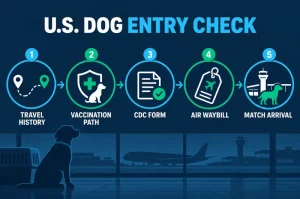
- Confirm the dog’s purpose of travel and intended U.S. arrival airport.
- Review its travel history during the previous six months and rabies vaccination location.
- Check the applicable CDC documentation, age, health and microchip requirements.
- For each dog, arrange the required air waybill or confirm that a CDC waiver applies, and check any CBP requirements.
- Match any required CDC-registered animal care facility reservation with the U.S. arrival airport and CDC Dog Import Form receipt.
- Confirm any additional USDA and destination-state requirements.
- Recheck the documents and arrival arrangements if the itinerary changes.
This checklist supports operational preparation but does not establish the dog’s admissibility or replace verification by the importer and relevant authorities.
Just Aviation Support for International Business Jet Operations
Just Aviation supports business and charter operators with coordinated international flight support based on the aircraft, route, destination and schedule. Support can include flight planning, permit coordination, ground handling, crew support and coordination with local service providers.
For pet-carrying trips, Just Aviation can coordinate flight arrangements with the planned route and arrival airport. The importer remains responsible for the pet’s eligibility and veterinary documents. The operator remains responsible for its applicable carrier obligations and flight operations.
For international flight coordination, contact the Just Aviation Operations Control Center at [email protected]
Frequently Asked Questions About Flying to the U.S. with Pets
1. Does each dog need a separate CDC Dog Import Form receipt?
A separate receipt is required for each dog. If the dog’s arrival date or U.S. port changes, the importer may need to submit an updated form.
2. A dog has been in a high-risk country during the previous six months. How does its rabies vaccination history affect the return plan?
The required documents depend on where the dog received its rabies vaccination. A U.S.-vaccinated dog needs a CDC Dog Import Form receipt and a USDA-endorsed Certification of U.S.-Issued Rabies Vaccination completed before it leaves the United States. A foreign-vaccinated dog follows a separate entry process that includes additional documentation and an animal care facility reservation.
3. A dog is travelling in the cabin on a private aircraft to the United States. What air waybill arrangements apply?
CDC guidance requires general aviation operators to create an air waybill for each dog unless the operator has a CDC waiver. CBP may still require an air waybill at the arrival port, including when a waiver has been issued.
4. A foreign-vaccinated dog with high-risk country history is arriving in the United States. How is the airport selected?
The dog must arrive at the U.S. airport where its reserved CDC-registered animal care facility is located. That airport must match the arrival airport on the dog’s CDC Dog Import Form receipt. If the dog does not have a valid rabies serology titer, the facility reservation must include a 28-day quarantine.
5. A dog has a layover in a high-risk country. When does the stop affect its U.S. entry requirements?
If the dog clears customs in the high-risk country, it is treated as having entered that country, and the high-risk requirements apply when it arrives in the United States. Cabin travel or an airline change may affect whether customs clearance is required, so the transit arrangements matter.
6. A cat is travelling on the same private flight as a dog. Does it follow the CDC dog import process?
The CDC Dog Import Form applies to dogs. Cats have different entry requirements. Federal animal health requirements and state or territory rules depend on the circumstances and destination.
7. A dog is entering the United States for resale or adoption. What additional requirements may apply?
The purpose of the movement can affect the documentation. Dogs imported for commercial purposes such as resale or adoption have additional USDA requirements alongside the applicable CDC rules.
8. Which parts of an international flight with a pet can Just Aviation coordinate?
Just Aviation can coordinate flight planning, permits, ground handling and other trip arrangements based on the aircraft, route, destination and schedule. The importer remains responsible for the pet’s eligibility and veterinary documents. The operator remains responsible for its applicable carrier obligations and flight operations.
Disclaimer
U.S. animal import requirements may change and can differ by species, travel history, vaccination record, import purpose and destination state. This article provides general operational information and does not replace current CDC, USDA, CBP, state or other applicable agency requirements.
The importer is responsible for the animal’s documentation and eligibility. Operators remain responsible for their applicable carrier obligations and flight operations. Confirm the requirements for the specific animal and itinerary with the relevant authorities before travel.
Conclusion
Successful pet movements depend on aligning the animal’s entry pathway with the flight and arrival arrangements. Confirming the relevant travel history, vaccination record and documents early gives the owner and operator time to address itinerary or airport changes before departure. Cats and other pets require separate checks based on their species and destination.


 +971 4 5855 689