
Flying to Davos for World Economic Forum 2027: Operator’s Guide to Airports, Permits and Ground Arrangements

16 November 2026
| By Just Aviation TeamThe World Economic Forum Annual Meeting is scheduled for 18–22 January 2027 in Davos-Klosters, Switzerland. The Davos Congress Centre confirms the event dates.
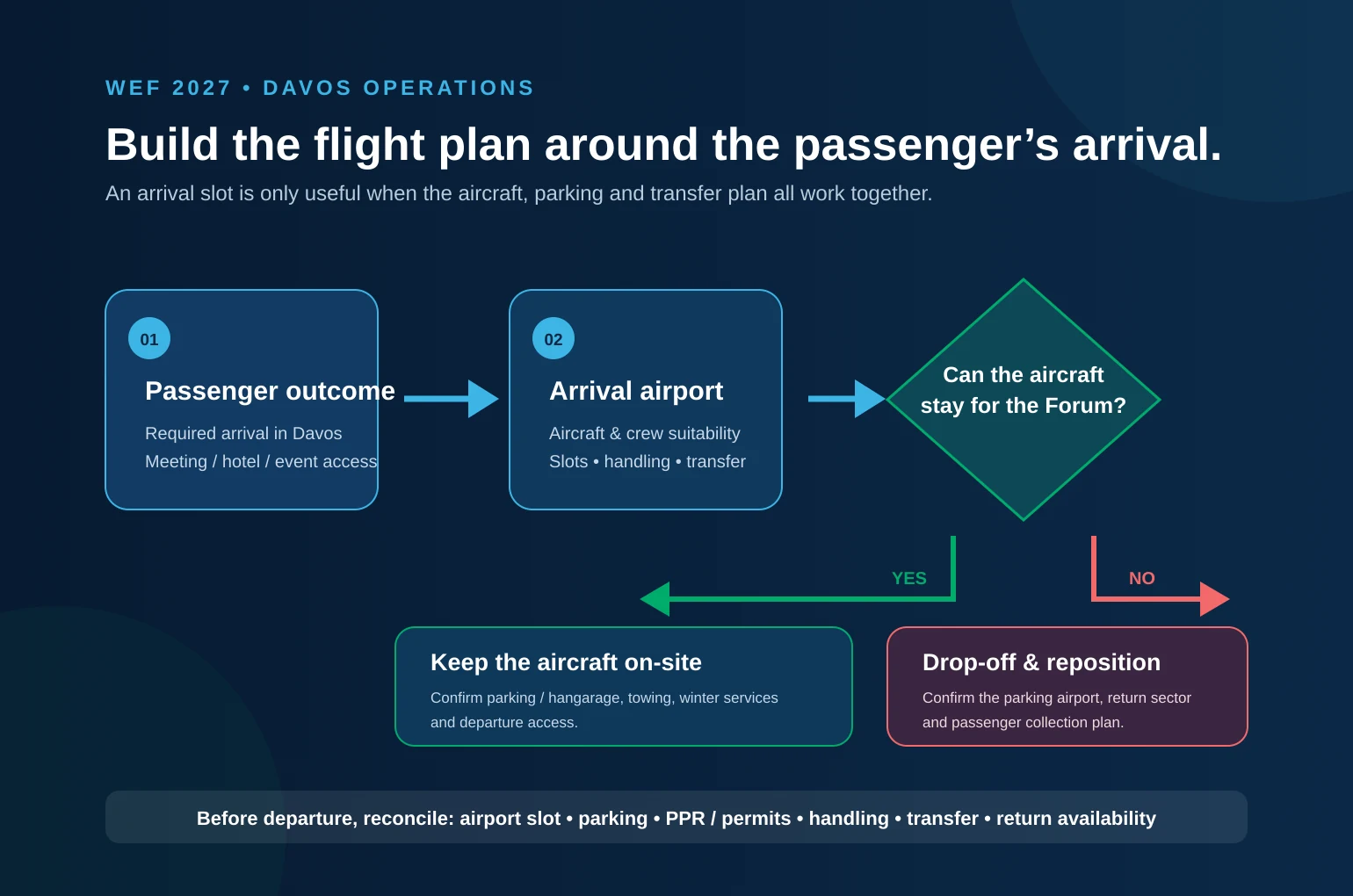
For business aviation operators, the destination plan extends beyond the arrival airport. Aircraft suitability, movement permissions, parking and the onward journey to Davos must work together. A convenient arrival slot has limited value if the aircraft cannot remain parked or passengers cannot reach their meeting on time.
Start with the required arrival time in Davos, then build the flight and ground arrangements around it. Winter conditions are one part of that assessment, alongside event access, airport capacity and the return itinerary.
Plan the journey through to Davos. Just Aviation’s flight permit services and ground handling coordination help operators connect airport enquiries, permissions and supporting services with the proposed schedule.
Key Takeaways
- Which airports should operators assess for access to Davos?
- How should arrival slots and aircraft parking be coordinated?
- When does passenger drop-off and repositioning make sense?
- Which permissions depend on the operator and flight purpose?
- How should passenger transfers influence airport selection?
- What must be reconfirmed before departure?
What Should the Flight Plan Achieve?
Begin with the passenger’s required arrival time at the hotel, meeting or event venue. Work backwards through the transfer, airport formalities and aircraft arrival.
The planning brief should establish:
| Planning detail | Operational purpose |
|---|---|
| Required arrival in Davos | Defines the passenger schedule the operation must support. |
| Aircraft type and registration | Supports airport suitability, equipment and parking assessment. |
| Operator and flight purpose | Determines the applicable approval route. |
| Passenger and crew numbers | Supports handling, border and transport arrangements. |
| Arrival and departure flexibility | Allows alternative movement times to be assessed. |
| Ground-stay duration | Establishes parking or repositioning requirements. |
| Passenger destination in Davos | Identifies the final transfer point and access needs. |
| Return schedule | Allows the aircraft’s availability to be planned in advance. |
Distinguish firm requirements from preferences. A fixed meeting time may leave room to adjust the arrival airport or travel a day earlier, while a preferred parking location may be negotiable.
Which Airport Options Should Be Assessed?
Airport selection should consider the complete operation rather than proximity alone. The following locations provide options for assessment; availability and suitability require flight-specific confirmation.
| Airport | Potential role in the itinerary | Main planning checks |
|---|---|---|
| Zurich – LSZH / ZRH | Passenger arrival and departure, with onward transport to Davos. | Airport slots, parking duration, handling, operating restrictions and transfer timing. |
| St. Gallen-Altenrhein – LSZR / ACH | Regional arrival or parking option for suitable aircraft. | Aircraft performance, operating hours, weather, handling and confirmed parking. |
| Friedrichshafen – EDNY / FDH | German arrival or repositioning option. | German operating requirements, parking, servicing and cross-border passenger transport where relevant. |
| Samedan / Engadin – LSZS / SMV | Alpine option requiring specific operational assessment. | Crew briefing, terrain, weather, aircraft performance, airport acceptance and onward access. |
| Dübendorf – LSMD | Potential event-related option where access is authorized. | Confirmed 2027 eligibility, PPR, applicable crew guide, operating conditions and parking. |
Zurich publishes dedicated general and business aviation guidance. St. Gallen-Altenrhein also provides business aviation services, while Friedrichshafen publishes information on ground services and winter deicing. The operator remains responsible for assessing aircraft and crew suitability. A handling enquiry should follow that assessment rather than substitute for it.
How Should Zurich Slots and Parking Be Coordinated?
Zurich requires a valid airport slot for the relevant arrival or departure. Its published guidance states that the airport slot ID must be entered in Item 18 of the flight plan. IFR slot arrangements are made through the dispatcher or handling provider. Track the movement slot and parking confirmation separately.
Before committing to Zurich, establish:
- Confirmed arrival and departure slots.
- The authorized ground-stay period.
- Parking or hangar arrangements for that period.
- Any towing or stand-change requirements.
- Handling and border-processing arrangements.
- An alternative if the requested parking cannot be provided.
A movement slot does not establish permission to leave the aircraft parked throughout the Forum. Likewise, a parking quotation does not demonstrate that an arrival or departure slot has been obtained.
Just Aviation can coordinate these enquiries together, helping operators identify gaps between the proposed flight schedule and the ground arrangements.
When Should Drop-Off and Repositioning Be Considered?
Passenger drop-off followed by aircraft repositioning can be assessed when the preferred arrival airport cannot accommodate the full ground stay.
Compare the complete alternatives:
- Remain at the arrival airport: Parking or hangarage, towing, winter preparation, crew accommodation and departure access.
- Reposition: Additional sectors, fuel, handling at both airports, parking elsewhere, crew logistics and the flight back for passenger collection.
Confirm the repositioning destination before relying on a short stay at the arrival airport. The plan should also address what happens if weather or movement restrictions prevent the aircraft returning at the requested time.
Treat the repositioning airport and the flight-plan alternate as separate decisions. A location used for parking is not automatically a suitable or available alternate for the passenger flight.
What Requires Particular Attention at Samedan and Dübendorf?
Samedan / Engadin
Engadin Airport identifies LSZS as an Alpine operating environment requiring a special briefing for flights into and out of the airport. Its published elevation is approximately 5,600 ft above mean sea level.
Assess current procedures, terrain, weather, aircraft performance and crew requirements before selecting it. Include departure performance and the onward journey to Davos, rather than evaluating the arrival alone. Use the airport’s pilot information alongside current official aeronautical publications. Earlier WEF briefings should not be used as authority for the 2027 operation.
Dübendorf
Dübendorf should be treated as an option requiring explicit confirmation of event access.
The published aerodrome information identifies PPR allocation and an Air Crew Guide. However, previous-year opening arrangements and eligibility restrictions should not be assumed to apply unchanged in 2027.
Obtain confirmation for the actual operator, aircraft, passengers and movements. Do not assume a Zurich–Dübendorf positioning flight is permitted simply because both airports appear in the itinerary.
Which Flight Permissions Need to Be Checked?
Establish the operating carrier’s domicile, commercial status and proposed traffic pattern before determining permit requirements. Swiss FOCA guidance distinguishes between operations benefiting from market access and those requiring permission. It also identifies exemptions for certain non-scheduled services and non-commercial operations.
Where FOCA’s individual-permit procedure for non-EU/EFTA charter operations applies, its published submission requirement is no later than 72 hours before the first flight. That requirement should not be treated as a recommended event-planning lead time or an approval guarantee. Relevant third-country commercial operators must also address EASA TCO requirements.
State flights follow a separate diplomatic-clearance process, including submission through the respective state’s diplomatic representative. Restrictions applying to those operations should not be presented as universal rules for private and charter flights. If the itinerary includes Germany or another country, assess that country’s requirements separately.
How Should WEF Airspace and Security Requirements Be Managed?
Event dates and aviation restrictions are different planning inputs. The meeting dates are confirmed, but the operation must use the applicable 2027 aeronautical publications, NOTAMs and airport instructions. Previous WEF procedures can identify matters to investigate; they cannot establish current authorization.
Check:
- Restricted-airspace activation dates and times.
- The geographical and vertical limits.
- Registration or authorization requirements.
- Procedures affecting the selected airport or heliport.
- Requirements specific to state or protected-person operations.
- Any restrictions affecting the proposed alternate or repositioning sector.
Airport PPR, an airport slot and permission to enter restricted airspace serve different purposes. Keep each status visible in the trip record.
How Should Passenger Transfers to Davos Be Planned?
Arrange the onward journey before finalizing the arrival time. For road transfers, confirm the passenger destination, vehicle capacity, luggage requirements, winter suitability and any event-access arrangements. Allow for conditions and access checks rather than relying on a fixed airport-to-hotel journey time.
Davos’s official travel guidance identifies road access through Landquart and rail travel using SBB to Landquart, followed by the Rhaetian Railway towards Klosters or Davos.
Helicopter transfers require a separate assessment of aircraft availability, landing arrangements, weather and applicable airspace permissions. Maintain a workable surface-transfer alternative where the passenger schedule depends on reaching Davos. For arrivals in Germany, include the cross-border journey in the transport plan. Confirm that the provider can support the complete transfer and relevant passenger formalities.
What Ground Services Should Be Confirmed?
Request services for the expected aircraft stay, including any repositioning sectors.
| Service | What to establish |
|---|---|
| Parking and hangarage | Confirmed period, aircraft fit, access and cancellation terms. |
| Fuel | Required uplift, availability and servicing window. |
| Ground power and heating | Aircraft-compatible equipment and permitted methods. |
| Deicing and anti-icing | Capability, treatment arrangements and expected demand. |
| Towing | Compatible equipment and required movements. |
| Catering and transport | Delivery, collection and amendment arrangements. |
| Crew support | Accommodation, transfers and access to the parked aircraft. |
Keep winter preparation proportionate to the aircraft and conditions. Use current aircraft documentation and operator procedures for technical requirements.
What Should Be Checked Before Filing and Operating?
Use one final review covering both the passenger flight and any supporting sectors.
- Reconcile the itinerary with permits, slots, PPR and parking confirmations.
- Check current AIP information, NOTAMs and event instructions.
- Include required airport slot identifiers in the flight plan.
- Review routing, weather, alternates and applicable traffic-management measures.
- Confirm aircraft performance and operational suitability.
- Reconfirm handling, fuel and winter services.
- Align passenger collection with the latest aircraft schedule.
- Verify the aircraft’s return availability if repositioning is planned.
Communicate material changes across the whole operation. An amended arrival affects more than the flight plan if parking, a chauffeur or a helicopter connection remains booked to the original time.
How Just Aviation Supports WEF 2027 Flight Planning
Just Aviation connects airport and service coordination with the operator’s proposed WEF itinerary through one Operations Control Center.
Support can include:
- Coordinating airport, parking and hangar enquiries.
- Supporting permit, slot and PPR application coordination.
- Arranging handling, fuel and requested winter ground services.
- Coordinating passenger transfers and crew logistics.
- Following up on repositioning arrangements and schedule amendments.
Build your Davos arrival around the meeting schedule. Contact [email protected] to discuss airport options, outstanding requirements and supporting arrangements.
Airport and provider confirmations remain subject to availability. Aircraft suitability, operational flight planning and final flight decisions remain with the operator and its authorized personnel.
Frequently Asked Questions About WEF 2027 Flights to Davos
Should passengers arrive before the Forum’s opening day?
Base the decision on their first commitment in Davos. An earlier arrival may provide more scheduling flexibility, but airport, hotel and transfer arrangements still need confirmation.
What if the arrival airport cannot accommodate the entire stay?
Assess a confirmed drop-off and repositioning arrangement, including the aircraft’s return for collection and an alternative if that return is disrupted.
Can one airport be used for arrival and another for departure?
This can be assessed where operationally suitable. Account for passenger transport, aircraft positioning, permissions and handling at both locations.
Does helicopter availability establish access to Davos?
The transfer also depends on weather, landing arrangements and applicable airspace authorization. Confirm the complete service, not only the aircraft booking.
Should the aircraft’s parking location be filed as its alternate?
Only where the operator determines it meets applicable alternate requirements and is available for that purpose. Parking and alternate selection are separate assessments.
What changes if the passenger party includes state officials?
Establish the flight’s status and any diplomatic or protected-person requirements early. Do not assume ordinary private or charter arrangements cover the operation.
What if the aircraft changes after airport confirmation?
Recheck slots, parking, PPR, permits, equipment and performance against the replacement aircraft.
Should crew accommodation follow the passenger hotel location?
Plan accommodation around the aircraft’s location, crew duty and rest requirements, and return-transfer needs. Repositioning may make a different crew base more practical.
Can previous WEF instructions be used for the 2027 flight?
They can support preliminary research, but the flight must follow the applicable 2027 publications, permissions and current operational information.
Disclaimer
This article provides general event-planning guidance. Airport access, parking, airspace restrictions and services remain subject to current publications and individual confirmations. Use applicable 2027 instructions, current aeronautical information and operator procedures before operating.
Conclusion
A practical WEF flight plan connects the passenger’s arrival in Davos with a suitable airport, confirmed aircraft arrangements and a workable onward transfer. Establish the parking and return plan early, keep permissions separate from service bookings, and reassess the full itinerary when conditions or schedules change.


 +971 4 5855 689