
How to Check a EUROCONTROL Route Charges Invoice Before You Pay

22 November 2026
| By Just Aviation TeamBy Just Aviation Team | Updated November 2026
Checking a EUROCONTROL invoice requires more than comparing the total with the flight budget. The review needs to establish whether the billed movements belong to the operator, whether the charging inputs are correct and whether payments or credits have already changed the amount outstanding.
A structured review connects operational records with financial controls. Dispatch verifies the aircraft and completed movements. Finance reconciles the billing documents and account balance. Any discrepancy is supported by evidence, assigned for follow-up and managed alongside the payment deadline.
Just Aviation’s navigation fee administration services help operators review invoices, verify route and aircraft weight information, follow up on discrepancies and reconcile payment records within the agreed scope.
Key Takeaways
- Reconcile the bill, flight breakdown, credits and payments to establish the outstanding amount.
- Match billed movements to completed-flight records, including aircraft substitutions and diversions.
- Verify the certificated MTOW, actual-route charging distance and applicable monthly unit rates.
- Support billing claims with flight-specific evidence and ensure EUROCONTROL receives them before the claim deadline.
- Arrange payment to reach EUROCONTROL by the due date. A claim does not authorise a deduction without written approval.
What Should Be Checked When the Invoice Arrives?
Record the invoice in the operator’s accounting workflow as soon as it is received. Identify the legal entity billed, CRCO user number, document reference, flight period, currency and amount.
Then record two separate deadlines:
- Payment deadline, allowing time for funds to reach the designated account.
- Claim deadline, allowing time to gather evidence and submit any correction request.
EUROCONTROL normally issues monthly bills in the middle of the month following the flights. Its billing calendar identifies issue dates, payment dates and claim deadlines. Payment must reach EUROCONTROL by the due date shown on the bill, which is 30 days from the invoice issue date.
Assign an owner for operational verification and another for payment approval where the organisation’s staffing permits. If an external administrator is involved, establish who receives documents, submits claims and authorises payment.
Which EUROCONTROL Documents Should Be Reconciled?
The Central Route Charges Office (CRCO) administers route charges and certain terminal, bilateral air navigation and Shanwick communication charges. Identify the charging system before checking the calculation or payment instructions.
| Document | Purpose in the review |
|---|---|
| Bill | Establish the charges, reference and payment deadline. |
| Pro forma statement | Reconcile the individual billed flights. |
| Bill and VAT breakdown | Examine charges and tax by charging zone and relevant entity. |
| Statement of account | Reconcile invoices, credits, payments and outstanding balances. |
| VAT invoice | Support the tax record. Its amount is included in the corresponding bill. |
| Credit note | Record a financial adjustment and link it to the affected charge. |
Avoid creating a second payable entry for VAT already included in the bill. Apply the same reconciliation discipline to VAT credit documents. EUROCONTROL explains the document relationships in Part B of its Customer Guide to Charges.
CEFA, EUROCONTROL’s portal for airspace users, provides billing documents, flight details, statements, fleet information and claim tracking. Use the operator’s authorised access to obtain the records needed for review.
How Should Billed Flights Be Matched to Operational Records?
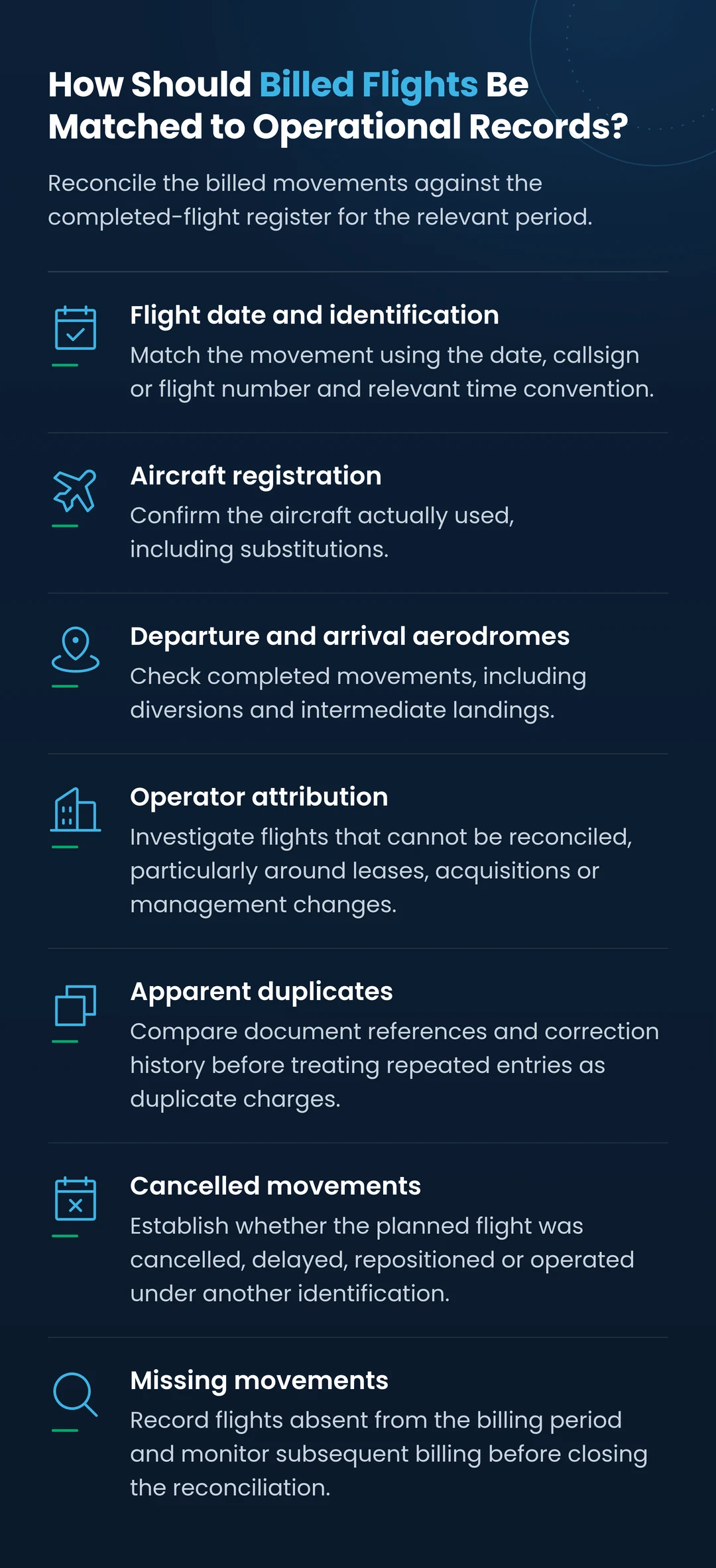
Reconcile the billed movements against the completed-flight register for the relevant period. Include passenger flights, positioning sectors, technical stops and other movements recorded under the operator’s account.
| Review item | What to verify |
|---|---|
| Flight date and identification | Match the movement using the date, callsign or flight number and relevant time convention. |
| Aircraft registration | Confirm the aircraft actually used, including substitutions. |
| Departure and arrival aerodromes | Check completed movements, including diversions and intermediate landings. |
| Operator attribution | Investigate flights that cannot be reconciled, particularly around leases, acquisitions or management changes. |
| Apparent duplicates | Compare document references and correction history before treating repeated entries as duplicate charges. |
| Cancelled movements | Establish whether the planned flight was cancelled, delayed, repositioned or operated under another identification. |
| Missing movements | Record flights absent from the billing period and monitor subsequent billing before closing the reconciliation. |
Investigate discrepancies using the evidence relevant to the issue. A journey log may establish the aircraft and aerodromes. A movement report may resolve the operating date. Lease or management records may help explain an attribution issue.
For higher flight volumes, reconcile the complete movement population electronically where possible, then investigate unmatched records and unusual changes. A consistent review rule is more useful than selecting flights solely because their charges appear high.
How Is the Route Charge Calculated?
For each charging zone, the calculation combines three inputs:
- Zone charge = distance factor × aircraft weight factor × applicable unit rate
The zone charges are then added to establish the route charge for the flight.
For each charging zone, the distance factor is the relevant great-circle distance in kilometres divided by 100. This distance runs between the departure aerodrome or zone entry point and the arrival aerodrome or zone exit point. Entry and exit points are determined by the actual route flown as recorded by the Network Manager. Deduct 20 kilometres for each take-off and each landing within that charging zone, following EUROCONTROL’s route charge calculation rules.
The aircraft weight factor is calculated from certificated maximum take-off weight (MTOW):
Weight factor = √(MTOW in metric tonnes ÷ 50)
The prescribed precision and calculation rules apply. Check the three inputs separately when investigating a difference.
How Can Operators Check the Arithmetic?
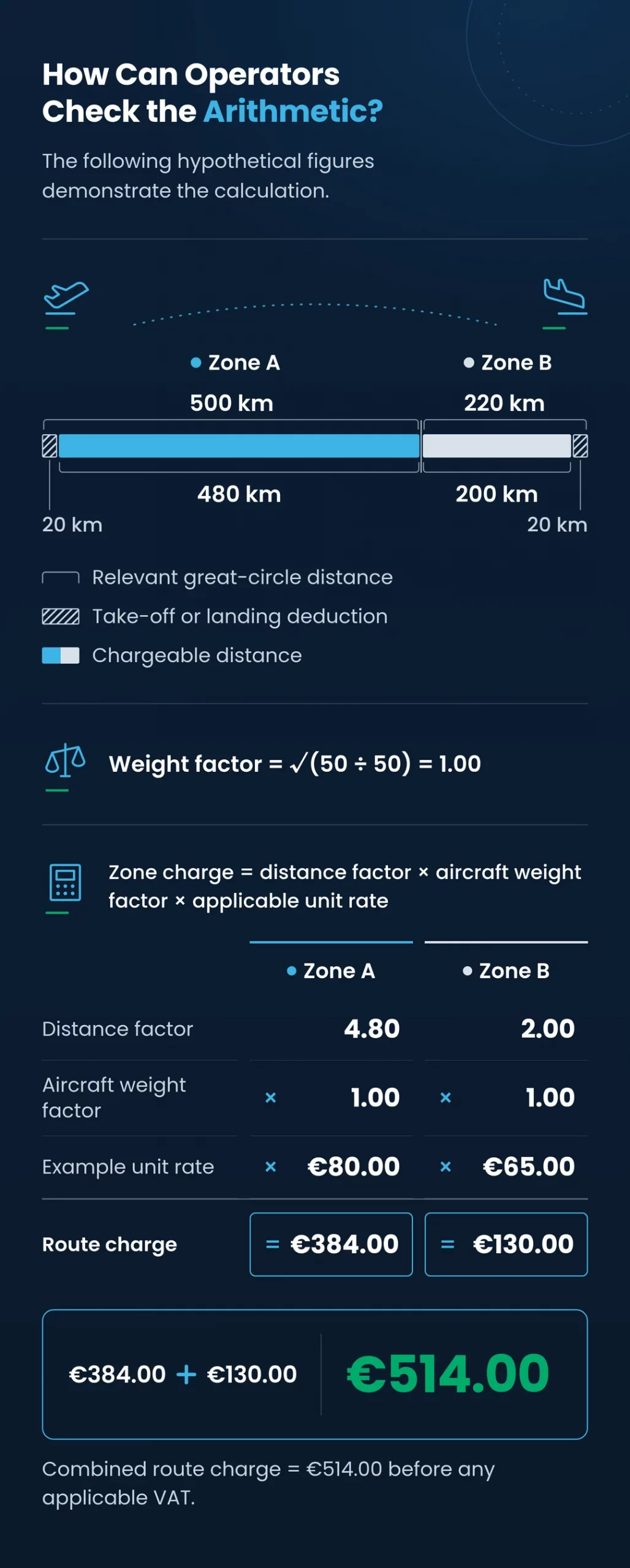
For example, consider a 50-tonne aircraft completing a flight through two charging zones. It takes off in Zone A and lands in Zone B. The following hypothetical figures demonstrate the calculation.
Weight factor = √(50 ÷ 50) = 1.00
| Calculation element | Zone A | Zone B |
|---|---|---|
| Relevant great-circle distance | 500 km | 220 km |
| Take-off or landing deduction | 20 km | 20 km |
| Chargeable distance | 480 km | 200 km |
| Distance factor | 4.80 | 2.00 |
| Aircraft weight factor | 1.00 | 1.00 |
| Example unit rate | €80.00 | €65.00 |
| Route charge | €384.00 | €130.00 |
Combined route charge = €514.00 before any applicable VAT.
The example covers the route charge. Review any terminal or communication charge under its applicable rules.
Which Aircraft Weight Should Be Verified?
Compare the billed weight factor with the aircraft’s applicable certificated MTOW and the supporting fleet declaration.
EUROCONTROL’s fleet declaration circular specifies that:
- Where an aircraft has multiple certificated MTOW values, the highest value must be used for route charge calculations and declared in accordance with EUROCONTROL’s fleet declaration rules.
- MTOW declarations require supporting Aircraft Flight Manual documentation.
- Fleet and MTOW changes are declared by the last working day of the month in which they occur.
- Fleet and weight declarations are renewed at least annually.
The circular also explains the circumstances in which EUROCONTROL uses the heaviest known aircraft of the same type as the billing basis, including missing or expired declarations.
A weight discrepancy therefore needs two checks: whether the aircraft documentation supports the proposed figure and whether the relevant declaration was submitted and remains current.
For leased or substituted aircraft, establish which registration performed the flight and verify its declared weight. Retain the submission reference and effective date when a fleet record is updated.
Why Can the Billed Distance Differ From the Planned Route?
EUROCONTROL’s route charging information specifies that the distance factor depends on the actual route flown as recorded by the Network Manager. The original flight plan or dispatch estimate may therefore differ from the billing basis.
Review whether the movement involved a revised clearance, different zone crossings, a diversion or an intermediate landing. The chargeable distance follows the defined charging method, so comparing the invoice with a tracker’s total track mileage may leave the difference unresolved.
A useful investigation identifies the disputed zone, the entry or exit information concerned and the operational evidence supporting a correction.
EUROCONTROL’s Route per State Overflown tool can support planning estimates using flight-plan information and current data files. Retain the assumptions used in an estimate so the later invoice comparison has a clear basis.
Which Unit Rate Applies?
Select the rate for the charging zone and month in which the flight operated. Check those against the billed movement before investigating the amount.
EUROCONTROL publishes monthly adjusted rates. Currency adjustments apply to relevant states, while states participating in the euro arrangements described in the charging circular follow the stated exceptions. A budgeting rate retained from an earlier month may therefore produce a different estimate.
For each reviewed calculation, retain the applicable publication or rate-table version. A flight crossing several charging zones requires the appropriate rate for each zone.
How Should VAT and Exemptions Be Checked?
Treat VAT status and route charge exemption as separate review items. Each has its own conditions and supporting evidence.
For VAT, verify the billed entity, fiscal information and documentary evidence held on the account. EUROCONTROL’s VAT circular explains the relevant charging zones and circumstances in which VAT is applied or exempted. It also identifies evidence needed to establish customer status.
For a route charge exemption, identify the applicable category under Article 8 and confirm the movement meets its conditions. Establish the evidence required before requesting an adjustment.
Refer uncertain tax treatment to the operator’s finance or tax adviser. Record the decision and supporting documents so the issue can be handled consistently in later billing periods.
How Should a Billing Claim Be Prepared?
Submit a claim that identifies the affected flight, disputed information and requested correction.
| Claim element | Information to include |
|---|---|
| Billing reference | CRCO user number, bill reference and relevant billing period. |
| Flight reference | Date, flight identification, registration and aerodromes sufficient to identify the movement. |
| Disputed item | The specific field or charge being challenged. |
| Proposed correction | The replacement information and explanation. |
| Supporting evidence | Documents that substantiate the correction. |
| Follow-up record | Submission date, acknowledgement, claim reference and assigned owner. |
Claims must be received by EUROCONTROL within 60 days of the bill date. Follow the claim deadline shown on the invoice and allow sufficient time for receipt. Include the supporting evidence required for the relevant claim category. CEFA provides claim submission and monitoring facilities.
A claim does not authorise withholding or deducting the disputed amount. Obtain written CRCO authorisation before making a deduction on that basis. The payment review should continue while the claim is investigated.
Where a correction is accepted, follow the credit and any subsequent corrected charge through the account. EUROCONTROL explains that an erroneous flight charge is credited in full and the corrected charge is subsequently billed.
What Should Finance Verify Before Releasing Payment?
Complete the operational review early enough to meet the payment deadline. Resolve the payment amount using the current account position and any authorised adjustments.
| Payment control | Required check |
|---|---|
| Amount payable | Reconcile the bill with payments already made and applicable credit records. |
| Payment responsibility | Confirm whether the operator or its appointed administrator will pay. |
| Currency and destination account | Follow the instructions for the relevant charging system. |
| Remittance information | Identify the bill or statement and the amounts being settled. |
| Bank costs | Arrange the transfer so the required net amount reaches EUROCONTROL. |
| Receipt timing | Allow for banking processing before the deadline shown on the bill. |
| Post-payment allocation | Check that the payment has been credited to the intended account and liabilities. |
EUROCONTROL states that bank charges are borne by the user and that accounts are credited with the net amount received. Payment receipt is determined by the value date on which funds are credited. Its payment guidance also explains remittance references and allocation.
Use bank instructions from official billing documents obtained through the authorised process. EUROCONTROL warns against fraudulent messages announcing bank-account changes. A changed payment instruction warrants verification before transfer.
After payment, retain the transfer confirmation and reconcile it with the statement of account. A completed transfer still needs to be matched to the correct outstanding balance.
How Just Aviation Supports Navigation Fee Administration
Just Aviation supports operators with navigation fee administration, invoice reconciliation, flight record verification and discrepancy follow-up.
Support can include:
- Receiving invoices and organising the supporting records.
- Verifying billed routes and aircraft MTOW information.
- Coordinating discrepancy enquiries and supporting documentation.
- Coordinating payment administration and reconciliation in accordance with the operator’s authorisation.
- Following up on payment allocation and account records.
The operator supplies the relevant aircraft and flight information and agrees the payment authority. EUROCONTROL determines billing corrections and claim outcomes.
For support with recurring invoice reviews or an outstanding reconciliation, contact the Just Aviation Operations Control Center at [email protected]
Frequently Asked Questions About EUROCONTROL Route Charges Invoices
1. Does a VAT invoice require a separate payment?
The VAT invoice supports the tax record, and its amount is already included in the corresponding bill. Reconcile the documents before creating the payment instruction.
2. Can a late invoice include flights from an earlier period?
Check the flight period and document sequence before treating it as a duplicate. Compare it with earlier bills and credits, then reconcile the individual movements.
3. What should be checked if the same route costs more than last month?
Compare the aircraft weight factor, recorded charging zones, distance factors and monthly unit rates. Review VAT and any other charge categories separately.
4. How should an aircraft substitution be handled?
Match the billed movement to the replacement aircraft’s registration and applicable MTOW declaration. Keep the substitution record with the reconciliation evidence.
5. Who handles a claim when a third party manages the account?
Define that responsibility in the service scope. Agree who submits the claim, provides evidence, checks acknowledgements and tracks the outcome. CEFA offers company accounts with assigned access roles.
6. What happens if bank fees leave a small balance outstanding?
Reconcile the net amount received and arrange settlement of the remaining balance. EUROCONTROL credits the amount received after bank deductions, so transfer costs need to be accounted for when paying.
7. Can finance deduct an expected claim credit before it is issued?
Any deduction based on a disputed bill requires written CRCO authorisation. Record that authorisation with the payment approval.
8. What should be reviewed when an unfamiliar flight appears?
Check flight identification, registration, aerodromes and the operating arrangements on that date. Investigate lease or management changes and compare the entry with the completed-flight register.
9. When can the monthly review be closed?
Close it once billed movements are reconciled, payment allocation is confirmed and remaining claims have assigned owners and deadlines. Retain the supporting records under the operator’s accounting and document-retention procedures.
Disclaimer
This article provides general administrative guidance. Apply the current EUROCONTROL charging conditions, relevant circulars and deadlines stated on the billing documents. Individual claims and tax treatment depend on the applicable rules and supporting evidence.
Conclusion
A complete invoice review establishes the billed flights, verifies the charging inputs and reconciles the amount outstanding. Document discrepancies at flight level, manage claims within the stated deadline and confirm that payments reach the correct account with sufficient remittance information for allocation.


 +971 4 5855 689