
Aircraft Parts Logistics at Lubango Airport, Angola: Coordinating AOG Support for Charter Operations

08 October 2026
| By Just Aviation TeamAn AOG event at Lubango’s Mukanka Airport (FNUB) quickly becomes a logistics challenge when a replacement component is outside Angola or specialist engineering support needs to travel separately. Effective aircraft-on-ground (AOG) parts logistics in Angola depends on confirming the technical requirement, customs entry route, shipping documents, engineer positioning, tooling and airside handover before dispatch.
For Lubango AOG support, Just Aviation can coordinate the non-technical flight-support and logistics arrangements around the recovery plan.
Key Takeaways
- What information needs to be confirmed before an AOG aircraft part is shipped to Lubango?
- Should a replacement component move directly to Lubango or enter Angola through Luanda?
- Which customs documents can delay an aircraft part after it reaches Angola?
- When can onboard courier or express freight be useful for an AOG recovery?
- What changes when the replacement component is classified as dangerous goods?
- How should engineer travel and specialist tooling be coordinated with the part?
- What happens to the removed component after the aircraft returns to service?
- How can operators prevent the part from arriving before the maintenance team is ready to use it?
Start With the Maintenance Requirement, Not the Courier
The first AOG decision is technical. Before selecting a shipping route, the operator or maintenance organization needs a clear definition of what is required to return the aircraft to service. The recovery file may need:
- Exact part number
- Serial number where applicable
- Approved interchangeability or alternate part information
- Component condition
- Serviceability documentation
- Package dimensions and weight
- Dangerous-goods status
- Storage or handling restrictions
- Required tooling
- Engineer qualification or authorization
- Expected maintenance task
This prevents a common AOG problem: moving a component quickly only to discover that it is the wrong variant, lacks acceptable release documentation, or cannot be installed without tooling that is still somewhere else. The shipping plan begins once the maintenance requirement is stable enough to act on.
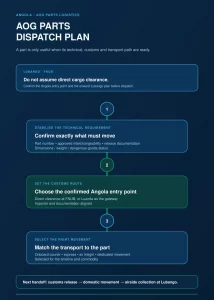
Do Not Assume the Part Can Clear Directly at Lubango
Mukanka Airport (FNUB) is a Class II aerodrome operated by SGA. For an imported AOG component, confirm the current international cargo, customs and handling arrangements for the specific shipment before dispatch.
Where direct Lubango clearance is not confirmed, establish a suitable Angola entry point and the onward domestic movement before the component leaves origin. The route depends on cargo acceptance, customs arrangements, shipment characteristics and the required recovery timeline.
Choose the Shipping Method Around the Part
There is no single shipping method that fits every AOG component. The practical choice depends on size, weight, documentation, dangerous-goods classification, routing and the required recovery timeline.
Onboard Courier or Hand-Carry
A small critical component can move with an accompanied courier where airline acceptance and customs arrangements support the shipment. Hand-carry does not remove customs requirements.
Before departure, confirm:
- Airline acceptance
- Cabin or checked-baggage limitations
- Customs documentation
- Consignee or importer
- Clearance location
- Handover after arrival
Express Courier
International express routing requires confirmation for the exact destination, commodity, package size, customs route and required delivery window before booking. A quoted carrier transit time covers only one part of the AOG timeline; customs release and onward movement to Lubango also need to be built into the recovery plan.
Air Freight
Larger or heavier components often require conventional air cargo where express-package limits do not fit the shipment. This applies particularly to wheels, brakes, larger LRUs, tooling and bulky assemblies.
Dedicated Movement
For a highly time-sensitive component, a dedicated charter, courier or other expedited transport can form part of the recovery plan where the operational value of reducing aircraft downtime supports the additional logistics cost.
Temporary Import Is Not a Generic AOG Shortcut
Temporary-import eligibility depends on the equipment and shipment conditions. Confirm the required documents, customs treatment, charges and re-export deadlines with the relevant customs authority or local broker before dispatch.
Typical cases include specialist tooling brought into Angola for the repair and later removed, test equipment entering temporarily, or goods moving between customs locations under customs control. Replacement components installed on the aircraft and specialist tooling that later leaves Angola require separate customs treatment, so keep them clearly separated in the shipping documentation.
Dangerous Goods Can Change the Entire Routing
Some aircraft components require dangerous-goods controls that affect packaging, documentation, carrier acceptance and routing. Examples include:
- Lithium batteries
- Aircraft batteries
- Oxygen equipment
- Fire extinguishers
- Chemical products
- Emergency equipment
- Components containing regulated substances
Confirm the classification, packaging requirements and carrier acceptance against the exact commodity and route before booking. Identifying the dangerous-goods requirement before dispatch prevents the shipment from reaching the cargo stage without an accepted transport solution.
Plan the Luanda-to-Lubango Leg Before International Dispatch
Getting the part into Angola is only part of the recovery. If the component clears in Luanda, its onward journey to Lubango still needs a confirmed transport method. Depending on timing and shipment characteristics, options may include:
- Domestic air cargo
- Accompanied domestic movement
- Dedicated courier
- Road transport
- Another approved expedited logistics solution
The choice depends on the component, available schedules and how quickly the maintenance team needs it.
The important sequence is: International transport → customs release → domestic movement → airport handover → aircraft
Each handoff needs an owner. Without that chain, a part can technically arrive in Angola while the AOG clock continues because nobody has arranged its movement from the customs point to Lubango.
Do Not Send the Part Without the Engineer Plan
A replacement component has limited value if no appropriately authorized person is available to install it. The maintenance recovery plan needs to establish:
- Who will perform the work
- Required licence, authorization or company approval
- Engineer travel
- Visa or entry requirements where applicable
- Airside access
- Tools and test equipment
- Aircraft manuals or maintenance data
- Consumables
- Ground power or other support equipment
- Expected maintenance duration
The engineer and the component do not always need to travel together.
They do need to arrive in the correct order. For example, positioning the engineer before the component can allow troubleshooting, access preparation and removal work to begin while the replacement part is still moving through the logistics chain.
Specialist Tools Need Their Own Logistics Plan
Some AOG recoveries fail to account for tooling until the component reaches the aircraft. A replacement wheel or line-replaceable unit may be straightforward. Another repair may require:
- Torque equipment
- Jacks
- Test sets
- Ground power
- Lifting equipment
- Aircraft-specific adapters
- Calibration-controlled tools
Tooling can also create its own customs issue if it is imported only for the repair and later exported again. Where specialist equipment is needed, pack and document it separately from the replacement part where practical so its customs status and return movement remain clear.
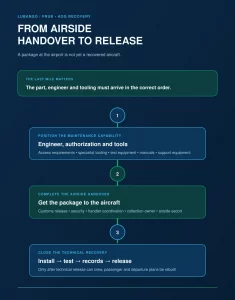
Airside Delivery Is the Last Logistics Handoff
“Delivered to Lubango” is not necessarily the same as “delivered to the aircraft.” The final stage may involve:
- Airport access
- Security screening
- Handler coordination
- Vehicle access
- Customs release confirmation
- Engineer identification
- Airside escort
The person responsible for collecting the shipment needs to know:
Which package → arriving where → collected by whom → cleared under which documents → delivered to which aircraft
This final handoff deserves the same attention as the international shipment. An AOG part sitting outside the airport perimeter is still not available to maintenance.
Plan the Removed Component Before Installation Starts
Many replacement parts create a second logistics movement. The removed component may need to:
- Return to the owner
- Go to an overhaul facility
- Be shipped as an exchange core
- Return under warranty
- Remain with the operator for investigation
Its customs status can differ from the incoming serviceable component. Before installation, record:
- Removed part number
- Serial number
- Condition
- Packaging requirement
- Return destination
- Customs or export requirement
- Exchange-core deadline where applicable
If the removed component contains dangerous goods or regulated material, its outbound transport needs the same classification discipline as the inbound replacement. Planning the return before the aircraft departs Lubango reduces the risk of leaving an expensive exchange core without a documented route back to the supplier.
The Aircraft Is Not Recovered When the Part Arrives
The AOG timeline ends when the aircraft is technically released and the operation can resume, not when the package reaches the airport. After delivery, the remaining sequence may include:
Installation → inspection/testing → maintenance records → release to service → crew and passenger replanning → flight preparation
The operator’s maintenance organization determines whether the repair, installation and release meet the applicable requirements.
For charter operations, this is also the point to update the passenger plan. A predicted repair-completion time should not automatically become the new passenger ETD until the technical work has progressed far enough to support a credible operating schedule.
Confirm Local Maintenance Capability Before Building the Recovery Plan
Confirm local maintenance capability for the aircraft type and required task before planning an on-site recovery at Lubango. A complex defect requires a clear plan for authorized engineering support, tooling, replacement components and the ground resources needed to complete the work.
Where personnel or components enter Angola through Luanda, coordinate the international arrival and onward Lubango movement before dispatch. Repositioning the aircraft remains a separate technical and operational decision based on the aircraft’s approved release status and operator requirements.
| Practical Scenario: A Replacement Component Must Reach Lubango From Europe A charter aircraft becomes AOG at Mukanka after maintenance identifies a failed component that is not available locally. The operator confirms the exact part number, acceptable interchangeability, serviceability documentation and tooling requirement before the shipment is released. The component is small enough for expedited air transport, but direct international clearance at Lubango is not assumed. The logistics team routes it through a confirmed Angola entry point in Luanda and prepares the invoice, packing information, airway documentation and customs instructions before departure from Europe. At the same time, an authorized engineer is positioned to Lubango with the required tooling. This allows access preparation and preliminary maintenance work to begin while the part is in transit. After customs release in Luanda, the component moves through a confirmed domestic transport channel to Lubango. The local airport and airside handover arrangements are confirmed before arrival so the shipment moves directly from collection to the maintenance team. Once installed, the engineer completes the required testing and maintenance records. The aircraft schedule is rebuilt only after a credible return-to-service time is available. The operational lesson is that AOG recovery at Lubango is a chain of technical, customs and transport decisions. Fast international shipping solves only one link. |
|---|
Lubango AOG and Flight Support Services
Just Aviation coordinates the non-technical flight-support requirements surrounding a Lubango AOG recovery, including:
- Ground handling and airport coordination
- Flight permits and route support for recovery or replacement movements
- Fuel coordination
- Engineer and crew transport and support
- Catering arrangements where required
- Navigation-fee coordination
- Parts routing and coordination with customs brokers
- Final airport and airside handover coordination
The recovery plan can be adjusted as the technical status, aircraft schedule or shipment routing changes. Maintenance diagnosis, component approval, installation instructions, engineer authorization, airworthiness determination and return-to-service release remain with the operator and appropriately authorized maintenance personnel.
For Lubango AOG, charter and flight-support coordination, contact the Just Aviation Operations Control Center at [email protected]
Frequently Asked Questions About Lubango AOG Support and Aircraft Parts Logistics
1. Can aircraft spare parts be shipped directly to Lubango Airport?
The routing depends on current international cargo, customs and courier arrangements. Operators should confirm the Angola entry point before dispatch rather than assume direct Lubango clearance.
2. What documents are normally needed to ship an AOG aircraft part into Angola?
The shipment may require an invoice, packing list, airway documentation, detailed part description, value, consignee information and customs classification, with additional documents depending on the part.
3. Can an AOG aircraft part be hand-carried into Angola?
Small components may move with an onboard courier where airline acceptance and customs requirements permit. Hand-carry does not remove the requirement for legal customs entry.
4. Can aircraft tools enter Angola temporarily for an AOG repair?
Temporary-import eligibility depends on the equipment and shipment conditions. Confirm the customs procedure, required documentation, charges and re-export deadlines with the customs broker and relevant authority before dispatch.
5. How are lithium batteries or other dangerous aircraft parts shipped to Lubango?
Dangerous-goods classification, packaging, documentation and carrier acceptance need to be established before booking. The available routing may differ from ordinary aircraft parts.
6. Is aircraft maintenance available at Lubango Airport for visiting business jets?
Confirm aircraft-specific engineering capability for the required maintenance task before planning an on-site recovery. Maintenance approval, installation and return-to-service remain with appropriately authorized maintenance personnel.
7. What happens to the unserviceable aircraft component after replacement?
The removed unit may require return to an overhaul shop, supplier or exchange program. Its export, packaging and dangerous-goods requirements need to be planned separately.
8. When is an AOG aircraft ready to resume charter operations?
Return to service follows completion of the required maintenance, testing and records by appropriately authorized personnel. Passenger and flight schedules can then be rebuilt around the released aircraft.
Disclaimer
Customs procedures, airport services, courier routes, cargo schedules, maintenance resources and local access arrangements can change. Operators should confirm current requirements for the specific aircraft, part and maintenance event. Maintenance diagnosis, component approval, tooling requirements, airworthiness and return-to-service decisions remain with the operator and appropriately authorized maintenance personnel.
Conclusion
Effective Lubango AOG support depends on managing the entire path from technical diagnosis to return to service. Operators need the correct component and documentation, a confirmed Angola customs route, an onward plan to Lubango, the right engineer and tools, and a controlled airside handover. For imported parts, Luanda may form an important logistics gateway, but the routing should be established for the actual shipment rather than assumed. The fastest parcel is not necessarily the fastest recovery; the objective is to remove delays at every handoff between supplier, customs, transport and maintenance.


 +971 4 5855 689